The Tashkent Branch of
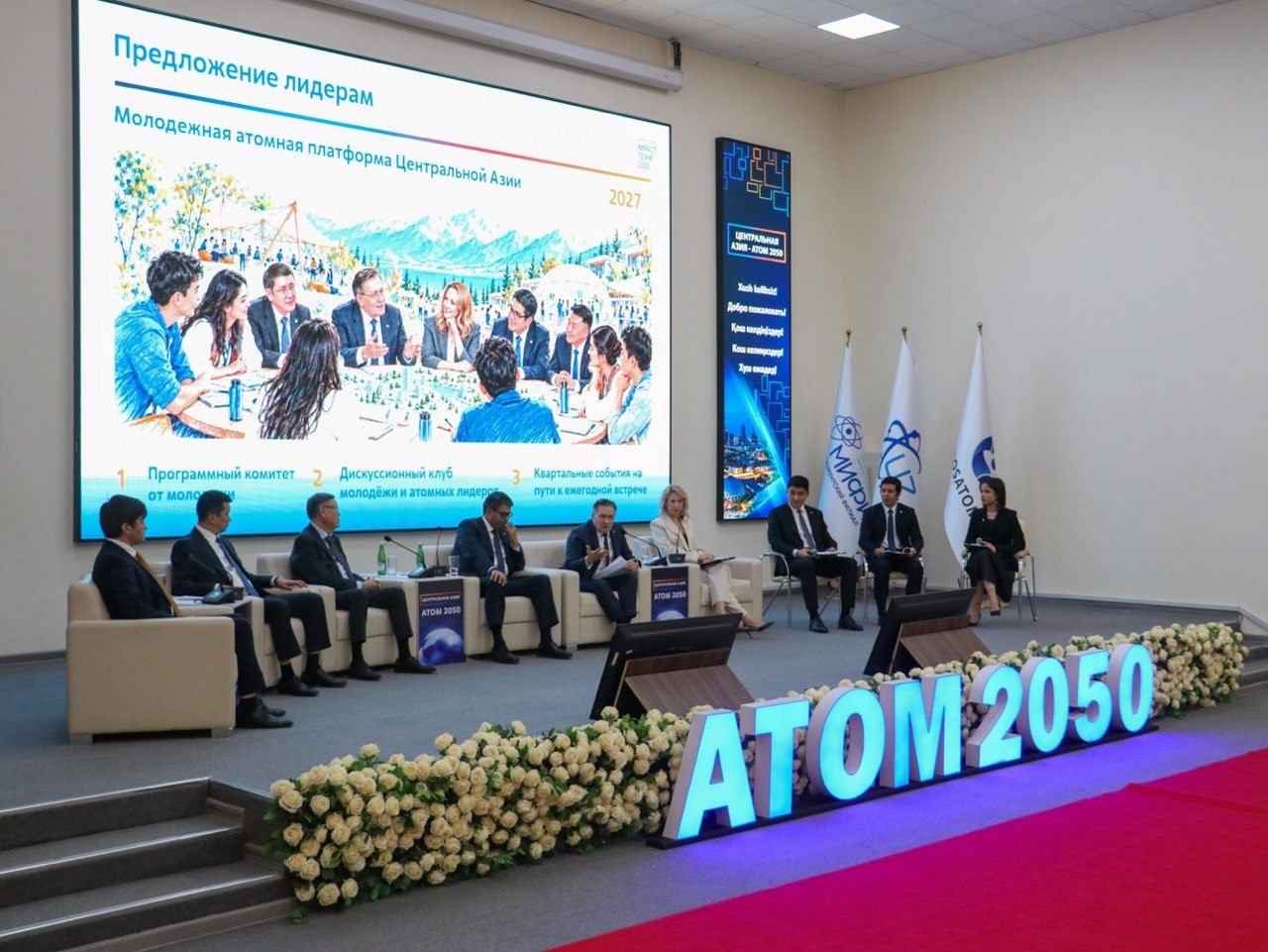
the National Research Nuclear University MEPhI (NRNU MEPhI) hosted the “Central
Asia — Atom 2050” meeting. It brought together more than 900 university
students from across the region: 200 participated in person, while more than 700
joined online. Participants included Alexey Likhachev, Director General of
Rosatom State Corporation; Azim Akhmedkhadzhaev, Director of the Agency for
Atomic Energy under the Cabinet of Ministers of the Republic of Uzbekistan;
Timur Zhantikin, Deputy Chairman of the Agency for Atomic Energy of the
Republic of Kazakhstan; Mirlan Parkhanov, Deputy Minister of Energy of
Kyrgyzstan; and Abduvakil Rasulov, Director General of OJSC “TAUZ Hydro”, under
the Ministry of Energy and Water Resources of the Republic of Tajikistan. The
meeting was moderated by Tatyana Terentyeva, Deputy Director General for Human
Resources at Rosatom.
Leaders of the international youth advisory council Impact Team 2050 presented the results of four national youth nuclear dialogues in Uzbekistan, Kazakhstan and Kyrgyzstan, with the participation of young people from Tajikistan. According to the survey results, the main barriers to entering the industry are a lack of practical experience and experienced mentors, as well as a lack of clarity about career options and training opportunities. The main concerns relate to safety, especially in Kyrgyzstan and Tajikistan. The most effective motivating factors were hands-on experience and mentorship — 69 %, a clear career path — 62 %, openness of the industry — 54 %, and support at the start of one's career — 47 %. The main proposal from the “Atom 2050” participants was to establish a Youth Platform for Nuclear Cooperation in Central Asia — a permanent platform for exchanging initiatives and implementing joint projects. It was proposed that its events be held in different countries across the region to enable regular meetings between young people and industry leaders.
“One of the key ideas put forward by Central Asia’s young nuclear professionals was to make this event an annual one. This will allow future nuclear specialists from all countries of the region to regularly exchange experience, participate in a continuing professional education program with leading lecturers at NRNU MEPhI, and work together on projects to develop nuclear energy and technologies. I am confident that this initiative will lay the foundation for long-term and strong youth cooperation and enable young nuclear specialists to jointly shape the future of the nuclear industry in Central Asia. We fully support this format and are ready to work with colleagues in the nuclear sector across the region to ensure that the next youth program takes place as early as 2027 under the auspices of the Impact Team 2050 Council leaders”, said Alexey Likhachev, Director General of Rosatom.
“It is important not only to tell young people what we can offer, but also to listen to what they themselves need from the nuclear industry, and to work together through dialogue to shape the future, develop strategy, and set the international agenda. Today, young leaders told us what they want the future of the industry to look like and showed that they are ready to take responsibility for creating it. Our task is to give them every opportunity to do so. The ‘Central Asia — Atom 2050’ meeting is an important part of this broader joint effort”, stressed Tatyana Terentyeva, Deputy Director General for Human Resources at Rosatom State Corporation.
The speakers at the meeting included Mukhiddin Umidov, the Impact Team 2050 council leader from Uzbekistan and a master’s student at the Institute of Nuclear Power Engineering of NRNU MEPhI (IATE NRNU MEPhI); Diana Gamazova, the council mentor from Kazakhstan and Project Manager of the “Nuclear Energy for Central Asia” project; and Bektan Kydyev, the council leader from Kyrgyzstan and Chairman of the Association of Students of Kyrgyzstan. After the presentations, industry leaders discussed the proposals put forward by young people and provided feedback.
The nuclear power
plant in Uzbekistan is a unique project by Rosatom State Corporation. It is
being built under the world’s first export contract for the construction of a
small nuclear power plant (SNPP). On 27 May 2024, an intergovernmental protocol
amending the 2018 intergovernmental agreement was signed, expanding cooperation
to include the construction of an SNPP in Uzbekistan, along with the
corresponding contract. On 26 September 2025, during the World Atomic Week
international forum in Moscow, Rosatom and the Atomic Energy Agency under the
Cabinet of Ministers of the Republic of Uzbekistan (Uzatom) signed documents
expanding their cooperation. On 24 March 2026, the parties signed a
supplementary agreement to the contract for the construction of an integrated
nuclear power plant in Uzbekistan. The project will comprise two large-capacity
power units based on VVER-1000 reactors and two power units equipped with
RITM-200N reactors, each with an electrical output of 55 MW. Once fully
operational, the NPP is expected to generate 17.2 billion kWh of electricity
annually.
International Youth
Advisory Council Impact Team 2050
Impact Team 2050 is an
international youth advisory council to the Director General of Rosatom State
Corporation. Its creation was announced by Alexey Likhachev, Director General
of Rosatom State Corporation, in 2021 at the Global Impact Conference. The council
serves as a platform for dialogue between the corporation’s leadership and
young international leaders on the development of nuclear technologies,
sustainable development, and international youth cooperation. The council’s key
tasks are to formulate proposals for engagement with young people
internationally, involve young leaders in Rosatom’s educational and partnership
initiatives, and expand the community of supporters of the peaceful use of
nuclear energy.
National Youth Nuclear
Dialogues
The National Youth
Nuclear Dialogues in Central Asia were held from September to October 2026 by
members of the Impact Team 2050 Council. Four dialogues took place in
Kazakhstan, Kyrgyzstan, and Uzbekistan, with young people from Tajikistan also
participating. They brought together 1,050 participants from 18 universities.
Following the dialogues, a survey was conducted, and the organizers received
800 questionnaires. Future nuclear specialists shared proposals for making
careers in the nuclear industry more attractive to young people and
strengthening youth cooperation in the nuclear sector across the region.
The “ATOM 2050” project will launch in 2027 with the support of Rosatom State Corporation. One hundred young people from different countries, together with scientists, engineers, experts, strategists and science fiction writers, will try to answer a complex question: “what might the world look like by 2050, and what role will nuclear and related technologies play in its development?” Participants will take technical tours of unique Rosatom facilities, meet leading experts, take part in “learning labs”, and work together to develop future scenarios. At the end of 2027, the team will present its vision to today’s decision-makers, who shape the development of technologies, industries and countries.