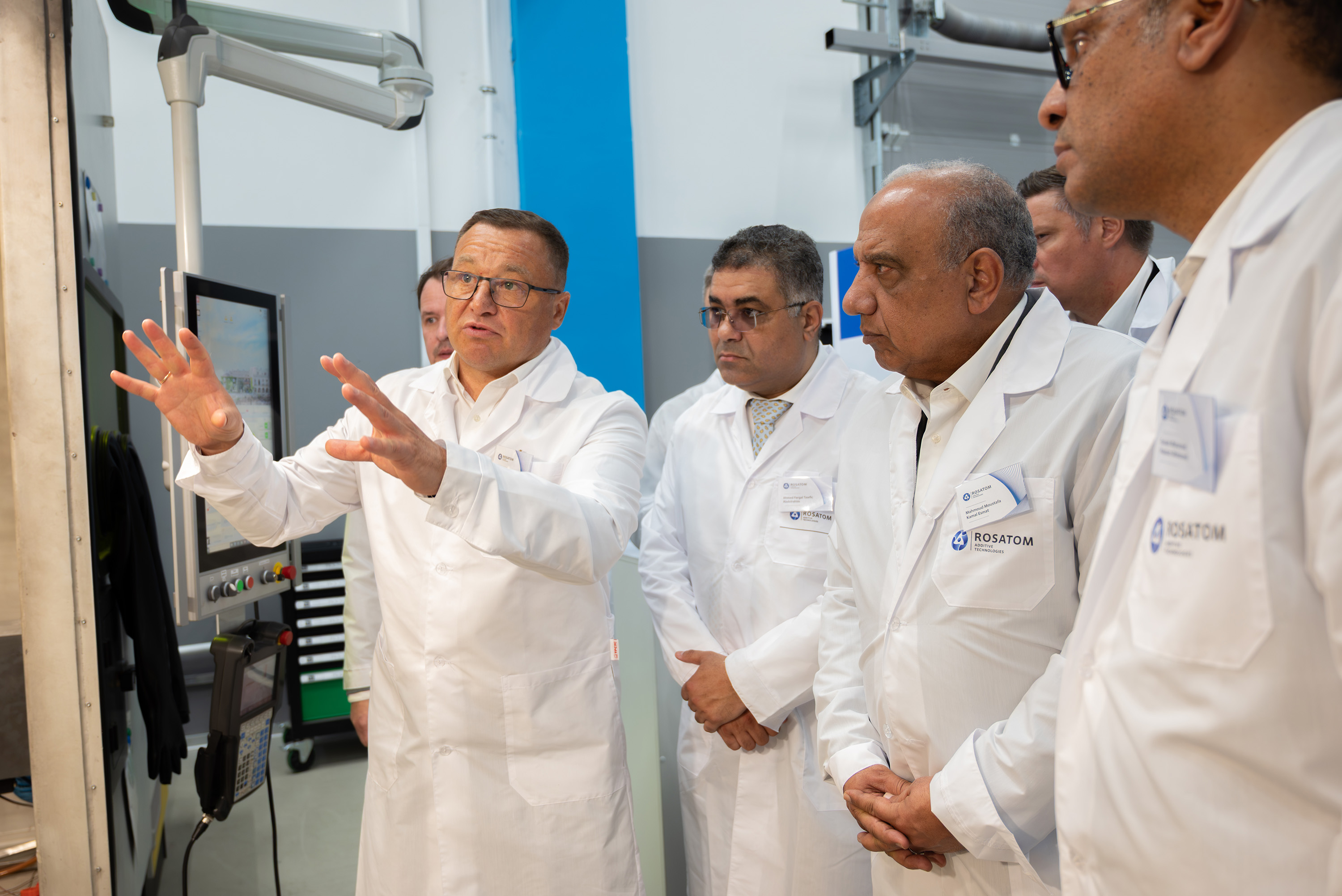
Dr. Mahmoud
Esmat, Egypt’s Minister of Electricity and Renewable Energy, during his recent
trip to Russia has toured the Moscow Additive Technologies Centre — a
facility operated by Rosatom’s Fuel Division — underscoring the
deepening coordination between the two nations on high‑tech industrial
solutions.
Rosatom
showcased its full additive manufacturing ecosystem to the minister, including
3D scanning, reverse engineering, metal and polymer printing, and a
comprehensive lineup of in‑house‑developed 3D printers, illustrating the
breadth of its industrial offering.
The Fuel Division currently manufactures industrial‑grade 3D printers capable of producing components across a wide dimensional range, leveraging key techniques such as selective laser melting (SLM), direct metal deposition (DMD), and electron beam additive manufacturing (EBAM), reflecting its integrated technological stack.
Ilya Kavelashvili, head of Rosatom’s Additive Technologies business, stressed that the company’s core export value lies not in standalone hardware sales, but in delivering fully operational additive technology centres tailored to local markets. “Such a centre functions both as a service bureau and a training hub, while also laying the groundwork for future local equipment production. Ultimately, it catalyses the emergence of a national additive manufacturing sector,” he noted.
Industry analysts view Egypt as a high‑potential market for additive technologies, with early adoption likely among state‑owned industrial groups, aviation and maintenance firms, oil and gas operators, equipment manufacturers, transport companies, and healthcare providers — sectors where rapid spare‑parts production and design flexibility are critical.
Adopting additive methods could significantly boost Egypt’s manufacturing resilience by enabling local manufacturing of spare parts and reducing dependence on imported components, thereby improving operational agility for local businesses and public entities.
Commenting on the visit to the Moscow Additive Technologies Centre, Dr. Mahmoud Esmat, Minister of Electricity and Renewable Energy, said: “Technology and knowledge transfer represent one of the important pillars of industrial cooperation between Egypt and Russia. Additive manufacturing technologies offer promising opportunities to support local manufacturing, develop the production of components and spare parts, and enhance the efficiency and sustainability of supply chains. Our visit to the Rosatom Center for Additive Manufacturing Technologies provided an opportunity to learn about an integrated technological system and explore the areas in which this expertise can contribute to supporting Egyptian industrial and technological capabilities.”
Natalia Nikipelova, President of TVEL JSC — the managing company of Rosatom’s Fuel Division — pointed to an established cooperation track record with Egypt, particularly in nuclear fuel supply for the ETRR‑2 research reactor in Inshas, and highlighted the upcoming milestone of fuel delivery for El Dabaa’s VVER‑1200 reactors in 2027. “Additive technologies open a promising non‑nuclear avenue for expanding our partnership, building on existing trust and technical alignment,” she said.
Following the visit, Rosatom's Fuel Division and the Executive Authority overseeing Nuclear Power Plant Construction Projects in the Arab Republic of Egypt, signed a joint statement of intent on cooperation in establishing an additive technology center in Egypt.
Rosatom has already secured footholds in several international markets with its additive solutions: Belarus launched its first national Additive Technologies Centre in autumn 2025, equipped with Rosatom systems; in 2026, the company delivered the RusBeam 2800 — India’s largest vacuum electron beam deposition printer — to a space research facility; and a memorandum was signed last year to replicate the Russian centre model in Vietnam.
Additive manufacturing addresses production gaps where traditional casting and machining fall short, particularly for geometrically complex or low‑volume components, offering a compelling alternative in cost‑ and time‑sensitive environments. 3D printing enables substantial weight reduction in components, improves material efficiency, and compresses lead times, making it increasingly attractive for capital‑intensive industries. Modern 3D printers support fast reconfiguration for multi‑material production, enhancing their utility across diverse industrial applications.
From aerospace
and nuclear engineering to medical device manufacturing, 3D‑printed components
are gaining traction as performance and customisation requirements grow. By
replacing lengthy development cycles with rapid prototyping and direct
fabrication, additive technologies can compress product realisation timelines
from months to days, delivering tangible productivity gains. The elimination of
tooling, casting, and extensive milling streamlines the production workflow and
reduces overhead, while design optimisation further enhances structural
efficiency.
Lifecycle cost
reductions of up to 90 % are possible at the disposal stage due to
minimised hazardous by‑products and the feasibility of material recycling,
aligning additive processes with broader sustainability goals. 3D printing
allows the consolidation of multi‑part assemblies into single, complex
geometries that previously required welding or bolting, improving both
performance and reliability. With deposition‑based methods, material
utilisation for high‑value metals can reach nearly 90 %, contrasting sharply
with subtractive techniques that waste large portions of expensive
feedstock — a factor that strengthens the economic case for adoption
in resource‑sensitive sectors.
The Fuel Division of Rosatom (managed by TVEL JSC) includes enterprises involved in the fabrication of nuclear fuel, uranium conversion and enrichment, gas centrifuge production, as well as research and design organizations. As the sole supplier of nuclear fuel for Russian NPPs, TVEL supplies fuel to more than 70 energy reactors in 15 countries, research reactors in nine countries worldwide, and transport reactors for the Russian nuclear fleet. One in six energy reactors worldwide operates on TVEL fuel. The Fuel Division of Rosatom is the largest producer of enriched uranium globally and a leader in the stable isotopes market. The division is actively developing new businesses in chemistry, metallurgy, energy storage technologies, 3D printing, digital products, and the decommissioning of nuclear facilities. Within the scope of TVEL's Fuel Company, industry integrators for Rosatom in additive technologies and energy storage systems have been established. http://www.tvel.ru