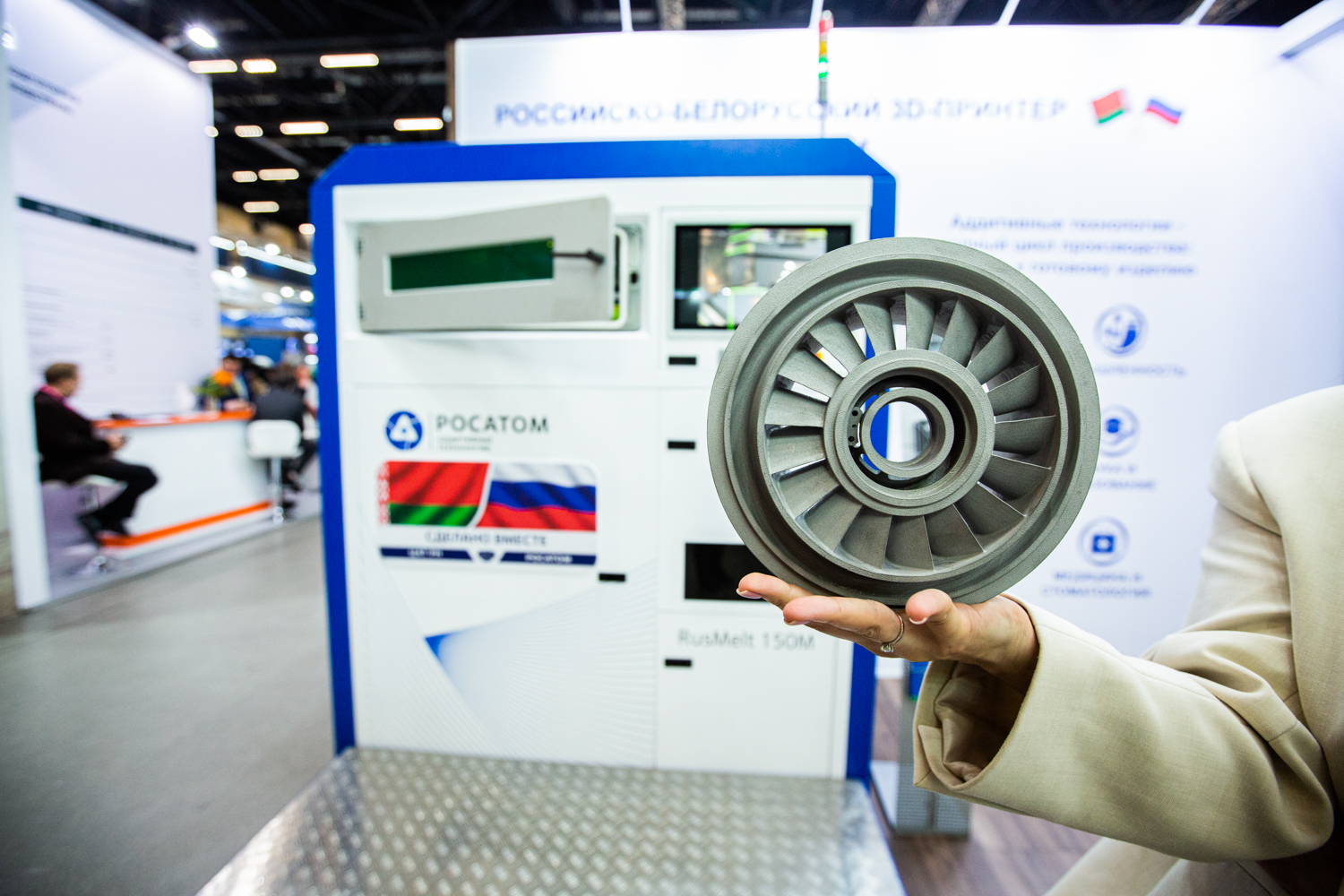
At the “Innoprom. Belarus” international industrial exhibition, Rosatom
unveiled the compact RusMelt 150M 3D printer, manufactured using Russian and
Belarusian components. The RusMelt 150M prints with metal using selective laser
melting (SLM) technology. This machine was developed by Rosatom’s Fuel Division
of Rosatom and complements the lineup of other production-ready SLM systems,
including the medium-sized RusMelt 300M printer and the large-sized RusMelt
600M.
As part of a collaboration between Russian and Belarusian engineers, some of the components for the RusMelt 150M were manufactured at Belarusian facilities, and the next step is expected to be the localization of production of these 3D printers in Minsk, at the facility of LLC “Center for Additive Technologies RN”—a joint venture between Rosatom and the Belarusian holding company “Horizon.”
“The RusMelt 150M is the first Russian-Belarusian 3D printer. The main mechanical assemblies, kinematic components, and load-bearing structures are manufactured at production facilities in the Republic of Belarus. The laser system, control system, and software were developed and manufactured in Russia. Our goal for 2027 is the phased localization of 3D printer production at the Additive Technologies Center in Minsk,” said Ilya Kavelashvili, director of the “Additive Technologies” business unit at Rosatom’s Fuel Division.
The development of the RusMelt 150M was a response to demand in the Belarusian market: industrial enterprises, research institutes, universities, and medical centers that needed their own affordable 3D printer capable of producing small-sized parts. Its compact size (build volume up to 150 mm), reduced power consumption, reduced gas and powder flow rates, and, as a result, a lower cost of ownership lower the barrier to entry into industrial metal 3D printing for interested enterprises.
“The Republican Center for Additive Technologies in Minsk was originally established to 3D-print parts for the needs of Belarusian industry. In its first six months of operation, the Center fulfilled more than 20 orders for companies in the machine-building and energy sectors, including the production of pilot batches of parts for leaders in the Belarusian machine-building industry. But we understood from the very beginning that our potential is not limited to this area. And today we are ready to offer the market not only 3D printing services, but also the RusMelt 150M 3D printer, developed in cooperation with our Russian partners. The equipment is available for pre-order in Belarus,” noted Denis Rogachev, Director of the RN Center for Additive Technologies.
Applications for the RusMelt
150M:
Industry – small-batch parts and repair manufacturing
Small metal components—nozzles, brackets, pump impellers, and tooling
elements—were previously manufactured using casting or machining, which was
economically viable only for medium- and large-volume production runs. The new
printer with a chamber up to 150 mm makes it profitable to produce small
batches and rush production of spare parts without expensive tooling and
lengthy production preparation. For instance, printing a complex geometry
nozzle can reduce delivery times from 6-8 weeks to 2-3 days and production
launch costs by up to 10 times.
Medicine – customized implants and dentistry
Formerly, small titanium implants and dental structures were produced by
milling from a solid billet: up to 80% of the expensive material was wasted as
cuttings and production time was several days. The new SLM printer with a build
chamber of up to 150 mm makes it possible to print customized implants, cranial
plates and dental frames directly from powder, with minimal material waste and
high precision. For clinics and laboratories, this reduces titanium consumption
by 3-5 times, and production times from several days to a few hours.
Science—Prototypes and
Experimental Fixtures
In research centers and R&D laboratories, small metal parts for
experiments—heat exchangers, sample holders, mini-reactors—were previously
produced through machining or ordered from contractors, a process that took
weeks and entailed significant costs per unit. The compact SLM printer enables
these products to be manufactured directly at the lab during 1-2 days, quickly
changing the design between iterations. This speeds up the R&D cycle by up
to 5 times and reduces the one-off production cost two- or threefold.
The Additive Technologies
business line of Rosatom's Fuel Division was created to coordinate efforts and
competencies within the state corporation to develop 3D printing on the scale
of the nuclear industry and Russia as a whole. Nowadays, Rosatom has created an
end-to-end production cycle, from development of 3D printers and components to
special powders, software, production of materials for printing, and training.
The company provides Russian manufacturing enterprises of strategic industries
with innovative and reliable equipment, materials and professional service for
the implementation of additive manufacturing technologies. https://rosat.tvel.ru/
Rosatom is systematically working to develop a new additive manufacturing
industry in Russia and partner countries. The partnership is based on deep
integration, the transfer of key technologies, the localization of high-tech
manufacturing, the creation of turnkey additive manufacturing centers, and the
development of joint export potential. The production of component kits for
additive manufacturing equipment in the Republic of Belarus opens up additional
opportunities for bringing Rosatom’s 3D printers to the Belarusian market and
ensuring their competitiveness on a global scale.