Project
logistics — the management of supply chains for specialized cargo tailored to
specific projects — is of critical importance for implementing large-scale
infrastructure projects. Project logistics addresses the challenges of
transporting non-standard cargoes around the world and transforming complex and
multifaceted tasks into controlled processes. Control over the supply chain is
a matter of efficiency, reliability, safety and timely contract fulfillment for
the customer. As a result, the partner receives not just a project, but a
guarantee of its physical feasibility, where logistics becomes one of the key
arguments in favor of the reliability of the entire solution. Therefore,
project logistics is the high-precision supply chain engineering for unique
tasks.
To ensure the reliability and predictability of the technology cycle for its projects, Rosatom has gained extensive competencies in the field of project logistics. Experience in transporting unique cargo — ranging fr om oversized and heavy-lift shipments to radioactive materials — has evolved into a systematic skill and transformed into a separate logistics business unit within Rosatom. Nowadays, Rosatom is a prominent player in the global freight transportation market, leveraging the capabilities and expertise of its logistics assets to develop this business line.
Transportation is required at every stage of Rosatom’s international projects. Due to the radioactivity of the materials, the supply chain is planned in accordance with strict safety standards to prevent any impact on the environment and people. The key link responsible for these highly complex operations is Rosatom’s specialized integrator, TENEX, which provides a full range of transportation and logistics services for the delivery of nuclear technology cycle (NTC) products in compliance with international and national safety requirements. TENEX, in cooperation with NTC Logistics Center JSC, organizes multimodal transportation, delivery by all modes of transport, freight forwarding, and customs clearance. These services are provided with the involvement of leading freight forwarders and licensed maritime carriers. The inability to store nuclear materials at ports requires advance planning and precise execution of shipments, while well-developed infrastructure and diversified route network make it possible to offer customers flexible transportation terms.
One of the most important and socially significant applications of Rosatom’s logistics capabilities is the delivery of medical isotope products. The timely delivery of short-lived isotopes is critical for their use in the diagnosis and treatment of life-threatening diseases, increasing patients’ chances of recovery. Amid turbulence in global supply chains, Rosatom, as one of the world’s leading manufacturers of medical isotopes, ensures stable deliveries to more than 50 countries, including those in Latin America, the Middle East, and Southeast Asia. This requires flexibility in planning, the ability to modify routes, and well-coordinated processes, confirming that the logistics model developed at Rosatom can operate reliably even under force majeure conditions.
Therefore, Rosatom is building an end-to-end delivery ecosystem capable of addressing complex challenges, offering logistics services worldwide and serving as a reliable transport hub for the goods flow.
The uniqueness of Rosatom’s logistics offering extends beyond land and airspace — into the Arctic. A key asset, unparalleled anywhere in the world, is the nuclear-powered icebreaker fleet operated by the subsidiary FSUE Atomflot. The experience of operating in Arctic conditions takes Rosatom’s project capabilities to a whole new level. The icebreaker escort ensures year-round navigation along the Northern Sea Route (NSR), which is critical for implementing projects in the Arctic and improving global transport connectivity. This capability is now also available to external customers. Today, the icebreaker fleet includes eight nuclear-powered icebreakers: the 50 Let Pobedy, the Vaigach, the Yamal, the Taimyr, the Arktika lead universal nuclear-powered icebreaker (LUNPI) (Project 22220), the Siberia serial universal nuclear-powered icebreaker (SUNPI) (Project 22220), the Ural SUNPI (Project 22220), the Yakutia SUNPI (Project 22220). Another four nuclear-powered icebreakers are at various stages of construction — three Project 22220 icebreakers (the Chukotka, Leningrad, and Stalingrad) and the Project 10510 super-heavy icebreaker Rossiya.
The nuclear technical support fleet includes two floating maintenance bases — the Imandra
and the Lotta — the Serebryanka special tanker for liquid radioactive waste,
and the Rossita multifunctional container ship. Furthermore, as part of
the “Portoflot” project, the Pur, Tambay, Nadym, and Yuribey tugs, along with
the Ob port icebreaker, are operating to provide port services to liquefied gas
tankers in severe ice conditions.
In 2025, Rosatom was designated as the Single Maritime Operator (SMO) of the Northern Delivery — a set of measures designed to ensure the regular and uninterrupted supply of essential goods to territories classified as part of the Far North, as well as areas classified as equivalent to the Far North. In 2025, Rosatom successfully completed the objectives of the Northern Delivery pilot project, delivering 152,44 ths tons of petroleum products and 6,77 ths tons of food and ancillary cargo to the Chukotka Autonomous District. In 2026, the successful experience of the pilot project will be extended to other regions of the Arctic and the Far East, and work will continue on developing approaches, volumes, and transportation routes, as well as the necessary fleet capacity and vessel schedules.
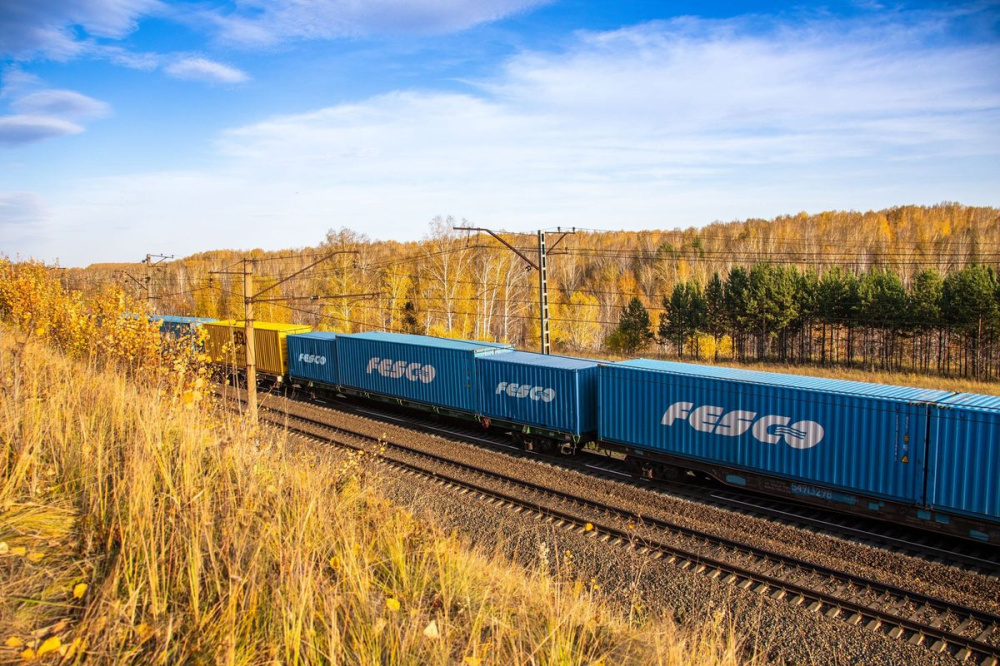
The management structure of Rosatom includes FESCO Transportation Group — one of Russia’s largest transportation and logistics companies, with assets in the port, rail, and integrated logistics sectors.
FESCO’s fleet consists of more than 30
transport vessels under management Its container fleet amounts to approximately
200,000 TEU (twenty-foot equivalent units). In addition, FESCO’s assets include
15,000 units of rolling stock (rail fitting platforms), five terminal complexes
in Novosibirsk, Tomsk, Khabarovsk, Kaliningrad, and Vladivostok, a fleet of
over 350 trucks, and 14 of its own diesel locomotives. The Group provides
transportation services along major transport corridors and operates in the waters
of all oceans — the Pacific, Atlantic, Arctic, and Indian.
FESCO also develops project logistics
services, including the delivery of heavy and oversized cargo, and operates its
own foreign trade and coastal shipping lines.
To ensure stable foreign trade for
Russia, the Group has regular container services with China, India, Vietnam,
Turkey, countries on the African continent, and other countries.
FESCO’s International Presence
China
FESCO organizes regular container transportation with
China for both imports and exports. China has traditionally been a key partner
for FESCO. The FESCO China Direct Line
(FCDL) maritime service operates from Vladivostok; it is one of the Group’s
key services and includes several container lines providing regular maritime
communication between the main ports of the PRC: Shanghai, Ningbo, Yantian,
Xingang, Rizhao (Jizhao), Qingdao, Dalian, Lianyungang, Nansha, Qinzhou, and
others.
To expand its shipping operations with China, FESCO has
also launched a direct maritime service from Chinese ports to St. Petersburg
via the Suez Canal — FESCO Baltorient
Line (FBOL). A series of six modern container ships, each with a cargo
capacity of 2,500 TEU, was specially ordered to serve the FBOL service.
In addition to marine transportation, FESCO also operates
container trains between Russia and China via land border-crossing points.
Trains depart from Chinese industrial cities such as Xi’an, Chengdu, Chongqing,
Shenzhen, Ningbo, Hefei, and others, primarily via border crossing points in
the Republic of Kazakhstan and Mongolia to Russia and CIS countries.
Trains depart on a weekly basis. Transit time varies from
15 to 25 days and depends on the destination. In 2025, the Group launched
direct rail services from cities in the PRC to St. Petersburg and Minsk.
FESCO’s main offices in China are located in such cities
as Shanghai, Ningbo, Qingdao, Tianjin, Guangzhou, Beijing, Shenzhen, Xiamen,
and Dalian. There is also FESCO's office in Hong Kong. In 2026, the Group plans
to open an office in Chengdu.
India and the Gulf States
Container shipping between India, the UAE, and Russia is
provided by the FESCO Indian Line West
(FIL-W), which directly connects the ports of Nava Sheva and Mundra
(India), as well as Jebel Ali (UAE), with Novorossiysk.
Through feeder lines operated by the Group’s partners,
the FIL-W service connects to the Indian ports of Kolkata, Tuticorin, and
Chennai, as well as to ports in Bangladesh, Pakistan, and Sri Lanka, and to
countries on the Arabian Peninsula. The route is served by three FESCO
container ships providing regular service every two weeks.
India and Russia are also connected by the FESCO Baltorient Line (FBOL) service,
whose rotation includes calls by container ships at Indian ports.
FESCO has its own agency network in all of the
aforementioned ports in India and neighboring countries, which allows it to
monitor the entire container delivery route and fully serve both import and
export cargo.
Vietnam and Southeast Asian Countries
A regular shipping service, FESCO Vietnam Direct Line (FVDL), operates between Vladivostok and the Vietnamese ports of Ho Chi Minh City and Haiphong — one of the key arteries for Russian-Vietnamese trade. Currently, the line is served by three container ships that sail on a weekly basis.
In the port of Ho Chi Minh City, FESCO has established a
regional logistics hub for consolidating container cargo from other Southeast
Asian countries.
The Group also operates its own direct shipping service
without calls to Russian ports — FESCO
Intra Asia Service (FIAS) — connecting Vietnam with Malaysia and Thailand.
The FIAS line was established not only to develop local
container transportation in Southeast Asia, but also as a feeder line for delivering cargo from Malaysia, Thailand, Sri
Lanka, Singapore, Bangladesh, India, and Indonesia to Russia. Containers are
shipped to Ho Chi Minh City, wh ere they are transshipped onto FESCO vessels,
which then sail to Vladivostok. In the same way, FESCO can ship cargo from
Russia in the opposite direction with a transshipment at the port of Ho Chi
Minh City.
At the end of 2024, FESCO opened a subsidiary in Vietnam to develop maritime and intermodal
container transportation in Southeast Asian countries.
In addition, starting in 2025, FESCO launched a direct
rail service from Vietnam to Moscow via China.
Türkiye
The maritime service FESCO Turkey Black Sea (FTBS) transports cargo between Novorossiysk and the Turkish ports of Istanbul and Gebze. Through FTBS, the Group offers customers not only liner shipping between ports, but also door-to-door delivery throughout Türkiye and Russia.
In 2023, FESCO
opened a subsidiary in Türkiye with headquarters in the city of Mersin. The
company provides a full range of transportation and logistics services to
customers in Türkiye.
South Africa
Since 2025, FESCO has been transporting containerized cargo between Russia (the Port of Novorossiysk) and South Africa (the Port of Durban). Owing to its own agent, the Group also offers road freight services throughout South Africa. As with the Kenyan service, cargo from South Africa is transshipped at ports in India or the UAE. The containers are then shipped to Novorossiysk via the regular FIL-W line. The service operates not only for imports but also for exports.
Kenya
At the end of 2024, FESCO launched container shipping services between Kenya and Novorossiysk, establishing a maritime service between Novorossiysk and Kenya’s largest port, Mombasa. Transportation is carried out via ports in India or the UAE, which are called at by FESCO vessels operating the FIL-W shipping line.
South Korea
FESCO Korea Soviet Direct Line (KSDL) is one of FESCO’s oldest active shipping lines. It has been connecting the Republic of Korea with Vladivostok for nearly 35 years. Until 1996, it was the only regular shipping line between the Korean Peninsula and Russia.
At present, KSDL provides a weekly service on the
Busan–Vladivostok–Busan route, with a transit time of just two days. Depending
on the cargo base, container ships also call at the Korean port of Gwangyang.
FESCO has a subsidiary in South Korea with offices in
Busan and Seoul.
Japan
Japan Trans-Siberian Line (JTSL) is FESCO's oldest and still-operating direct foreign trade line, which was launched in 1972. JTSL serves Japanese ports such as Yokohama, Nagoya, Kobe, and Toyama, as well as Vladivostok. In addition, FESCO operates its own subsidiary in Tokyo.
Rosatom's structure includes Delo Group (the
Group, Delo Group) — Russia's largest transport and logistics holding company
in terms of the volume of services provided, and a leader in sea transshipment
and rail transportation of containers, as well as deep-sea grain transshipment
in Russia. Rosatom owns 49 % of the shares.
The Group’s companies provide cargo delivery services at
every stage of the multimodal transport chain, both in Russia and
internationally. The main business lines are stevedoring, transport and
logistics, shipping, and other areas. Delo Group develops transshipment of
non-containerized cargo, including fertilizers, metal products, equipment, and
rolling cargoes. The Group’s customers have access to import and export
container transportation between key regions of Russia and China via multimodal
routes through ports in the Far East, the Black Sea, and the Baltic Sea, as
well as through land border crossing points in Russia.