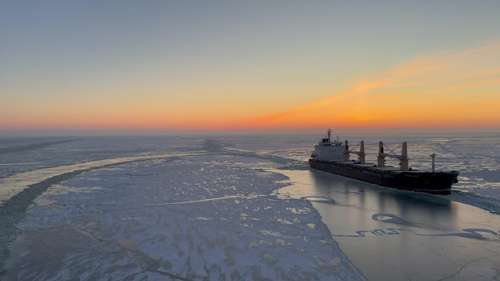
The Northern Sea Route (NSR) is the shortest shipping route between the
western part of Eurasia and the Asia-Pacific region and a historically
developed national transportation artery of Russia.
The water area of the Northern Sea Route is understood as the water space
adjacent to the northern coast of the Russian Federation, encompassing the
internal sea waters, territorial sea, contiguous zone and exclusive economic
zone of the Russian Federation, bounded on the east by the parallel of Cape
Dezhnev in the Bering Strait, on the west by the meridian of Cape Zhelaniya to
the Novaya Zemlya archipelago, the eastern coastline of the Novaya Zemlya
archipelago and the western boundaries of the Matochkin Shar, Karskie Vorota
and Yugorsky Shar straits.
The length of the Northern Sea Route is about 5,600 km. The NSR passes
through the seas of the Arctic Ocean: the Kara Sea, the Laptev Sea, the East
Siberian Sea, and the Chukchi Sea.
The NSR services the ports in the Arctic and major Siberian rivers. There
are currently six major seaports located in the waters of the NSR in the Arctic
zone of the Russian Federation: Sabetta, Dickson, Dudinka, Khatanga, Tiksi, and
Pevek.
The Northern Sea Route, as Russia's national transportation link in the Arctic, is extremely important for ensuring further development of the economy of the northern regions and the state in general. It is the Northern Sea Route that is an important element in the creation of Russia's unified logistical space stretching from Murmansk to Vladivostok, uniting waters from Russia's western maritime border to the borders of the Asia-Pacific region.
Advantages of the
Northern Sea Route
1) This route is shorter than the traditional southern
route. The Arctic shortens the route from Asia to most European ports, compared
to the route through the Suez Canal by 30-40%.
2) In the face of global challenges to de-carbonize maritime logistics, taking shorter routes is one of the ways to reduce the human impact on the world's oceans. It is important to note that the Arctic seas are navigated by nuclear-powered icebreakers that produce virtually no carbon dioxide emissions.
3) With shorter distances and no queues to pass through, the use of the transport thoroughfare via the NSR can significantly reduce travel time, helping to optimize cargo transportation costs and improve the efficiency of the global logistics chain. The use of the NSR route may reduce potential payments for greenhouse gas emissions under the European Emissions Trading Scheme.
Given the turbulence of global logistics routes, global trade needs additional stable, safe and predictable routes. The Northern Sea Route runs along Russia's Arctic coast, which eliminates the risk of piracy and privateering, ensuring cargo security.
Rosatom is the infrastructure operator of the Northern
Sea Route
Since 2018, Rosatom has been the infrastructure operator of the Northern
Sea Route.
As part of Rosatom's responsibility, the development of the Northern Sea
Route as a global logistics corridor is ensured through the establishment of
regular cargo transportation, construction of new nuclear icebreakers,
modernization and construction of port infrastructure.
Rosatom ensures issuance of navigation permits based on the NSR Navigation
Rules, icebreaker escorting, development of safe routes for ships in the NSR
waters, and provides nuclear icebreaker fleet services based on shippers'
requests.
In 2025, Rosatom was appointed the single offshore operator of the Northern
Delivery. The priority in the work of the single offshore operator is to
maintain the reliability of supplies and stabilize the cost of transportation
of life support cargoes to remote locations in the Arctic region of the Russian
Federation. During the year, Rosatom successfully completed the objectives of
the Northern Delivery pilot project, delivering 152,44 ths tons of petroleum
products and 6,77 ths tons of food and ancillary cargoes to the Chukotka
Autonomous District. In 2026, the successful experience of the pilot project
will be extended to other regions of the Arctic and the Far East.
Dynamics of cargo
traffic through the Northern Sea Route (NSR)
Cargo traffic through the NSR is growing steadily, having increased almost
7 times over the last 10 years.
In 2025, the cargo traffic through the NSR amounted to 37.02 mln tons,
confirming the record volumes of the previous two years.
At the same time, the volume of transit cargo transported in 2025 broke
another record and reached 3.2 mln tons, testifying to the consistent
integration of the NSR into the global logistics context. In October 2025, the
first transit voyage from China to Europe passed along the Northern Sea Route.
The voyage through the Russian Arctic took 20 days, which is almost half the
time it would have taken using traditional southern routes.
The Trans-Arctic transport corridor
Today, the
development of Arctic navigation is reaching a qualitatively new level: work is
underway to form a comprehensive transportation system, the Trans-Arctic
Transport Corridor (TTC).
The Trans-Arctic Transport Corridor is a unified system of routes including the Northern Sea Route (as a key section), related inland waterways and transport infrastructure facilities, aimed at the integrated development of the territories of the Arctic zone of the Russian Federation and the Far East, cargo base, as well as domestic, international and transit transportation of cargo and passengers along the Russian coast.
The Trans-Arctic Transport Corridor is intended to become not only a backbone transportation system for domestic and export and import deliveries. The logistics system will allow increasing international cargo traffic between Europe and Asia.
International cooperation
The Northern Sea Route has great potential for multifaceted cooperation in
various areas, from expanding cargo traffic and infrastructure development to
scientific cooperation in the field of ecology and environmentally sustainable
Arctic navigation.
Cooperation with the People's Republic of China on the development of the
Northern Sea Route is carried out within the framework of the Sub-Commission
for Cooperation on the Northern Sea Route of the Russian-Chinese Commission for
the Preparation of Regular Meetings of Heads of Government. The Co-chairman of
the Sub-Commission from the Russian side is the Director General of Rosatom
State Corporation A.E. Likhachev, from the Chinese side - Liu Wei, Minister of
Transport of the PRC. There are three working groups within the Sub-Commission
- on navigation development, polar vessel construction and technology, and
navigation safety.
The first meeting of the Sub-Commission was held in November 2024 in St.
Petersburg. In October 2025, the second meeting of the Sub-Commission was held
in Harbin. The meeting resulted in the approval of an action plan for the
further development of transportation along the NSR between Russia and China
and the target cargo traffic between the countries until 2030.
The Russian-Indian working group on the development of the NSR was
organized in 2024 following the visit of the Prime Minister of the Republic of
India to Moscow. The joint working body was created to address key issues
within the framework of cooperation on the NSR, discuss joint projects on the development of Arctic
infrastructure and polar navigation. From the Russian side, the working
group is headed by the special representative of Rosatom State Corporation for
Arctic Development V. A. Panov, from the
Indian side - Deputy Minister of Ports, Shipping and Waterways of the Republic
of India R.K. Sinha. The
first meeting of the working group was held in October 2024 in New Delhi and
the second meeting was held in June 2025.
Nuclear-powered icebreaker fleet
The seas of the Arctic Ocean are covered with ice for most of the year.
Safe navigation in the Arctic region is ensured by nuclear-powered icebreakers.
The nuclear-powered icebreaker fleet is a key link in unlocking the transport
potential of the Northern Sea Route.
Russia is the only country in the world with a nuclear-powered icebreaker
fleet. The operator of the nuclear-powered icebreaker fleet is FSUE Atomflot
(an enterprise of the Rosatom State Corporation).
Advantages of nuclear-powered
icebreakers:
1. Power. Nuclear icebreakers can plough through up to
three-meter thick ice*.
2. Self-sufficiency. A nuclear power plant allows a
nuclear-powered vessel to operate for up to 7 years without refueling*
3. Environmental neutrality. When a nuclear-powered icebreaker operates, there are virtually no carbon dioxide emissions into the atmosphere.
* Icebreakers of the newest project
22220
Today, the icebreaker fleet of FSUE
Atomflot includes eight nuclear-powered icebreakers: the 50 Let Pobedy, the
Vaigach, the Yamal, the Taimyr, the lead universal nuclear-powered icebreaker
(GUAL) the Arktika (Project 22220), the Siberia universal nuclear-powered
icebreaker (SUAL) (Project 22220), the Ural (Project 22220), the Yakutia
(Project 22220).
The following ships are under
construction:
- The Chukotka SUAL (Project 22220), 60 MW shaft power, Icebreaker 9 ice class, the construction is underway at the Baltic Shipyard JSC. Launched in 2024.
- The Leningrad SUAL (Project 22220), 60 MW shaft power, Icebreaker 9 ice class, the construction is underway at the Baltic Shipyard JSC. The keel-laying ceremony took place in January 2024.
- The Stalingrad SUAL (Project 22220), 60 MW shaft power, Icebreaker 9 ice class, the construction is underway at the Baltic Shipyard JSC. The keel-laying ceremony took place in November 2025.
- Rossiya lead icebreaker, 120 MW shaft power, Icebreaker 9 ice class, the construction is underway at the shipyard of SSC Zvezda LLC.
Environmental safety
The priority conditions for the development of the Northern Sea Route as an
international transport corridor are to ensure environmentally sustainable
navigation, protection of the marine environment, and prevention of pollution
of Arctic waters.
Rosatom's structure includes the Main Directorate of the Northern Sea
Route, which is responsible for managing navigation at every stage: issuing,
suspending, renewing and terminating permits for navigation in the NSR waters.
This was done in the conditions of increased cargo traffic in order to
strengthen control over navigation safety.
An important step to ensure environmental safety in the Arctic is the NSR
environmental monitoring program, which takes into account the best
international practices and relies on the experience of leading environmental
organizations. For this purpose, the International Group of Experts (IGE) for
environmental monitoring of the NSR was created. Since the project's existence,
it has involved representatives of leading scientific institutions from Russia,
Norway, Finland, France, Iceland, the UK, China, India, Egypt, Malaysia,
Turkey, Japan, and the USA.
The IGE participants are experts on birds, zoo- and phytoplankton, marine
mammals, fish, etc. They participated in the development of the integrated
monitoring program as reviewers, assessed the main results of environmental and
biodiversity monitoring in the NSR waters, made presentations on the topics of
environmental monitoring and environmental safety in the marine environment,
and held discussions on the areas of work within the project.
The results of environmental monitoring studies confirm that at the current level, the development of Arctic navigation has no significant impact on the environment. The experts confirm these conclusions.