- The RES support program in Russia has always been focusedon
the localization of industrial technologies. Mastering competencies in the
production of RES equipment is the key result of investments in the industry development.
The second stage of the support program is aimed at the further localization of high-tech
components.
- Rosatom has developed all competencies for further
deepening of localization. The use of technologies localized in Russia is an integral part of Rosatom
Renewable Energy JSC's development program. Currently, the division is an
anchor customer for Russian industrial enterprises supplying products and servicesin
the wind power industry. The company has already done pretty much work. The
current level of our stations' localization is 20% above the minimum set level.
As part of the wind power support program under the RES CDA 2.0, it is planned
to improvethe localization of generating facilities further, as well as to continue building up
competencies and references in wind power, export of equipment, works and services, thereby
increasing the competitiveness of Russian products on world markets.
- Rosatom State Corporation has developed a full scope of
industrial competencies for wind power generation, and now all key elements of
a wind power plantare manufactured in Russia.
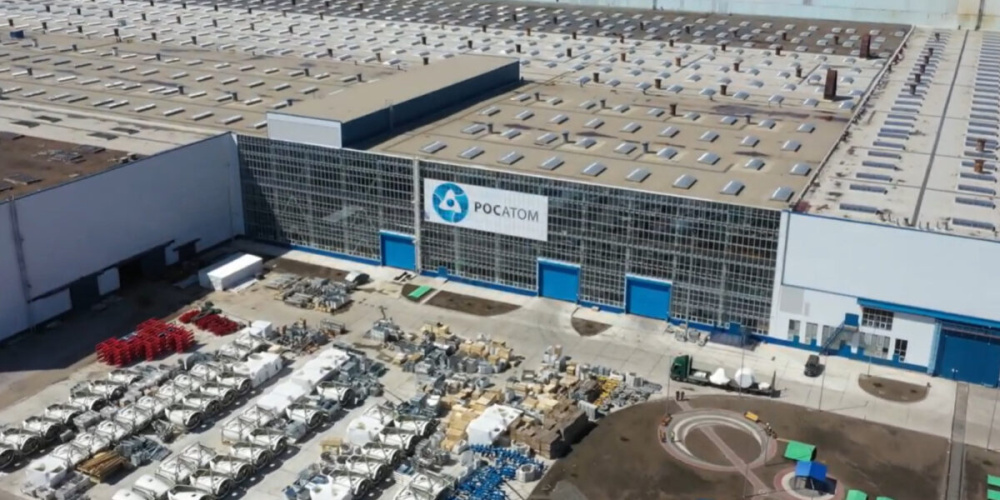
Rosatom plant in Volgodonsk.
- As part of the program for localization of wind power
plants, production of a hub, nacelle, generator, and cooling system for a 2.5
MW wind turbine was organized in Volgodonsk at Rosatom's production facilities (Atommash plant). Rosatom has
not only developed competencies in a completely new industry for the country,
but also solved the problem of serial production of components and assemblies
for wind turbines in the territory of the Russian Federation.
- As part of the preparation of the plant's infrastructure,
the building and crane facilities were reconstructed to meet the peculiarities
of the wind turbine operation.
- The total area of the plant is 30 thousand m2. Serial
production capacity is upto 120 turbines per year. The number of jobs is more than
320.
1. Wind turbine generator
stator.
2. Rotor and main bearing of the
wind turbine generator.
3. Wind turbine generator.
4. Wind turbine nacelle.
5. Hub and platform of the wind turbine tower base.
Each site in turn consists of posts, the number of which dependson the complexity of the operations performed and the composition of the equipment.- The most complex technical unit of a wind turbine is the generator.
Organizing the production of such a unit requires advanced industrial development,and, most importantly,
generators havea high export potential in new markets.
Background Information:
The uniqueness and benefits of
direct drive technology:
1. Direct drive permanent
magnet and power conversion technology is characterized by a simple and
efficient transmission chain and low mechanical loss.
2. High power generation
efficiency: A direct-drive wind turbine has no gearbox, which reduces
transmission losses and increases the power generation efficiency, especially
under low wind speed conditions. The effect is more pronounced, which is
relevant for the Russian Federation.
3. High reliability: The
gearbox is a component with a high failure rate in wind turbine operation.
Gearless technology eliminates the need for a gearbox and its accessories, simplifies the transmission structure, and enhances device
reliability. At the same time, the unit operatesat low speed with fewer rotating parts and
higher reliability;
4. Low operation and
maintenance costs: The gearless technology can reduce the number of wind turbine components, avoid regular oil changes in the
gearbox, as well as reduce operation and maintenance costs.
- Implementing its localization program, Rosatom Renewable Energy is focused on building local supply chains: more than 250 Russian companies have already joinedthe industrial cooperation within the project, which means more than 2,000 new jobs.
- As the project integrator, Rosatom's wind power division not only established an efficient supplier chain, but also contributed to the development of new competencies among companies in the state corporation's circuit.
- In 2024, Rusatom Wind
Blades JSC (part of Rosatom's Composite Division) launched a plant for the
production of composite wind blades in Ulyanovsk. The shop's production
capacity is designed to manufacture 450 blades per year at maximum utilization.
The blades are 51 m long, weigh 8.5 tons, and are 90% glass composite and 10% carbon composite. The production is highly automated. The very
technology of manufacturing large-size geometrically complex parts by vacuum infusion
method is essential for the development of domestic competencies in the field of
composite construction. Fast creation of the plant and its fitting with
advanced equipment also made it possible to retain and build up the project
team comprising almost 400 people of engineering and technical personnel with accumulated competencies in a
unique production. The project is supported by the Industrial Development Fund
(IDF) under the Priority Projects program. The first Russian blades are currently being
installed at the Novolak Wind Farm in the Republic of Dagestan.
- The blades are made of domestic materials. Glass fiber and glass fabrics for them are supplied by the plant of Rosatom Fiberglass JSC in Gus-Khrustalny fr om the Composite Division of Rosatom. Due to high requirements and complexity of blade manufacturing technologies, the demand for domestic composite materials is already generated in the amount of 3000 tons per year.
- Large-sized parts for Rosatom's wind turbine generators are manufactured by Parsek Firm LLC. The company was founded in 1992 and has almost 30 years of experience in metal machining. Over this period, the equipment park has become one of the largest and most diverse in Russia. Today it comprises more than 120 units of CNC machines. The company currently manufactures more than 250 components. Some of them have been produced in Russia for the first time. The combination of strict technical requirements, peculiarities of the required material and product configuration demanded tailored solutions, development of numerous technological processes, and coordination of all plant services. Specifically, the manufacturing process involved machining equipment (medium and large machining centers, lathes, and CNC boring lathe), as well as equipment in related production areas: cutting, welding, rolling, zinc and nickel plating, and painting. This makes it possible to manufacture any sophisticated and high-precision part, including large-sized products up to 10 m long and up to 3.2 m in diameter.
- Sibgazstroydetal Plant CJSC supplies copper parts of the generator stator for wind turbines. Special production was organized in Volgodonsk: winding equipment was purchased (insulating machine for arc blanks), a GigaOhm 5 kV insulation parameter meter, and a test bench required to perform measurements of insulation resistance value at 5 kV DC was manufactured and installed. The company also manufactures metal nacelle frames.
- Towers for wind turbines are manufactured by VetroStroyDetal LLC. MST towers consist of segments carried by standard 53-foot trailers, which significantly reduces logistics costs and increases the number of locations wh ere the wind turbine can be placed. The tower is assembled on site by welding-free bolted connections. Twelve 53-foot trailers and only one oversized trailer are needed to carry one 96-meter tower weighing 220 tons. The industrial site of VetroStroyDetal LLC with an area of 20,000 sq. m. in Volgodonsk is equipped with modern high-tech equipment: a unique for Russia step-by-step forming press with a force of 3000 t and a bending length of up to 14 m with automated bending, a plasma cutting line with a function of high-speed hole drilling and with two tables 27 m each, a robotic line of gas-flame zinc spraying, as well as a unique automated three-component coating line of 120 m, which allows covering up to 40,000 sq. m. per month. The plant's production capacity is 154 MST towers per year. The investment project created new high-tech jobs. The headcount of the Volgodonsk branch of VetroStroyDetal exceeds 200 people.
- On January 29, 2025, VladPolyProm LLC launched a new workshop for the production of glass plastic hub covers and nacelles for wind turbines in Suzdal district of Vladimir region. The company's production site occupies 7000 sq. m., and there are plans to increase it by another 2000 sq. m. More than 50 new jobs have already been created. Backed up by more than ten years of experience in the development and production of fiberglass plastic products for various purposes, the company specialists were able to prepare the site within a short period and deploy serial production of the largest and most complex products. Designers and technologists of VladPolyProm have supplied the production with additional equipment, produced tooling for the whole range of covers, adapted the physical and mechanical part of the composite elements to the dimensions of the products and operating conditions of wind power plants, and produced the first pilot batch. The share of Russian materials used by the companyis more than 65%. Up to 30% of the materials used to manufacture the products are produced in the local region. The implementation of Rosatom's wind power project enabled VladPolyProm to complete the formation of a full-cycle production facility. The competencies acquired allowed expanding the range of manufactured products and generating a long-term order portfolio in the field of fiberglass components for power engineering, transport,and agricultural engineeringg.
- Rosatom Renewable Energy continues its work on expanding the presence of Russian companies in the supplier chain. The division's requests promote the development of production of a new type of products by Russian companies. Thus, specifically for the project, R&D with reverse engineering elements was launched by Shcherbinsky Lift Building Plant JSC (service hoist for wind turbines), SKB IS JSC (encoders), Parus Electro LLC (medium and low voltage cabinets), Centrotech RPA LLC (lip seal), and other companies.
- To automate the monitoring and control of wind power plant operations, Rosatom Renewable Energy JSC developed a software solution enabling the real-time collection of information on the operation of each wind turbine for analysis and prompt response by maintenance personnel. Software tools for process control created by Rosatom Renewable Energy JSC were included in the registry of Russian software, which allowed the company to achieve import independence in terms of software for wind turbine control. Also, to minimize the effects of sanctions pressure, the key hardware elements of the critical wind turbine infrastructure management system were replaced with domestic ones.