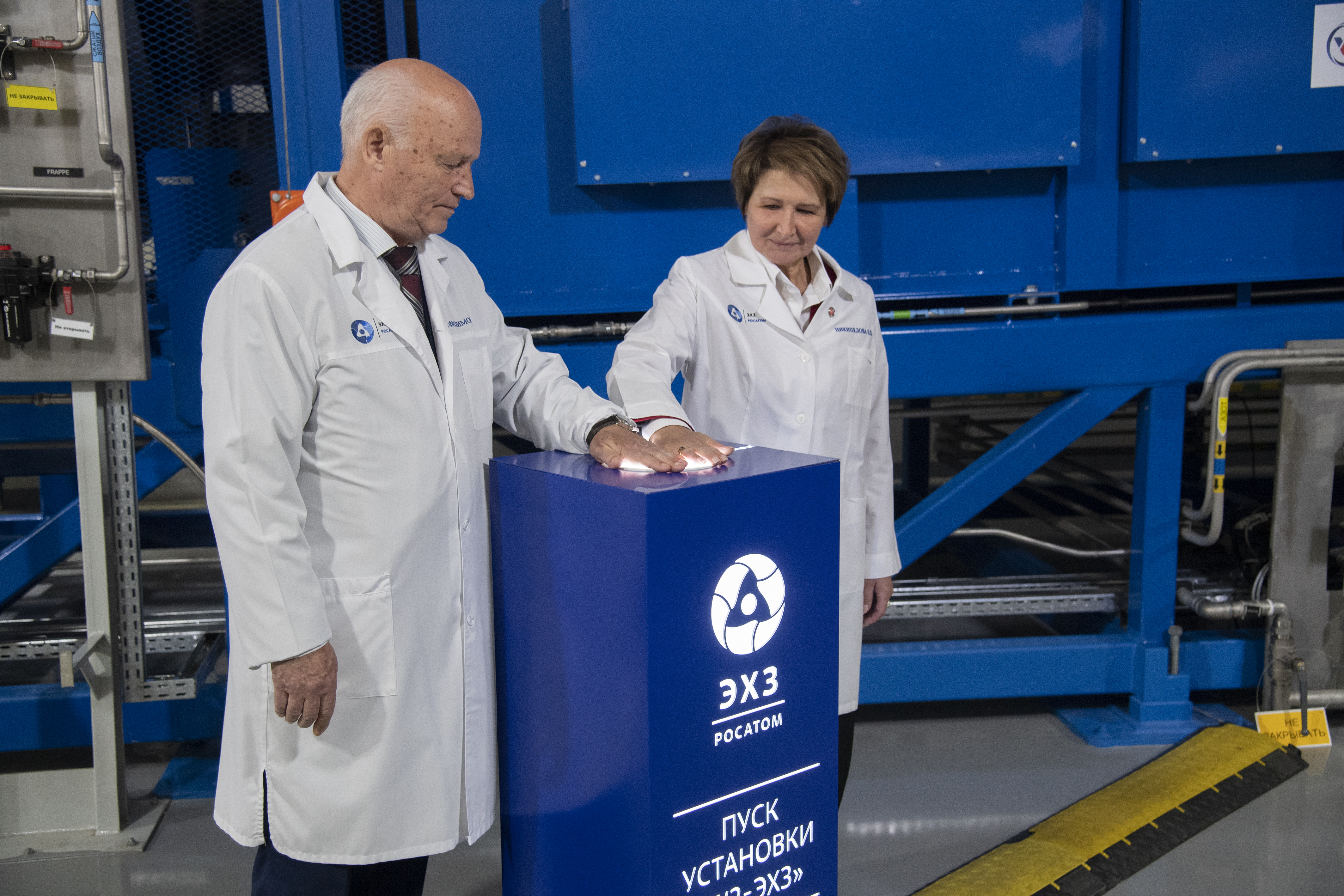
Rosatom's Fuel Division has commenced
pilot operation of a new production unit, W2-ECP, at the Electrochemical Plant (ECP) in Zelenogorsk, Krasnoyarsk Region, East Siberia. The unit is designed
for defluorination of depleted uranium hexafluoride (DUHF), a compound of uranium and fluorine.
This is the second such facility in Russia, with an annual processing capacity
of 10,000 tonnes. The new unit will double Russia's total deconversion capacity
to 20,000 tonnes per year.
This achievement a significant milestone in ensuring the
environmental safety of Russia's nuclear industry, in line with the Sustainable
Development concept. The defluorination units employ pyrohydrolysis technology
to convert chemically aggressive DUHF
into a safe and stable compund
— uranium oxide powder. In this form, depleted uranium can be safely stored
long-term in containers at open-air sites.
Even after repeated extraction of the fissile uranium-235 isotope, the remaining "tail" uranium retains its value as an energy resource. Depleted uranium is used in oxide uranium-plutonium MOX fuel for the BN-800 fast reactor (prospectively for BN-1200), as well as in nitride UP fuel for the BREST-OD-300 reactor (and prospectively BR-1200).
"Russia is the undisputed global leader in low-enriched uranium production, and this carries a certain responsibility for managing the DUHF that remains at our facilities after enrichment. Rosatom is deeply committed to environmental and sustainable development priorities, which is why we are investing in expandingDUHF processing capacity. Given our extensive work on fourth-generation nuclear technologies, depleted uranium is no longer a production waste — it is becoming a strategic resource for the energy of the future," said Alexey Likhachev, Director General of Rosatom.
"Rosatom is actively investing in the development of nuclear fuel cycle technologies and production facilities across the entire chain, including the recycling of uranium tailings, spent nuclear fuel, and other materials that should not be merely stored but put to reuse. Given growing global demand in uranium, as well as our next-generation technologies, any depleted uranium — regardless of its uranium-235 content — remains of enormous value to the industry. Our centrifuges enable highly efficient re-enrichment of DUHF, and the availability of fast reactors in Russia allows secondary nuclear materials, such as plutonium and depleted uranium to be used in nuclear fuel. ThroughDUHF defluorination, we achieve a closed-loop cycle not only for uranium but also for fluorine, which is returned to the conversion process," noted Natalya Nikipelova, President of TVEL JSC (managing company of Rosatom's Fuel Division).
Fluorine-containing products obtained through hexafluoride defluorination —are supplied to the market as certified chemical products. Since 2011, the Electrochemical Plant's hydrofluoric products have been delivered to Rosatom enterprises as well as to customers in the chemical, metallurgical, mining, and oil & gas industries.
Uranium
conversion
is an intermediate stage in the front end of the nuclear fuel cycle, performed
after mining and primary purification of uranium ore but prior to enrichment.
At this stage, uranium feedstock is converted into uranium hexafluoride (UF₆) —
a compound of uranium and fluorine. In this form, uranium is delivered to
enrichment facilities, where its isotopes are separated in gas centrifuge
cascades: uranium-235, needed for nuclear power generation, is separated from
the more abundant uranium-238. Fluorine is used as a component of the
enrichment compound due to its unique properties. First, uranium hexafluoride
transitions to a gaseous state at relatively low temperatures, which is
essential for isotope separation in centrifuges. Second, fluorine occurs in
nature as a single stable isotope, enabling unambiguous separation of lighter
uranium isotopes from heavier ones. After enrichment, uranium in the form of
hexafluoride is shipped to nuclear fuel fabrication facilities. Depleted
uranium hexafluoride, in turn, is sent either to storage or to deconversion
(defluorination).
Uranium
deconversion
is the process of converting uranium hexafluoride — a chemically aggressive
substance — back into an oxide form with removal of fluorine. The result is a
chemically stable uranium oxide suitable for long-term safe storage or further
use in the nuclear fuel cycle, along with fluorine-containing by-products that
are also recycled back into production.
Rosatom's
Fuel Division
(managed by TVEL JSC)
comprises enterprises for nuclear fuel fabrication, uranium conversion and
enrichment, gas centrifuge manufacturing, as well as research and engineering
organizations. As the sole supplier of nuclear fuel for Russian NPPs, TVEL
supplies fuel to a total of over 70 power reactors in 15 countries, research
reactors in nine countries worldwide, and transport reactors of the Russian
nuclear fleet. One in six power reactors globally operates on TVEL fuel. The
Fuel Division is the world's largest producer of enriched uranium and a leader
in the global stable isotopes market. The Division is also actively developing
new businesses in chemistry, metallurgy, energy storage technologies, 3D
printing, digital products, and nuclear decommissioning. Sectoral integrators
for additive technologies and energy storage systems have been established
within its scope.
The Electrochemical Plant (ECP) is a Rosatom Fuel Division enterprise located in the closed administrative territory of Zelenogorsk, Krasnoyarsk Region. The plant produces low-enriched uranium for nuclear fuel, stable and radioactive isotopes of various chemical elements, and a range of other high-technology products.