As part of the Quantum Project
managed by Rosatom, qubit operations have been demonstrated on planar ion traps
for the first time in Russia. This
milestone marks a transition to planar technology for scaling ion-based quantum
computing systems under the Russian quantum computing development roadmap. The
advanced technology is used in quantum computing to trap and control ions,
making it key to scaling ion-based quantum computers to the levels required for
practical industry applications.
Two research teams within the Quantum Project demonstrated these outcomes simultaneously: the team fr om the Lebedev Physical Institute of the Russian Academy of Sciences (LPI RAS) led by Ilya Semerikov, and the team from the Russian Quantum Center (RQC) led by Kirill Lakhmansky. The Lebedev Physical Institute demonstrated the trapping of ytterbium-171 ions in planar traps, their shuttling along the chip, and single-qubit operations. The team also measured the ion heating rate, which is one of the most critical metrics for such chip-based devices. Concurrently, the Russian Quantum Center focused its research on calcium ions, successfully demonstrating particle trapping, ion shuttling, and single-qubit operations.
"Today, I have no doubt that the future development of ion-based quantum computers depends on the transition to planar technologies. This opens up numerous avenues for platform improvement, including more precise and parallel operations, larger qubit counts, integrated photonics, and near-field operations. Moreover, planar traps are significantly more manufacturable. Therefore, these outcomes are highly important from both scientific and practical standpoints," said Ilya Zalivako, a Quantum Project researcher and Senior Research Fellow at the Lebedev Physical Institute.
"The transition to planar technology is fundamentally important for elevating our work to a qualitatively new level, which is essential for creating powerful quantum computing systems. This is only the first step: we plan to advance this technology to enter the global race for planar-based quantum computing and reach the level of leading international quantum initiatives by the 2030 horizon," said Kirill Lakhmansky, a Quantum Project researcher and head of the research team at the Russian Quantum Center.
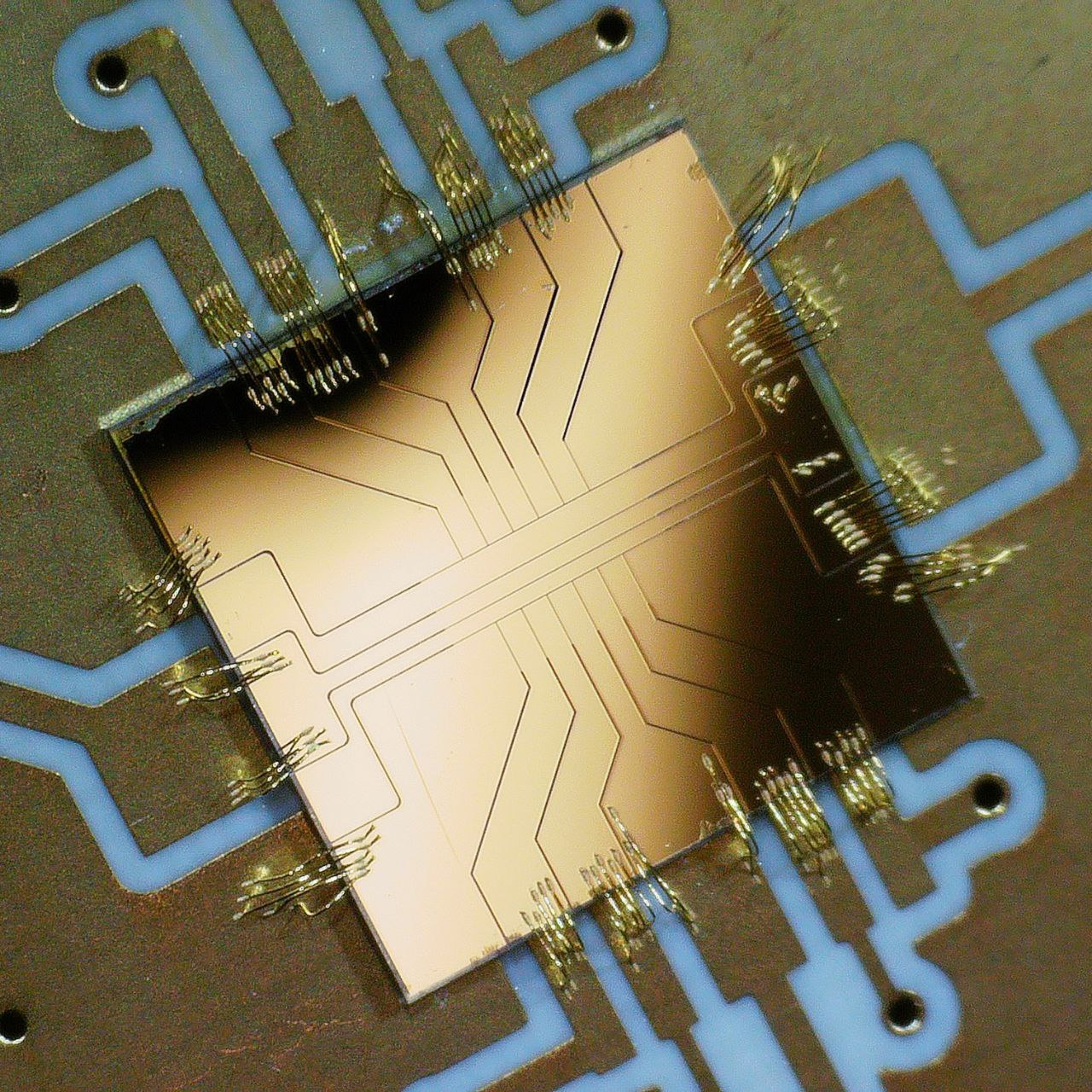
Planar traps are a type of
electromagnetic trap wh ere the electrodes generating the radio-frequency (RF)
and direct-current (DC) electric trapping fields are arranged on a single plane
(a chip). These devices are used in
quantum computing to trap and control ions.
The advantages of planar traps include the ability to hold a larger
number of qubits (over 100), the option to integrate optical elements for qubit
manipulation and readout, and the capacity to create zones with targeted
properties to improve operation quality independently of the number of qubits
in a register.
Fr om a practical standpoint,
mastering planar technology marks a qualitative step on the path toward
commercial-scale ion quantum computing systems capable of solving practical
industrial problems. It also accelerates the integration of quantum computing
into the operational workflows of various industrial sectors. The scientific
significance of these outcomes lies in the fact that planar traps enable a
shift from operating a single chain of ions to more complex configurations
consisting of several small arrays between which ions can be shuttled. As the number of qubits grows, this approach
prevents vibrational spectra and individual addressing from becoming overly
complex, opening up vast possibilities for the advancement of the ion-based
platform.
Rosatom is a global, diversified technology holding company with assets spanning energy, mechanical engineering, and construction. It comprises approximately 600 enterprises and organizations, employing around 415,000 people. Since 2020, Rosatom has been responsible for the implementation of the roadmap (RD) for the development of the high-tech area of Quantum Computing. This initiative forms the core of Rosatom's Quantum Project, an ecosystem that brings together 19 research institutes and universities, including over 750 researchers and engineers. During its initial phase, the Quantum Project focused on building a domestic quantum computer. By developing prototypes for four distinct computing platforms—ions, neutral atoms, photons, and superconductors—this initiative positioned Russia among the top three global leaders in this category. Today, Russia possesses seven quantum processors, five of which were created under the roadmap framework. Three of these quantum computers have reached scales of 70 qubits or more. The 2025–2030 roadmap is focused on achieving qualitative advances in Russia’s quantum technology sector and developing practical applications of quantum technologies, particularly within the Russian nuclear industry, wh ere more than 30 pilot projects are currently underway. In 2026, Rosatom also expanded the scope of its research and development to include the field of quantum sensors.