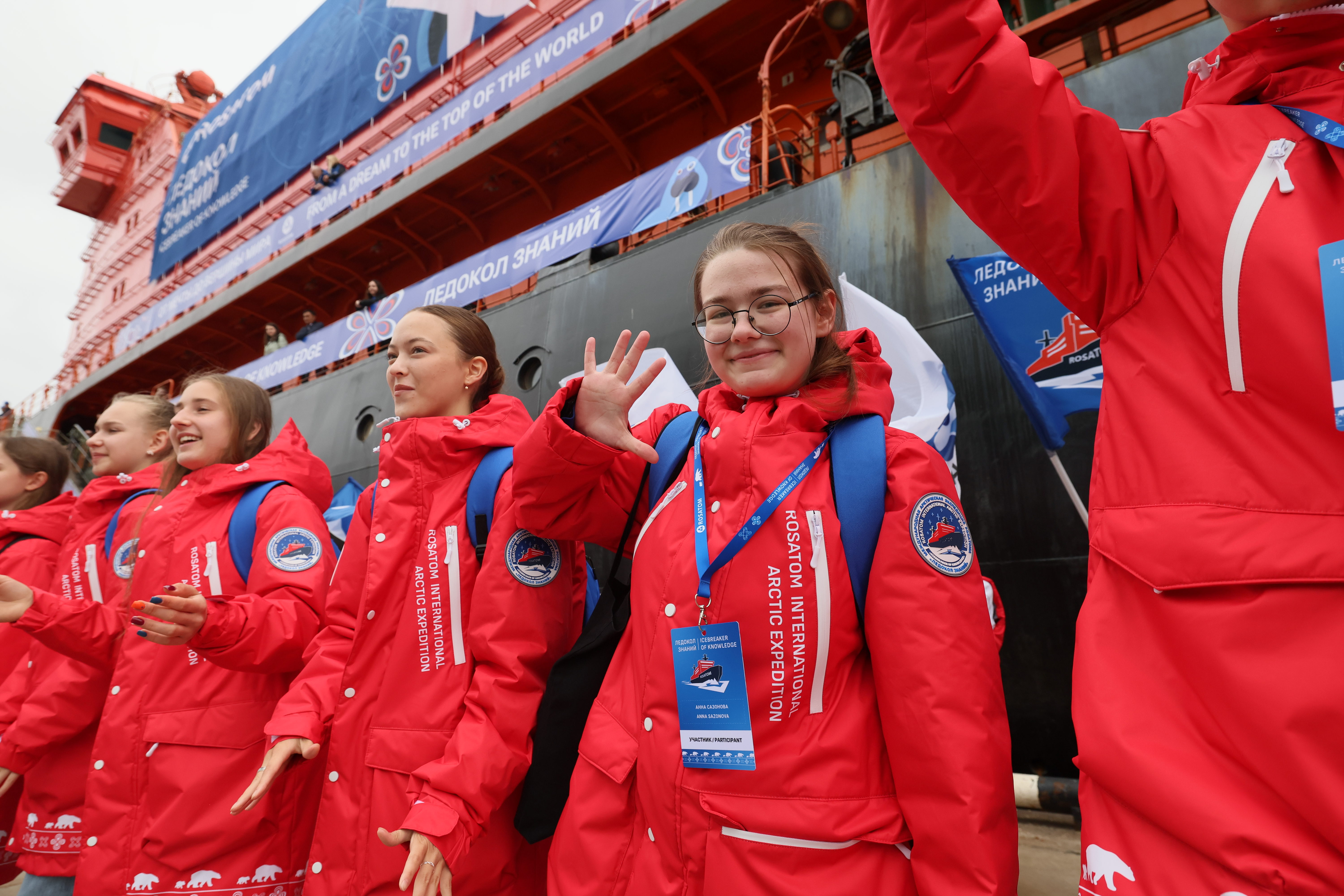
Rosatom’s seventh scientific and educational expedition, Icebreaker of
Knowledge, set sail fr om Murmansk for the North Pole to mark the Year of Unity
of the Peoples of Russia. During the expedition’s departure ceremony, Ruslan Sasov,
captain of the nuclear-powered icebreaker 50 Years of Victory, gave the order
to begin the educational voyage, and the ship set sail on the route Murmansk —
North Pole — Franz Josef Land — Murmansk.
The expedition included high school and college students fr om eight federal districts of Russia, as well as their peers from 22 countries around the world. The expedition included Russian and foreign winners of an open selection process, as well as participants in the Rosatom Juniors engineering and technical movement, winners of the All-Russian Big Change competition, prize winners of other federal and international science competitions and Olympiads, as well as Ekaterina Malkova, a high school student from Moscow who scored 500 points on the Unified State Exam (EGE). One of the season’s major innovations is the Master track for future highly skilled workers, which for the first time has opened the door to the Arctic for students from colleges and technical schools.
"The Arctic is a place of power, wh ere the most ambitious ideas are born and brought to life. This is wh ere bold and active people who are ready to build a better future come. The Icebreaker of Knowledge is taking exactly these kinds of children to the North Pole. And we are proud that our nuclear-powered icebreaker fleet — the only one of its kind in the world — provides them with this opportunity. Students from 23 countries on board the nuclear-powered ship 50 Years of Victory will learn about technologies they won’t see anywhere else. We want to harness the energy of the best young minds to advance science and protect the planet. “This energy is the main driver of progress,” noted Alexey Likhachev, Director General of Rosatom.
“Projects like Icebreaker of Knowledge are investing in our children’s future: they give young people the opportunity to go beyond the school curriculum, prove themselves, develop a passion for science and engineering, receive recognition for their hard work, and gain the motivation to move forward. I am confident that the participants in Rosatom’s scientific and educational expedition will build their futures in science, technology, and highly skilled trades,” — commented Alexander Bugaev, First Deputy Minister of Education of the Russian Federation.
“Science fiction has long ceased to be just a dream: much of what writers imagined a hundred years ago is now in use on nuclear icebreakers and in scientific laboratories. I’m interested in talking to the kids specifically about this — how an idea is born and what it takes to turn it into real technology. Those who are heading to the North Pole already know how to dream big, and I’m confident that one of them will write the next chapter in the history of our science. In the meantime, during the expedition, we’ll work together on some scientific prose,” — said science fiction writer Sergey Lukyanenko.
The Icebreaker of Knowledge science and education project is organized with the support of the Rosatom. It is aimed at promoting natural science disciplines and technologies of the nuclear industry, finding and supporting talented and gifted children, developing their abilities and offering career guidance. Over the six seasons of the Icebreaker of Knowledge project, more than 400 talented schoolchildren from around the world have participated in Rosatom’s Arctic expeditions to the North Pole. The project has provided them with a unique opportunity to explore an active nuclear-powered icebreaker and learn about cutting-edge scientific and technological developments in the Russian nuclear industry.
The seventh season of the selection process for Rosatom’s Arctic expedition
was the largest in the project’s history: high school students and vocational
school students from all 89 regions of Russia and 22 countries around the world
competed for a spot aboard the nuclear-powered icebreaker. More than 73,000
teenagers aged 14–16 took part in the Russian selection process, and the
competition reached a record 3,045 applicants per spot. The final stage of the
competition took the form of an engaging “scientific sparring match”: teams
from the same federal district engaged in intellectual duels, articulately
defending opposing positions on key science and technology topics. The
discussions focused on quantum computing, nuclear medicine, the development of
energy technology, and the exploration of the Moon and the Arctic. The debates
themselves consisted of two stages: a presentation of each team’s position and
a cross-examination round. The impartiality of the judging was ensured by a
distinguished panel of judges, which included experts from the nuclear
industry, leaders of educational and youth organizations, and prominent
cultural figures.
From the very first day aboard the icebreaker 50 Years of Victory, the students will participate in a rich scientific and educational program organized by the Rosatom Corporate Academy — including discussions, lectures, workshops, and career counseling. The experts contributing to the educational programme of the seventh expedition include leading specialists from the nuclear industry: Egor Plakhotnyuk, Project Manager at the Laboratory of Genomic Technologies and Tissue Engineering of the Research Institute of Technical Physics and Automation, NIITFA, part of Rosatom’s Science Division; Andrey Smelov, Deputy Chief Engineer of the Beloyarsk NPP; Ilya Kholkin, General Director of Consist-OS, an IT integrator of Rosatom’s Electric Power Division; and others.
Special guests on the cruise include renowned Russian science fiction writer Sergey Lukyanenko, members of the band Ay Yola from Bashkortostan, and popular bloggers Yan Dylan and Vika Zhang. During the expedition, Sergey Lukyanenko will hold a creative laboratory for the voyage participants dedicated to writing science fiction: he will set an intriguing opening for a story, and the school students will offer their own versions of the ending. Also at the North Pole, the northernmost premiere of the animated feature film Smeshariki: Through the Universes — written by Sergey Lukyanenko — will take place, followed by a group discussion after the screening.
Russia’s nuclear-powered icebreaker fleet is one of the country’s key competitive advantages: only Russia possesses such vessels. Today, the fleet consists of eight nuclear-powered icebreakers: the lead multipurpose nuclear-powered icebreaker of Project 22220, the *Arktika*; the series-production multipurpose icebreakers of the same project, the Sibir, Ural, and Yakutia; as well as the icebreakers Yamal, 50 Years of Victory, Taimyr, and Vaigach.