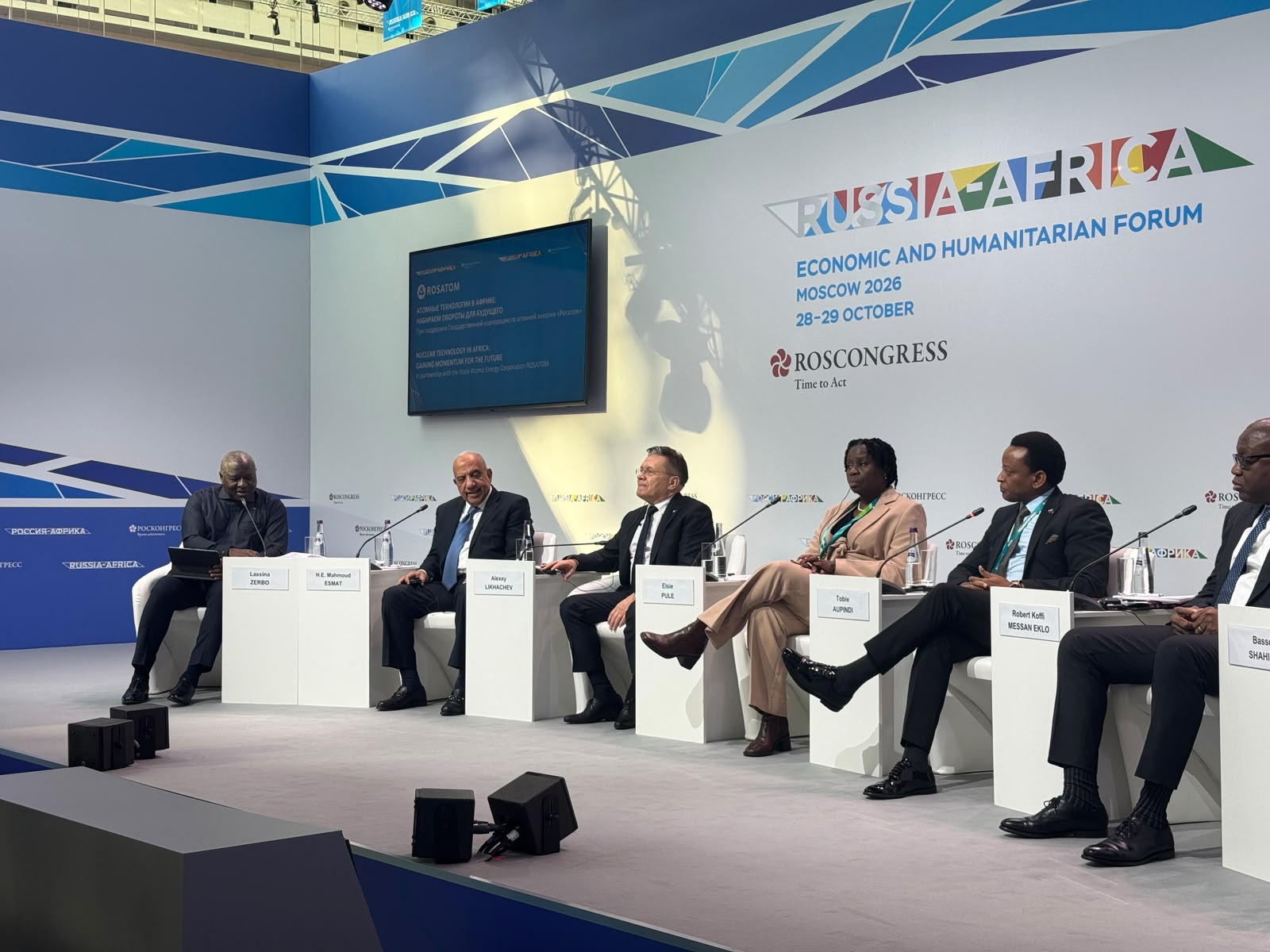
On 28 October, a session titled “Nuclear
Technologies in Africa: Gaining Momentum for the Future” took place in Moscow
as part of the business programme of the Third Russia–Africa Summit. The event
was held with the support of Rosatom State Atomic Energy Corporation, the title
partner of the forum. The session was moderated by Lassina Zerbo, Chairman of
the Board of the Rwanda Atomic Energy Board and Advisor to the President of
Rwanda. Participants in the discussion included Alexey Likhachev, Director General
of Rosatom; Robert Koffi Messan Eklo, Minister of Mines and Energy Resources of
the Togolese Republic; Tobie Aupindi, Chairperson of the Parliamentary Standing
Committee on Natural Resources of the National Assembly of the Republic of
Namibia; and Mahmoud Esmat, Minister of Electricity and Renewable Energy of the
Arab Republic of Egypt.
Participants discussed the first steps in developing a nuclear industry, the use of national expertise and resources, and the challenges of implementing nuclear projects. Speakers highlighted the role of nuclear technologies in ensuring a reliable energy supply and in advancing nuclear medicine, agriculture and science. Alexey Likhachev noted that Rosatom operates in 29 of the continent's 54 countries and that African partners are showing interest in nuclear power. Particular attention was paid to floating nuclear power units: following the signing of the world's first export agreement for the supply of electricity from such units in Indonesia, Rosatom has seen significant interest in this technology from African countries.
“For African countries, nuclear technologies can become an effective tool for building national technological sovereignty: the ability to independently set development priorities, train their own specialists and master advanced industries. This is comprehensive work that requires systematic cooperation, from workforce training and infrastructure development to large-scale projects worth billions of dollars. For us, working in Africa is, above all, a responsibility to people,” said Alexey Likhachev, Director General of Rosatom.
“Every successful programme develops step by step, and the IAEA approach serves as our guide. Before we build reactors, we train engineers, regulators and technicians, and we earn the trust of our citizens. No African country should walk this path alone: regional power grids, shared training centres and cooperation between regulators will make project implementation faster and safer. Nuclear power in Africa has moved from discussion to construction, and that is exactly what we are talking about with Rosatom today. Let us now ensure that it moves from construction to transformation: electricity for our homes, medicine for our hospitals, jobs for our youth and sovereignty for the continent,” said Lassina Zerbo, Chairman of the Board of the Rwanda Atomic Energy Board and Advisor to the President of Rwanda.
For Rosatom, its work in Africa is a long-term
partnership in the interests of energy security, technological development and
the training of national personnel. Nuclear power remains the corporation's
priority, while it also offers solutions in renewable generation and energy
storage, and develops raw materials projects, educational cooperation and
logistics. Since the launch of the quota programme for African states, around
1,000 places have been allocated for study at Russian universities in nuclear and
related fields. Today, 370 students from 26 African countries are studying in
Russia through Rosatom, and more than 100 students from 17 countries are
expected to be admitted next academic year.
Russia develops cooperation with all interested countries. Major international projects involving Rosatom and its divisions continue to be implemented.