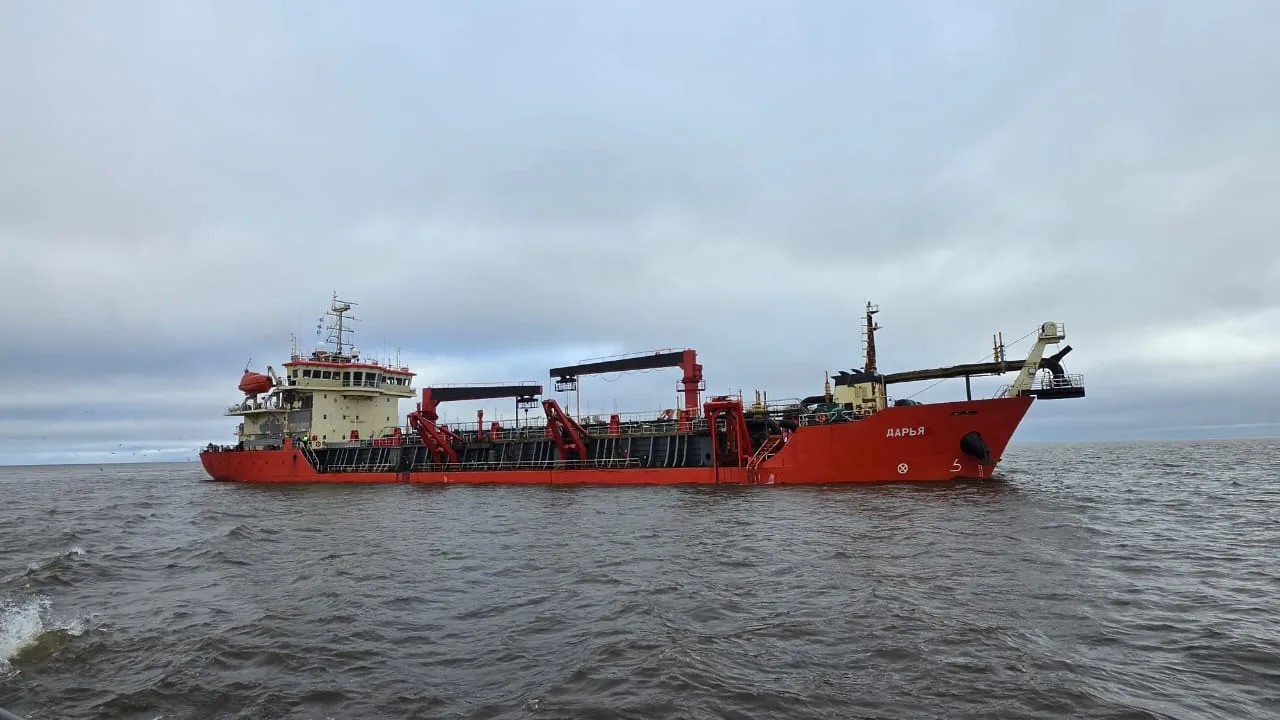
The hopper dredger “Darya” sailed from Vladivostok via the Northern Sea Route, arrived in the waters of the Ob Bay, completed all necessary clearance procedures, and received permits from the port and border authorities to conduct its operations. The vessel, acquired by the Federal State Unitary Enterprise Hydrographic Enterprise (part of Rosatom’s management circuit), has commenced its operational mission in the seaport of Sabetta. The purpose of the work is to maintain the previously established dimensions of the approach channel and ensure safe navigation in order to support the port’s planned cargo throughput. Sabetta became the first port in Russia built specifically for the transportation of liquefied natural gas. The heavy traffic of large-capacity gas carriers in the port’s waters leads to natural silting of the seabed, and the mission of the “Hydrographic Enterprise” is to restore the channel to its design dimensions and standard depth.
“Over the past 5 years, the Port of Sabetta alone has completed dredging operations totaling more than 70 mln cubic meters. Starting next year, it will be necessary to dredge approximately 5 mln cubic meters of sediment annually to maintain the required depths — a volume comparable to the total amount of maintenance dredging at all other Russian ports combined,” said Dmitry Ageev, Acting Director of the Federal State Unitary Enterprise Hydrographic Enterprise, highlighting the magnitude of the task.
During the first day of operations, the “Darya” dredged more than 12,000
cubic meters of soil; the total projected volume to be dredged by this hopper
dredger in 2026 is approximately 600,000 cubic meters. The task is also
complicated by the fact that Sabetta is a freezing port, and the “window of
opportunity” for dredging operations lasts only about 3 months.
Dredging is one of the key elements in ensuring the safety of navigation on
the Northern Sea Route, along with navigational and hydrographic support.
Annually, the Federal State Unitary Enterprise Hydrographic Enterprise conducts
surveys of more than 40,000 linear kilometers: knowledge of water depths and
their annual updates make it possible to vary routes, thereby preventing the
risk of ships running aground.
For Rosatom this is the first vessel of its kind, marking an important step in developing its own specialized fleet. The company plans to acquire nine more units of high-performance dredging equipment. This will enable it to carry out the entire scope of repair dredging operations in the waters of the Ob Bay and at the approaches to shippers’ terminals entirely with its own resources.
The Federal State Unitary
Enterprise Hydrographic Enterprise is a subsidiary of Rosatom that provides navigational and hydrographic
support for maritime navigation in the waters of the Northern Sea Route, in the
waters of seaports located along the coast of the Northern Sea Route, and their
approaches, as well as in the estuaries of rivers with maritime navigation
regimes, to create favorable navigational conditions for ensuring the safe
passage of vessels in the Northern Sea Route waters; it also constructs and
operates federally owned facilities in the seaports of the Northern Sea Route.
The Northern Sea Route is the shortest maritime route running through the
Arctic Ocean along Russia’s Arctic coastline and linking Europe with the
Asia-Pacific region. It is a historically established national transportation
artery of Russia. The length of the Northern Sea Route is about 5,600 km. Six
major seaports are located along the NSR in the Arctic zone of the Russian
Federation: Sabetta, Dickson, Dudinka, Khatanga, Tiksi and Pevek. The Arctic
shortens the route from Asia to most European ports, compared to traditional
southern routes.
In 2018, the Russian Government authorized Rosatom as the infrastructure
operator of the Northern Sea Route (NSR). The corporation supervises the
federal project Development of the Northern Sea Route and also participates in
implementing the Northern Sea Route Development Plan through 2035 and the
Russian Federation’s socio-economic development initiative through 2030
entitled Year-Round Northern Sea Route, approved by an instruction of the
Government of the Russian Federation.
One of Rosatom’s strategic objectives is to develop the Northern Sea Route
as a global transportation artery connecting Europe, Russia, and the
Asia-Pacific Region.
The comprehensive development of Russia’s Arctic territories is a strategic priority for the Russian State. It is essential to intensify the NSR transportation for accomplishing the assigned tasks. This logistics corridor is being developed through arranging regular cargo traffic, building new nuclear-powered icebreakers, as well as updating the relevant infrastructure. Rosatom's enterprises are contributing actively to this endeavor.