Engineersfr om Rosatom’s Fuel Division (Additive Technologies business unit), have successfully developed the manufacturing of
components from copper and its alloys using RusMelt industrial 3D printers.
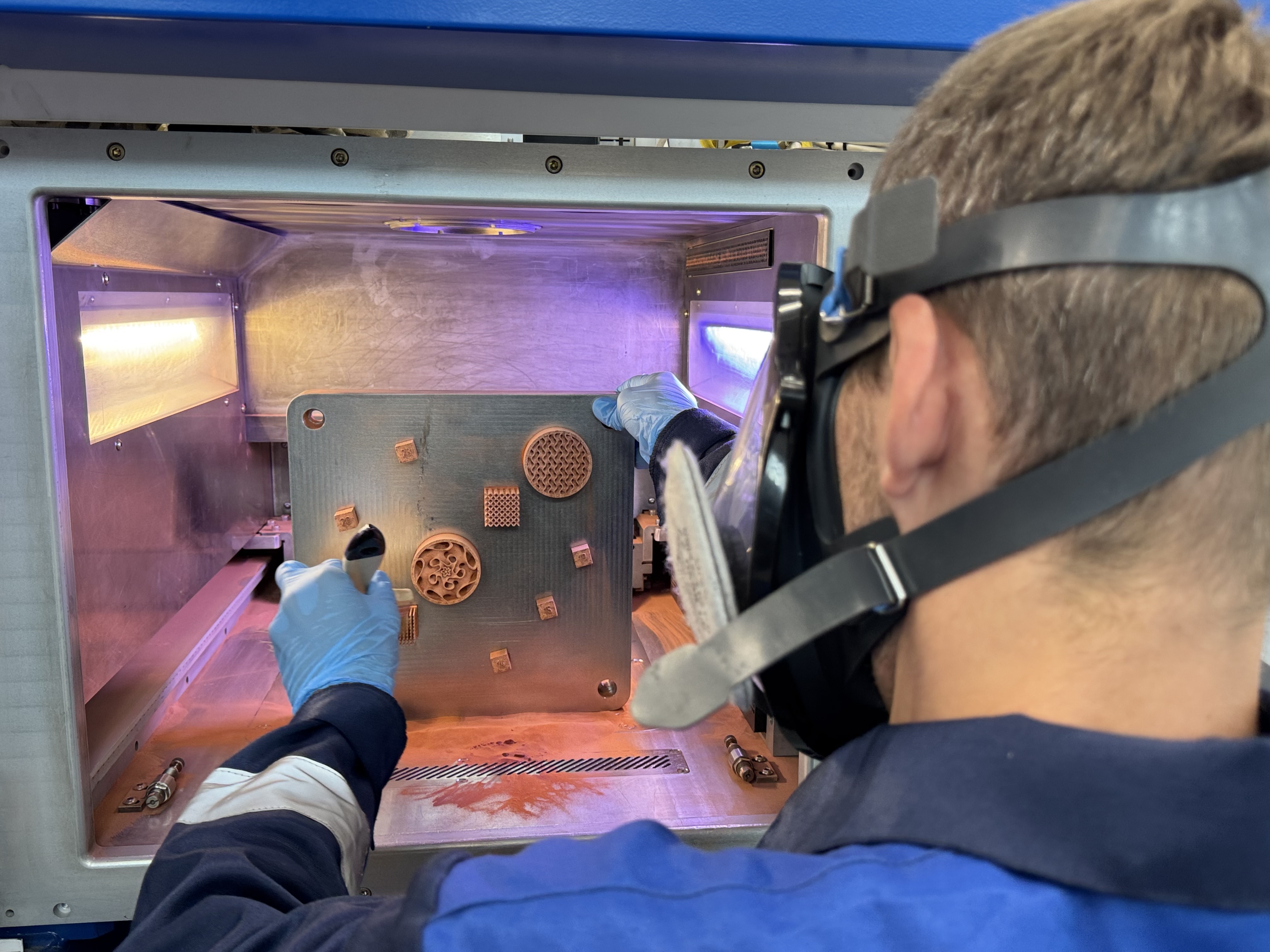
Rosatom’s serial 3D printers RusMelt, available in various sizes and based on selective laser melting technology (SLM), have traditionally used metal powder compositions of stainless steel, heat‑resistant materials or titanium. Copper 3D printing has remained limited for a long time due to the material’s physical properties. However, engineers at Rosatom’s Moscow Additive Technologies Center have identified and refined layer‑by‑layer selective laser melting parameters for copper powder that ensure the required product quality, minimal porosity, and high thermal conductivity.
“Copper 3D printing expands the functional capabilities of RusMelt SLM printers, boosting their global competitiveness by entering new market segments, particularly in electrical engineering, energy, and electronics, wh ere the high electrical and thermal conductivity of copper components is in demand. For our customers, this means the ability to produce complex parts - such as heat exchangers, current‑carrying elements, and inductors - without the traditional constraints of casting and machining technologies. This translates into shorter production cycles, reduced material consumption, and greater flexibility to customize solutions for specific tasks,” said Ilya Kavelashvili, Director of the Additive Technologies business unit at Rosatom’s Fuel Division.
Thanks to its unique electrical and thermal conductivity, copper is widely used in electronics, aerospace, automotive manufacturing, as well as in the production of engineering components and medical devices. Experts highlight the following copper parts that are particularly suitable for 3D printing in the future: heat exchangers for power electronics, semiconductors, and telecom equipment; engine and generator components; aerospace assemblies (including combustion chambers and cooling systems); molds and tooling with conformal cooling channels; as well as induction coils, conductive elements, and electrodes.
RusMelt industrial 3D
printers by Rosatom operate on selective laser
melting (SLM) technology and include three models - RusMelt 150M, 300M, and 600M - covering tasks from R&D and small‑batch
production to large‑scale manufacturing. The printers are compatible with a
wide range of metal powders, feature real‑time quality control systems, and
rely on Russian software and key in‑house components, supporting import
substitution and full process traceability.
The models differ in build
chamber dimensions and functionality: the compact RusMelt 150M (build
volume Ø 150×200 mm) is cost‑effective and well suited for
laboratories and medical applications; the mid‑size RusMelt 300M
(300×300×450 mm) targets industrial sectors such as aerospace, energy, and
mechanical engineering; and the RusMelt 600M, with a large build area and
an automated unloading system, is designed for serial production of large and
complex parts.
Rosatom was among the first
in Russia to develop domestic 3D printing equipment. The Additive Technologies
business line (within the Fuel Division) offers a comprehensive solution
spanning 3D printer and component development, printing materials, software,
service support, staff training, 3D printing services, and turnkey additive
technology centers at customer facilities.
Rosatom integrates the
entire additive manufacturing value chain and provides Russian industrial
companies in strategic sectors with innovative, reliable equipment, materials,
and professional services to implement additive technologies. The company offers
a full‑scope package for adopting additive manufacturing, including printing
with three different technologies using metals, plastics, and sand, as well as
3D scanning, R&D, and technology audits at customer sites to identify the
optimal direction for implementing additive technologies tailored to individual
needs.