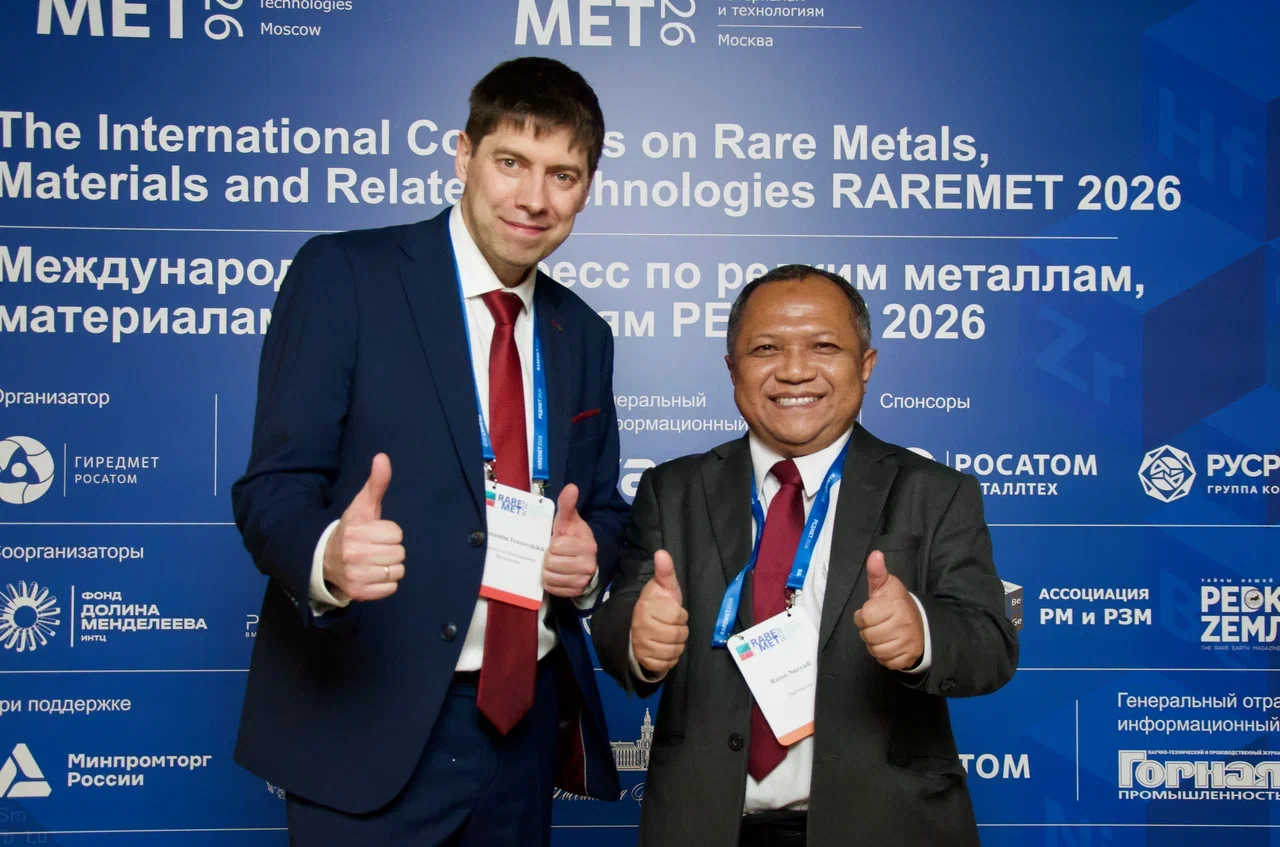
On May 20, 2026, the International Congress on Rare Metals, Materials and Technologies “Raremet 2026” officially opened in Moscow at MIREA – Russian Technological University. The congress is organized by Giredmet, part of Rosatom's Scientific Division. The largest industry-focused venue has brought together more than 750 participants from 20 countries, including leading scientists, government representatives, top executives of industrial corporations, and engineering companies. Delegates from Russia, India, China, Kazakhstan, Republic of Korea, Mongolia, Cuba, Egypt, Belarus, Tajikistan, Uzbekistan, Venezuela, Pakistan, Vietnam, Bangladesh, Armenia, Iran, Malaysia, Singapore and South Africa are taking part in the Congress. The largest foreign delegation is from India, with more than 100 participants, including high-level representatives of the Ministries of Steel, Electronics and Mining.
In a video address to the delegates of Raremet 2026, Rosatom Director General Alexey Likhachev spoke about extensive efforts to develop the rare-earth industry in order to ensure Russia’s technological sovereignty. "The forum is organized by the Giredmet Institute, the flagship of the domestic rare earth industry. This year it celebrates its 95th anniversary. Rosatom is actively involved in developing the rare-earth sector in the country. We are restoring rare-earth production at the Solikamsk Magnesium Plant, modernizing the enrichment plant at the Lovozero Mining and Processing Plant, and creating a processing cluster in Yakutia. Very soon, the country’s first large-scale production facility for permanent rare-earth magnets will begin operation in Glazov. We expect these efforts to help solve a strategic task: reducing Russia’s dependence on rare-earth imports and ensuring domestic industry is supplied with national resources", he stated.
Director of Giredmet Andrey Goliney noted that Raremet 2026 continues the tradition of the “Sazhin Readings” scientific seminars and previous international scientific and practical conferences dedicated to the development of the industry. According to him, the rare and rare-earth metals sector is currently undergoing a global transformation that requires new approaches to strategic partnerships and international cooperation in “closed-cycle” technologies — from mining and processing to extraction and final products. He emphasized that the Congress is intended to become the largest platform for constructive dialogue between fundamental and applied science, government authorities, and the real sector of the economy.
"I want to express my respect to the organizers of the Congress, it is a great platform for policy makers, scientific and industrial leaders. A key part of this Congress is the role of scientific and technological innovation. In India, we believe international scientific cooperation must become deeper and broader, while maintaining practical orientation. Magnet production is currently the most important need. I invite Russian academic institutions and research laboratories to cooperate with Indian academic institutions. Now is the time for cooperation with Russia and other partners. Our close ties are the foundation for stable and sustainable development. Thank you for inviting me to the Congress, I hope it will achieve its goals," Mr. Sandeep Poundrik, Secretary of the Ministry of Steel of the Republic of India called for closer cooperation between the countries.
About the Congress
On the opening day, three international panel
discussions attracted full audiences. The first session focused on the role of
rare earth metals in energy transition and sustainable development. The second
panel was dedicated to the Angaro-Yenisei cluster as an integration platform
for the new technological and economic policy of the Russian Federation.
Participants of the third panel discussed the tasks of advanced workforce
training for the rare and rare-earth metals industry.
The key event of the first day was the ceremony of
presentation of Academician N.P. Sazhin awards "For Contribution to the
Development of Science and Technology in the Field of Rare and Rare Earth
Metals". The awards were presented to:
- Andrei Bulanov, Corresponding Member of the Russian Academy of Sciences;
- Andrey Voshkin, Corresponding Member of the Russian Academy of Sciences, Professor, Doctor of Technical Sciences;
- Liya Kogarko, Doctor of Geological and Mineralogical Sciences, Professor, Academician of the Russian Academy of Sciences;
- Stanislav Kudj, Rector of the Russian Technological University MIREA;
- Dhiraj Kumar, Professor of Chemistry, Indian Institute of Technology;
- Kalli Sanjay, Ph.D., Institute of Mineral and Material Technologies, CSIR;
- Ruslan Khamizov, Corresponding Member of the Russian Academy of Sciences.
Representatives of the media received the Academician N.P. Sazhin Medals from Yury Mikhailov – Chairman of the Editorial Board of the Rare Earth journal, member of the Presidium of the Russian Academy of Sciences, Deputy Director General of Spetshimiya of the Rostec State Corporation, and Academician of the Russian Academy of Sciences:
- Oksana Galkevich, Deputy Director General of Public Television of Russia – for producing a series of educational programs on rare and rare-earth metals;
- Alexandras Budris, correspondent for the Russian edition of Forbes – for producing a series of analytical publications on rare and rare-earth metals;
- Prospect of Mineral Resources journal, represented by editorial board member Alexander Rogozhin member of the editorial board, First Deputy Director General of the N.M. Fedorovsky All-Russian Research Institute of Mineral Resources – for many years of scientific and journalistic work and in connection with the publication’s 95th anniversary.
The day’s program concluded with plenary presentations
on key scientific and technological areas.
On May 21 and 22 the work of the Congress will
continue in four parallel tracks covering the full technological cycle – from
raw material extraction to the production of high-tech products:
- Rare Metals Mineral Resources and Sustainable Processing Technologies (RAREMET:Minerals) – ore and technogenic waste processing, hydrometallurgy, and digital twin deposits.
- Metallurgy, Magnetic Materials, Powders and Composites (RAREMET:Metallurgy) – permanent magnet production, additive technologies, rare and refractory metals.
- Chemistry and Technology of Ultra-Pure Substances (RAREMET:Chemistry) – production and purification of rare-metal compounds, extraction and sorption processes.
- Materials for Electronics, Optics, Photonics and Energy (RAREMET:Functional) – semiconductors, scintillators, thermoelectric materials, and hydrogen energy.
The program of the second and third days of the Congress also includes panel discussions “Materials and Components for High-Tech Industries: The Role of Digital Design and AI" and "The New Geography of Rare and Rare Earth Metals: Technological Sovereignty, Global Chains and the Sixth Technological Stage". Roundtable discussions will be held on synchrotron studies of materials based on rare and rare-earth metals, as well as an expert session on the economics of critical metals.
Guests can also visit the specialized exhibition RAREMET:Expo, showcasing technologies, equipment, and services from leading companies and scientific centers.
The Congress closing ceremony and awards presentation for the best speakers will take place on the evening of May 22.
The Congress is organized by Giredmet (Scientific Division of Rosatom State Corporation).
Co-organizer and general sponsor is Kirillitsa Group.
Sponsors: Rosatom MetalTech, Rusredmet Group.
Co-organizers: Mendeleev Valley Innovative Scientific and Technological Center Development Foundation, MIREA – Russian Technological University, D. Mendeleev University of Chemical Technology of Russia, N.M. Fedorovsky All-Russian Research Institute of Mineral Resources, Kurnakov Institute of General and Inorganic Chemistry, Association of Rare and Rare-Earth Metals, Rare Earth Journal.
Supported by: Rosatom , Ministry of Industry and Trade of the Russian Federation, Ministry of Natural Resources and Ecology of the Russian Federation, Russian Academy of Sciences.
The general information partner is TASS federal news agency.
The general industry information partner is Russian Mining Industry Journal.
Partners:
Tomsk State University, Scientific Council of the Russian Academy of Sciences on Chemical Technology, Scientific Council of the Russian Academy of Sciences on Inorganic Chemistry, National Association for Subsoil Expertise, the journal Subsoil Use in the 21st Century, the newspaper Strana Rosatom, the scientific and business portal Atomic Energy 2.0, the analytical journal RUБЕЖ, the scientific and technical journal Mineral Mining and Conservation, the journal Mining Industry, the journal Globus. Geology and Business, the popular science magazine Chemistry and Life, the industry journal Metal Supply and Sales, the information publication MetalTrade, the popular science magazine DUMAI, the scientific and technical journal Photonics, the information and advertising publication Tekhsovet Premium, the journal Mining Science and Technology, the journal Proceedings of Higher Educational Institutions. Materials of Electronic Engineering, the journal Proceedings of Universities. Powder Metallurgy and Functional Coatings, the journal Proceedings of Universities. Non-Ferrous Metallurgy, the journal Proceedings of Higher Educational Institutions. Ferrous Metallurgy, the journal Russian Journal of Industrial Economics, the journal Modern Electronic Materials, the journal Analytics, the Telegram channel Metal and Mineral, the National Technology Initiative Projects Support Fund, and Monocle business magazine.
Official Congress website: redmet.giredmet.ru
Telegram channel: t.me/raremet2026
MAX messenger channel: https://max.ru/id7707072637_gos22
Rosatom’s Scientific Division conducts cutting-edge fundamental and applied research to advance both nuclear and non-nuclear technologies, including nuclear fuel cycle closure, fusion energy, and nuclear medicine. It also develops high-tech solutions for both the nuclear sector and a wide range of other industries. The division comprises 13 research institutes and commercial organizations, including JSC Research Institute NPO Luch, JSC IRM, and the V.G. Khlopin Radium Institute, among others. These organizations are equipped with advanced research infrastructure as well as their own pilot production facilities, enabling the full innovation cycle –from fundamental research and engineering development to prototype production. Most of the division’s R&D activities are carried out within a unified industrial thematic framework. Its responsibilities also include testing, development of high-tech medical equipment, and creation of advanced structural materials. In addition, projects are underway to commercialize promising high-tech solutions.