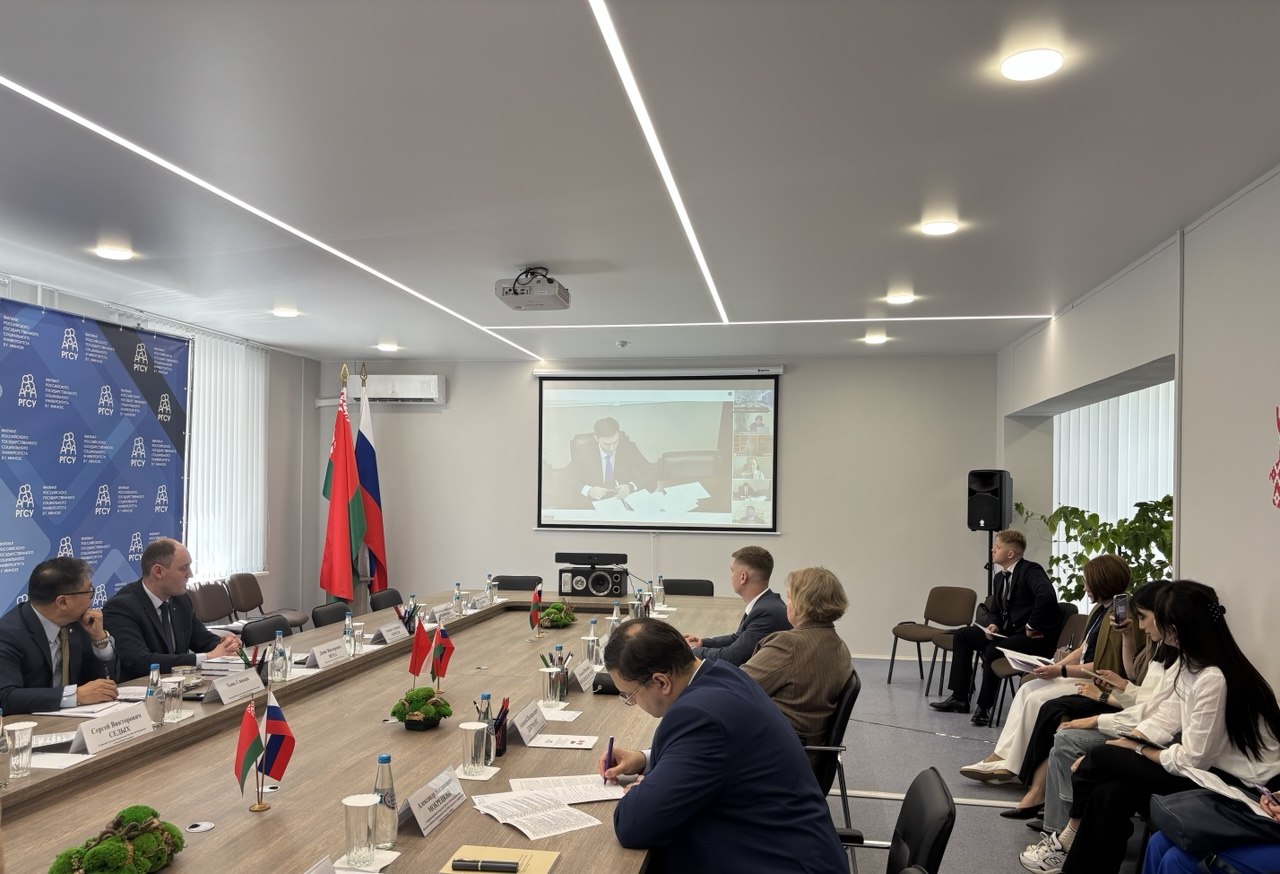
On June 2,
2026, the second international meeting of scientists and young researchers from
Belarus, Russia and China was held in Minsk at the branch campus of the Russian
State Social University, with a main focus on strengthening trilateral
cooperation and enhancing the role of joint initiatives in the global agenda.
The meeting
brought together representatives of research organizations, public authorities,
civil society associations, and members of parliament. Participants discussed
approaches to further expanding scientific and technological cooperation among
the three countries in order to strengthen the Minsk–Moscow–Beijing axis and
promote security and sustainable economic development in their respective
regions. They exchanged views on coupling the efforts of the Union State,
Russia, and China in investment, technology, and logistics, as well as on
implementing new joint initiatives, including the development of the Northern
Sea Route (NSR), for which Rosatom serves as the infrastructure operator.
Azamat Khochuev, Director of the Department for Developing the Northern Sea Route and the Arctic of Rosatom State Corporation, told about the work being done to develop navigation along the Northern Sea Route (NSR) and create the necessary infrastructure. He addressed issues related to the expansion of the icebreaker fleet and measures being taken to ensure safe navigation along the Arctic route amid increasing cargo traffic.
“The Northern Sea Route is one of the recent new global transport corridors. Its development is already a reality shaping the contours of Eurasia's transportation infrastructure. The NSR's transportation potential, combined with the vast resources of Russia’s Arctic zone, provides an economically efficient foundation for long-term cooperation with international partners,” Azamat Khochuev emphasized.
In turn, Professor Ruslan Yesin, Head of the Department of Comprehensive Chinese Studies at the Faculty of International Relations of the Belarusian State University, highlighted the Belarusian side's interest in jointly exploring the potential of the Northern Sea Route together with its Russian and Chinese partners. To this end, the stakeholders are continuing to discuss the possibility of arranging a joint trilateral research expedition to the Arctic.
“This is important for us as it will help Belarusian exporters better understand the opportunities that will emerge following the modernization and construction of new port facilities along the Northern Sea Route,” Ruslan Yesin said.
The
Northern Sea Route (NSR) is the shortest shipping route along the Arctic Ocean
along the Arctic coast of Russia, connecting Europe and Asia Pacific. It is a
historically established national transportation artery of Russia. The length
of the Northern Sea Route is about 5,600 km. Six major seaports are located
along the NSR in the Arctic zone of the Russian Federation: Sabetta, Dickson,
Dudinka, Khatanga, Tiksi and Pevek. The Arctic shortens the route from Asia to
most European ports, compared to traditional southern routes.
The Northern Sea Route has great potential for multifaceted cooperation in various areas, from expanding cargo traffic and infrastructure development to scientific cooperation in the field of ecology and environmentally sustainable Arctic navigation. In recent years, the route has developed dynamically: cargo traffic along the NSR has consistently exceeded 37 million tons over the past two years. International transit interest is also growing: during the 2025 summer-autumn navigation season, some 400,000 tons of containerized cargo passed along the route, i.e. 2.3 times more than in 2024 (176,000 tons).
In 2018, the Government of the Russian Federation granted Rosatom the authority of infrastructure operator of the Northern Sea Route. The Corporation supervises the federal project "Development of the Greater Northern Sea Route", and also participates in implementing the plan for the development of the Northern Sea Route until 2035, approved by the Government of the Russian Federation.
The Minsk branch campus of the Russian State Social University provides training for specialists in the social and labor sectors. Its activities are also aimed at fostering and developing a common educational space between Russia and Belarus. The branch regularly hosts round tables and seminars devoted to Russian-Belarusian cooperation.