At the International Industrial
Exhibition "Innoprom India" in New Delhi, Rosatom has showcased
the capabilities of Russian additive technologies, including advances in
industrial 3D printing and production localization.
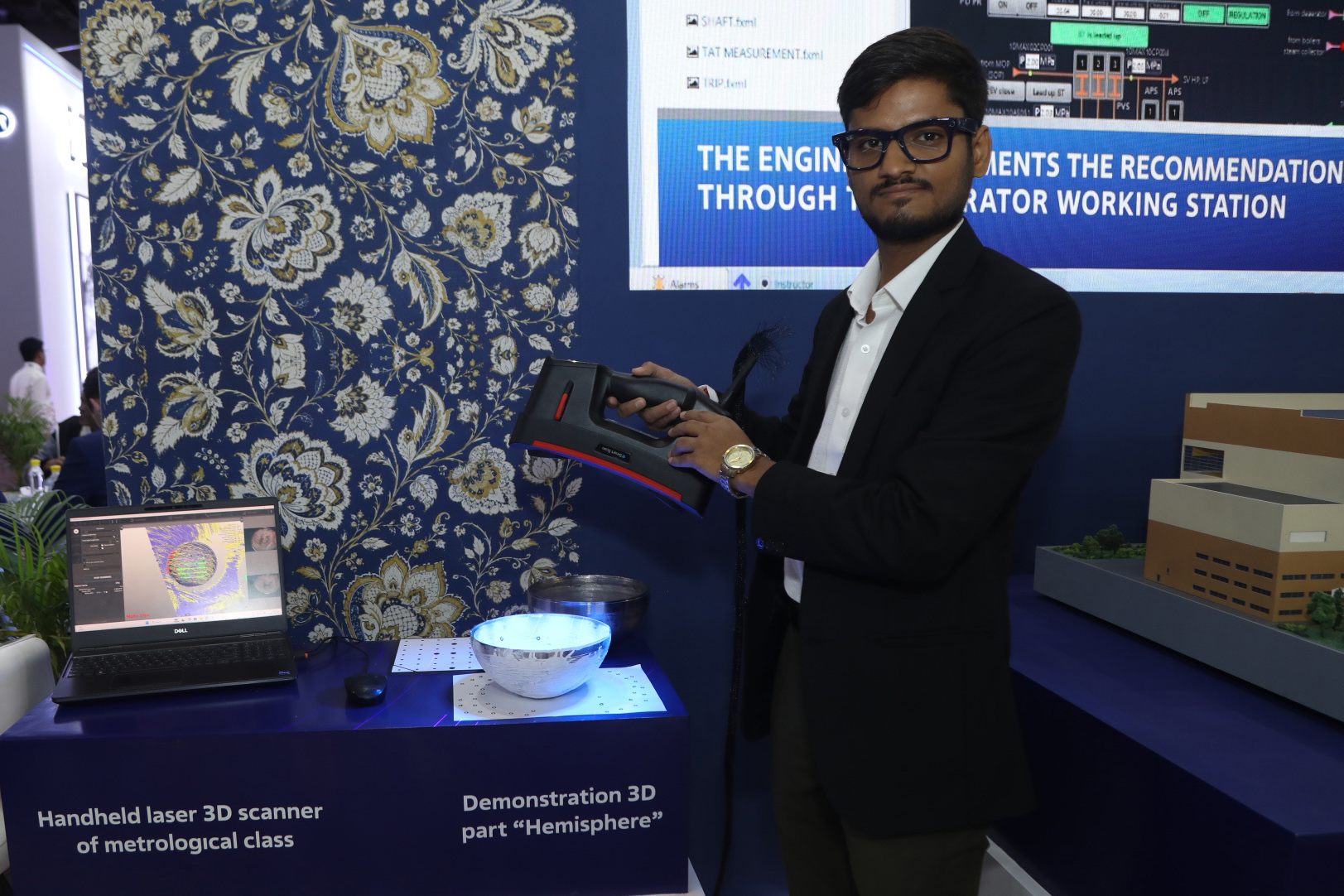
The corporation featured the
first localized 3D scanner of Russian design, manufactured at the facility of
an Indian partner. The scanner was developed and produced by RangeVision, a
technology partner of Rosatom's Fuel Division in the field of 3D scanning,
which has been integrated into the state corporation's additive technology
ecosystem since 2025.
Rosatom initiated the cooperation with an Indian partner company to localize the industrial 3D scanning equipment and facilitated the entry of the Russian-developed product into the Indian market. Localization of Russian 3D scanners production in India has begun this year and will reduce equipment costs for customers in the national market while securing "Make in India" status for the product. In the Indian market, the product is promotedas the Smart Scan brand.
"Previously, our Indian partners used a traditional method to manufacture such products — stamping. By delivering the large-format RusBeam 2800 3D printer to India, Rosatom proposed replacing multi-stage stamping with electron beam melting in a vacuum, achieving a production rate of up to 5 kg of metal per hour. A seven-liter cylinder of this kind can be produced on the RusBeam 3D printer in just four hours," commented Ilya Kavelashvili, Director of the Additive Technologies business unit at Rosatom's Fuel Division.
The additive manufacturing agenda extended into the exhibition's
business program. On September 9, a panel session titled "Additive
Manufacturing: A New Vector of Russian-Indian Partnership" was held,
organized by the industry integrator for Additive Technologies and the Rosatom
South Asia country office.During the
session, Indian and Russian experts discussed the possibility of transitioning
from a "supplier-buyer" model to jointly building an additive
technology ecosystem in the Indian market. Session participants — including
representatives of relevant government bodies, the National Centre for Additive
Manufacturing (NCAM), Indian partners, as well as Russian state corporations
and financial institutions — examined how to combine Russian expertise with
India's manufacturing scale, regulatory mechanisms that could accelerate the
partnership, and prospects for bringing joint developments to the markets of
the Global South.
Rosatom's additive technology
products are
already being successfully exported. In the fall of 2025, Belarus opened its
first Additive Technology Center in the country, equipped with
Rosatom-manufactured hardware. In 2026, Rosatom's Fuel Division delivered the
unique RusBeam 2800 3D printer to an Indian space center, making it the largest
wire-fed electron beam additive manufacturing system in the country.
Additionally, in 2026, an agreement was signed to establish an additive
technology center in Vietnam based on the Russian model.
Rosatom's Fuel Division
(managed by TVEL JSC) comprises enterprises engaged in nuclear fuel
fabrication, uranium conversion and enrichment, gas centrifuge manufacturing,
as well as research and design organizations. As the sole supplier of nuclear
fuel for Russian nuclear power plants, TVEL fuels a total of more than 70 power
reactors across 15 countries, research reactors in nine countries worldwide,
and transport reactors of the Russian nuclear fleet. One in six power reactors
in the world operates on TVEL fuel. The Fuel Division is the world's largest
producer of enriched uranium and a global market leader in stable isotopes. The
Division is actively developing new businesses in chemistry, metallurgy, energy
storage technologies, 3D printing, digital products, and nuclear
decommissioning. Within its structure, Rosatom has established industry
integrators for additive technologies and energy storage systems. www.tvel.ru