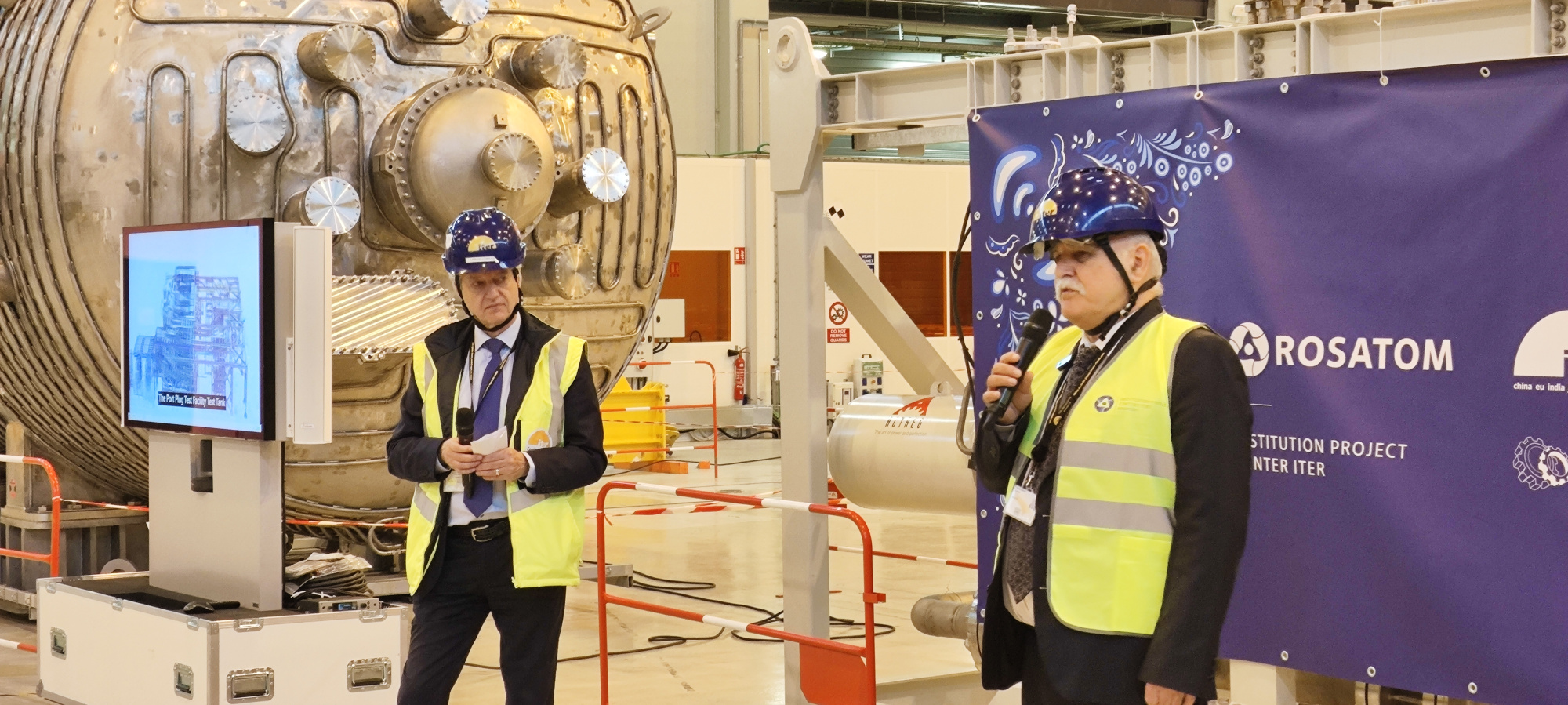
The first of four Russian test stands has arrived at the construction site of the International Thermonuclear Experimental Reactor (ITER) in southern France. The stand is intended for vacuum, thermal and functional testing of port plugs, which are key diagnostic elements of the future installation. The delivery was coordinated by the ITER Project Center, a private institution of Rosatom State Corporation. A ceremony was held at the ITER Organization on the 17th November to mark the arrival of the equipment. The next stage is testing, during which conditions close to operational will be reproduced inside the stands.
“This test stand is one of the most complex and science-intensive systems in the scope of our responsibilities for the project. To design and manufacture it, our key suppliers had to develop and implement advanced innovative solutions. Russia has been tasked with producing all four stands, and this reflects our experience and technological leadership,” said Anatoly Krasilnikov, Director of the ITER Project Center.
Sergio Orlandi, Head of the ITER Construction
Project, praised Russia’s contribution.
“As the head of the construction, I am very glad that the first port-plug test stand has been delivered from Russia. The system shows the strong industrial potential of the Russian Federation. The work was completed on time, with the required quality and within budget. I thank the Russian specialists who supervised every stage of design, procurement and assembly. I also thank Rosatom for supporting the creation of such a critical system. On behalf of the entire ITER Organization team, and particularly the diagnostics programme, I express our sincere satisfaction with our productive cooperation with the ITER Project Center and Rosatom,” he said.
The test stands are manufactured in Bryansk by
GKMP Research and Production Association, a domestic producer of high-tech
equipment for fusion, cryogenic complexes and thermovacuum testing. Production
involves modern and often unique Russian technologies, and the stands undergo
complex on-site testing. Under the Supply Agreement signed in 2011 between the
Russian Federation and the ITER Organization, the Russian company is to
manufacture and deliver all four test stands.
ITER is the first international next-generation
thermonuclear experimental reactor, currently under construction near
Marseille, France. The project’s purpose is to demonstrate the scientific and
technological feasibility of using fusion energy for peaceful purposes and to
develop the related processes. The practical deployment of fusion will open the
way to new energy horizons. Environmentally clean and safe, controlled fusion
could provide humanity with energy for millennia.
The initiative to unite international efforts to
create an experimental fusion reactor belonged to Academician Evgeny Velikhov.
The future installation is based on the tokamak system, a toroidal chamber with
magnetic coils, developed in the 1950s by Soviet scientists Andrei Sakharov and
Igor Tamm; the word “tokamak” has since entered many languages.
Russia is among the active participants in the
ITER project, alongside China, India, Japan, Korea, the United States and other
countries. Russian institutes and enterprises are tasked with producing and
supplying 25 high-tech systems for the future installation. The ITER Project
Center serves as Russia’s Domestic Agency responsible for the country’s in-kind
contributions.
Russian nuclear enterprises have previously
delivered superconductors, a poloidal field coil, and four gyrotron complexes
to the ITER site; production of other components continues. Deliveries of
Russia’s unique equipment are made on time, fully in line with the reactor
construction schedule.
Russia’s contribution to ITER has already given an additional boost to several areas of domestic science and engineering: research and production teams have been formed, unique equipment has been developed, and technological growth points have emerged. Such projects enhance the overall competitiveness of the Russian economy. Rosatom enterprises are actively involved in this work.