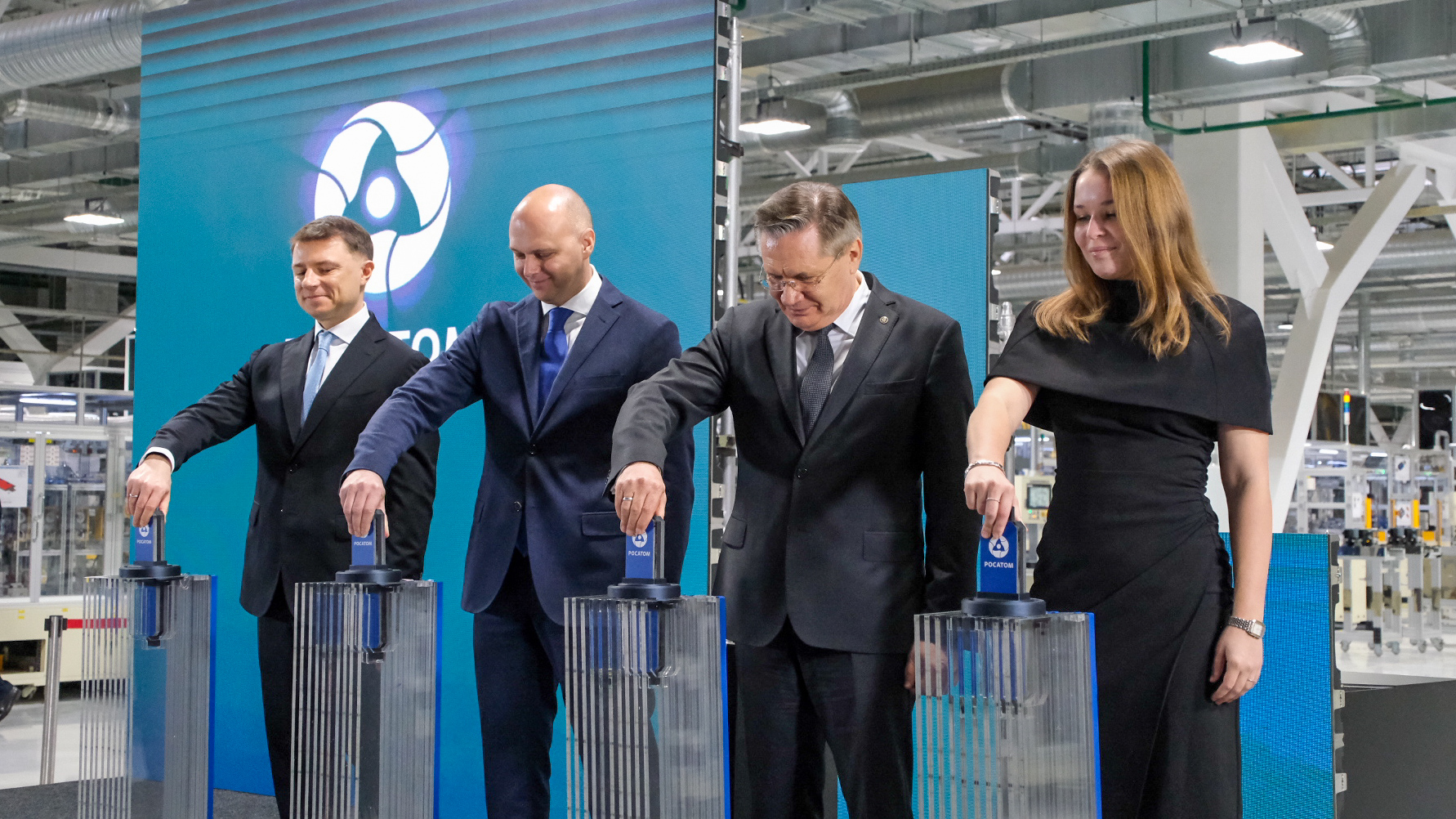
Rosatom's
Fuel division, managed by TVEL, has started pilot production of energy storage systems
at the first Russian “gigafactory” built in the Neman district of Kaliningrad
Region.
The
facility has a production capacity of four gigawatt-hours per year, which is
the total capacity of the manufactured devices. This is the only large-scale
manufacturing facility in the country for the production of lithium-ion
batteries. The facility covers the entire production process, from the initial
chemistry for cells to finished modules and complete batteries.
The energy
storage systems represent a most promising sector of the new technological
landscape. Lithium-ion batteries are already widely used in various types of
electric vehicles, ranging from cars, and trucks to buses and boats. They are
also used in special-purpose equipment such as forklifts and warehouse and
logistic vehicles, mining equipment, logistic robots, etc. Energy storage
systems have recently been used more widely in the power industry. Operating DC
voltage systems provide uninterrupted power for critical production facilities,
while energy storage systems help smooth out fluctuations in load demand and
reduce electricity costs.
The Russian energy storage market is expected to grow to between 20 and 30 gigawatt-hours (GWh) by 2030. The Kaliningrad gigafactory has a capacity of 4 gigawatt hours, which is equal to the production of around 1.5 million charging modules or 50,000 traction batteries for electric vehicles.
“The launch of the Kaliningrad "gigafactory" is Russia’s industrial breakthrough and a major contribution to the national technological independence. Energy storage is a crosscutting technology in Rosatom's range of new non-nuclear businesses, allowing the creation of entire production chains and product ecosystems. This includes a lithium production chain from raw material extraction to used battery recycling, as well as industrial cooperation in the emerging Electromobility business. Despite the fact that the "gigafactory" is a unique project for the country, it was built and commissioned on time thanks in part to the effective support of the government of Kaliningrad Region, the Russian Ministry of Industry and Trade, and other development institutions”, noted Alexey Likhachev, Director General of Rosatom.
“This is undoubtedly the major project in Kaliningrad Region in the last decade and ranks among the largest in recent history of the region. Now, during the pilot phase, 334 specialists are working at the facility. When the factory reaches its designed production capacity, the number of employees will be three and a half times greater. The new facility is becoming a key player in the electric mobility program that is being developed here thanks to the decision of the Russian President. Kaliningrad Region is striving to be the leader in this area, and Rosatom provides an excellent opportunity for it to lead in this high-tech industry. The today's event is undoubtedly significant for the Neman district and other eastern municipalities, which are becoming industrial zones”, said the Governor of the Kaliningrad Region Alexey Besprozvannyh.
“In 2023, the Russian government and Rosatom signed an agreement to develop the Energy Storage System high-tech business. We can see that two years after that, the plans are being realized through full-scale production. This project is unique because it takes advantage of a range of government support measures. Energy storage systems represent a new rapidly growing industry. Over the past four years, the market for these systems has grown by a factor of five in Russia. We hope that the commissioning of this facility and its reaching full production capacity will make it possible for domestic products to meet most of the needs of the Russian market”, said Deputy Minister of Industry and Trade Mikhail Ivanov.
The
Kaliningrad "gigafactory" is a large-scale high-tech manufacturing
facility that houses more than three thousand pieces of equipment weighing a total
of 25,000 tons. The factory has a total production line length of 2.5 kilometers
and a footprint of more than 23 hectare. There are over 20 factory buildings
and structures on the site. Approximately 90% of all processes are automated
and this high level of automation allows for a production rate of one cell per
second.
The new
facility was established with active support from the federal and regional
governments. The project made use of a variety of incentives and financial
tools, including the status of a resident in a special economic zone, direct
subsidy from the regional budget, special investment agreement with the Russian
Ministry of Industry and Trade and the government of Kaliningrad Region,
preferential loan from the development institution, and syndicated loan through
the Project Finance Factory program.
The construction of the “gigafactory” has already boosted economic growth in the region. Procurements from local suppliers have totaled over 4 billion rubles, which includes reinforced concrete products, metal structures, concrete, specialized equipment rentals, and other goods.
In
September 2021, Rosatom Fuel division and the government of Kaliningrad Region
signed an agreement to build a gigafactory for energy storage devices. The
construction began in October 2022 and was completed on schedule despite
international trade and economic pressures, as well as logistical challenges associated
with implementing the project in Kaliningrad Region. Since the start of the
construction, Rosatom Fuel division has been actively supporting social
development in the region. Since 2022, the company has provided 180 million
rubles funding for social programs in Neman and Sovetsk. In collaboration with
the government of Kalinigrad Region, a project has been launched in Neman to build
five residential buildings with 150 apartments for employees of the gigafactory.
Two of these buildings have already been commissioned.
In
September 2023, the construction of the second “gigafactory” commenced in
Krasnaya Pakhra of New Moscow. This similar facility will have an annual
capacity of 4 GWh and is expected to be commissioned in 2026.
Rosatom Fuel division managed by TVEL includes nuclear fuel factories, uranium conversion and enrichment companies, gas centrifuge manufacturers, and research and design facilities. TVEL, the sole supplier of nuclear fuel for Russian NPPs, provides fuel for over 70 reactors in 15 countries, research reactors in nine countries, and propulsion reactors for Russia's nuclear fleet. One-sixth of the world's power reactors run on TVEL fuel. The Fuel division is the world's largest producer of enriched uranium and a global leader on the stable isotope market. It actively develops new businesses in areas such as chemistry, metallurgy, energy storage, 3D printing, and digital products, as well as decommissioning of nuclear facilities. The division includes Rosatom’s industry integrators in the fields of additive manufacturing and energy storage systems. https://www.tvel.ru