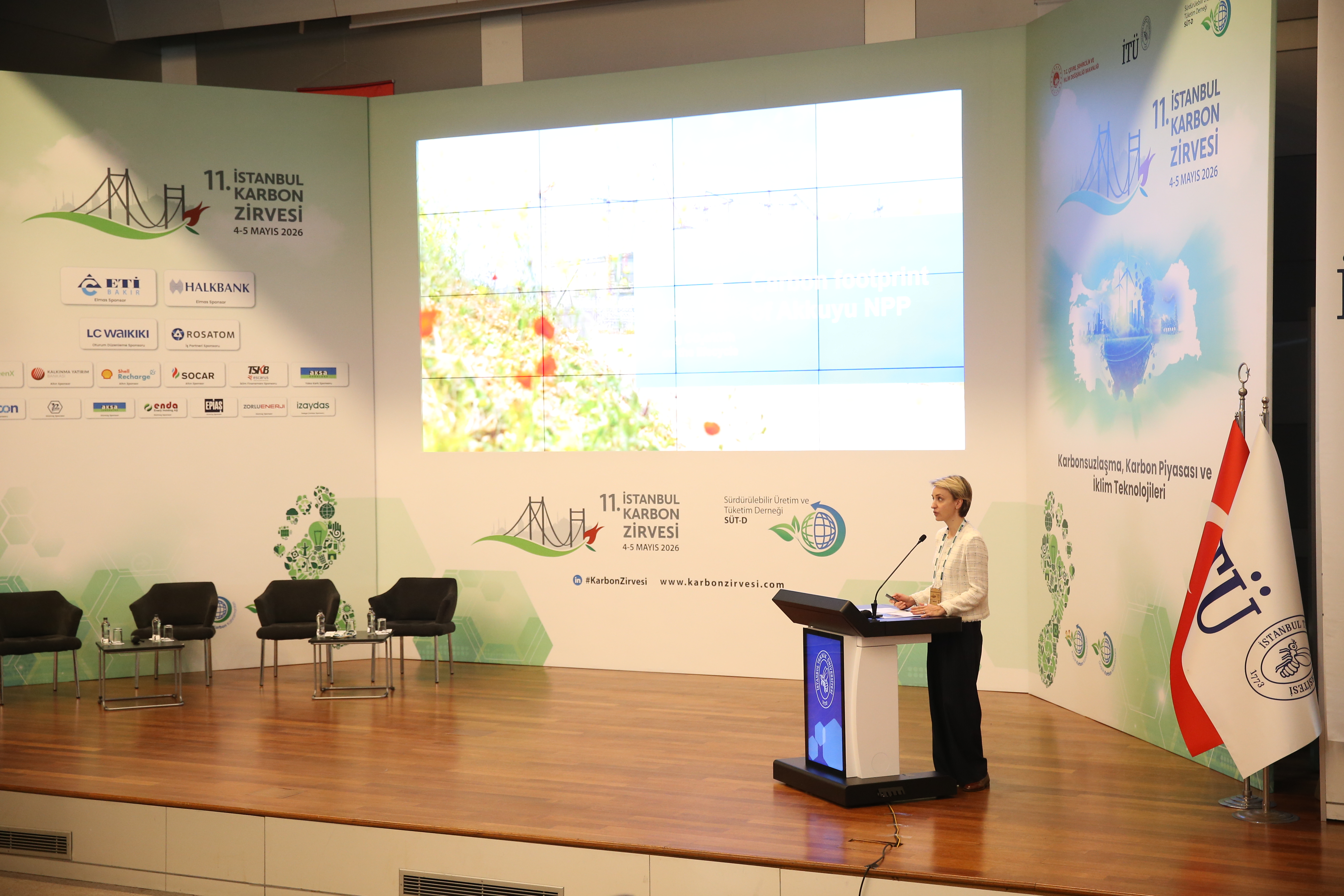
Rosatom took part in the 11th Istanbul Carbon Summit, held on May 4–5,
2026, at Istanbul Technical University. This annual event brings together representatives
of Türkiye’s key government institutions, non-profit and banking organizations,
as well as representatives of the green energy sector and leading Turkish
experts. Rosatom acted as a partner of the event and participated in the
summit’s business program, which focused on carbon regulation, climate finance,
industrial decarbonization, and the role of energy in achieving the country’s
climate goals.
Rosatom’s participation in the summit continued its systematic efforts to integrate nuclear energy into the professional discourse on Türkiye’s low-carbon development. In 2025, the country adopted its first climate law, which establishes the legal framework for reducing greenhouse gas emissions, developing a national carbon market, climate finance, and green taxonomy. Against this backdrop, discussion of the role of nuclear energy is gaining particular importance as part of a practical dialogue on technologies designed to ensure reliable, scalable, and low-carbon energy supply.
As part of the event’s business program, Polina Lion, Rosatom’s Chief Sustainability Officer, spoke about the role of nuclear energy in the new architecture of climate regulation. The speaker noted that the international climate agenda is already having a direct impact on the economy: mechanisms of cross-border climate regulation and green finance systems are being developed. In this context, nuclear energy can become not only a source of reliable low-carbon electricity, but also a practical tool for achieving decarbonization goals both for individual industrial companies and for the country’s economy as a whole. According to Rosatom’s calculations, the carbon footprint of the Akkuyu NPP project throughout its entire life cycle is less than 4 g CO₂-eq/kWh, meeting the demand for low-carbon energy sources. This is one of the lowest indicators among modern sources of electricity, confirming the importance of nuclear generation for achieving Türkiye’s climate goals and forming a clean national energy mix.
“As the climate agenda moves from general discussion to the creation of practical instruments for its implementation, it is important to take into account all technologies capable of delivering real reductions in greenhouse gas emissions while also supporting the reliability of energy supply. Nuclear energy meets these objectives: it provides stable generation of low-carbon electricity, operates independently of weather conditions, and can become an important part of Türkiye’s path toward carbon neutrality by 2053. It is important to note that, thanks to their scale, contribution to infrastructure and industrial development, and employment opportunities for local communities, nuclear power plants create a green ecosystem that not only ensures climate efficiency, but also creates the conditions for a comfortable life for generations to come,” emphasized Polina Lion.
The sustainable development agenda is an integral part of Rosatom’s
strategy. In
Russia, major companies pay significant attention to implementing projects in
the field of sustainable development. Rosatom, which generates electricity through
low-carbon power generation, is consistently taking steps toward the transition
to a green economy. Rosatom provides around 20 % of the total electricity
generated in the country. The average carbon footprint of Russian NPPs with VVER
reactors is 5.5 g CO₂-eq/kWh, which is significantly below the 100 g CO₂-eq/kWh
threshold for confirming the low-carbon status of an electricity source, and
also lower than the carbon footprint of wind and solar power.
Rosatom ranks first in the world in terms of the size of its portfolio of orders for NPP construction: 41 power units are at various stages of implementation in 11 countries.
Akkuyu NPP is the first nuclear power plant in the Republic of Türkiye and is being constructed by Rosatom State Corporation. The Akkuyu NPP project includes four power units with Russian-designed Generation III+ VVER reactors. Each power unit of the NPP will have a capacity of 1,200 MW. The construction of Akkuyu NPP is the first project in the global nuclear industry to be implemented under the Build-Own-Operate organizational and economic model.