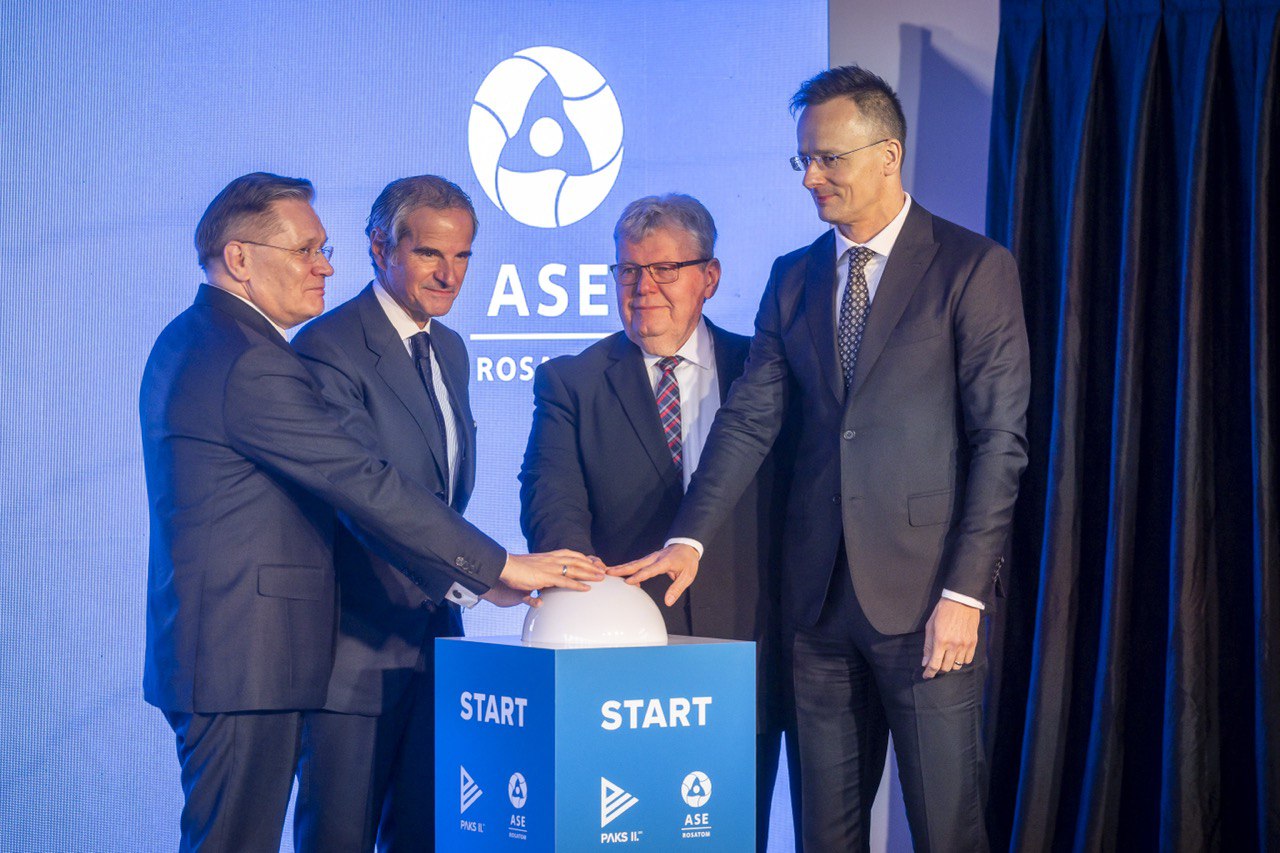
On 5 February 2026, the first concrete ceremony took place at the construction site of the Paks NPP in Hungary. The ceremony was dedicated to the pouring of the “first concrete” for the reactor building of Unit 5 to be built according to the most recent Russian design of an NPP with a VVER-1200 unit (Rosatom’s Engineering division acting as the general designer and contractor for the project). Rafael Grossi, Director General of the International Atomic Energy Agency (IAEA), Péter Szijjártó, Minister of Foreign Affairs and Trade of Hungary, and Alexey Likhachev, Director General of the State Corporation Rosatom, were present at the ceremony. The Paks NPP will be the first NPP in the European Union to be equipped with a Russian-designed Gen III+ reactor of VVER-12 type.
The “first concrete” pouring for the reactor building's foundation marks the transition of the facility into a status of under construction in accordance with the IAEA standards. This milestone is crucial for the nuclear energy development in Hungary and confirms a steadily progressing collaboration between Hungary and Russia that started in the field of peaceful atom in 1956.
Alexey Likhachev, Director General of Rosatom, emphasized in his address to the guests of the ceremony: “This milestone event demonstrates the constructive and mutually beneficial relationship between our two countries. The Paks II NPP represents a logical development of our long-term cooperation in the field of nuclear energy. The Paks II NPP is undoubtedly a strategic move for Hungary that brings a number of substantial benefits to the country and drives its economic growth. As for Rosatom, the project is another confirmation of its leadership position in the nuclear industry and a contribution to the growth of Russian industry."
“Without nuclear energy, it is impossible to stay ahead. The country that is first to succeed in constructing nuclear power plants will be the most competitive. Hungary is one of those countries as the Paks II nuclear power plant is the largest and most modern project in Europe, the flagship of the nuclear revival. This plant will guarantee a long-term energy security. Thanks to Paks II, Hungary will be able to independently cover up to 70 % of its electricity consumption, significantly reducing dependence on international market volatility," — said Peter Szijjártó.
On 4 November 2025, the Hungarian Atomic Energy Authority (HAEH) issued permits for the first concrete pouring for the foundation of Unit 5 at the Paks NPP and for the construction of the nuclear island. The licenses, issued in addition to the main construction license obtained in 2022, confirm that the project meets the highest international, European, and national nuclear safety standards. A comprehensive safety approach, which involves both active and passive systems, ensures full compliance with all applicable standards.
Concrete
Pouring Technology
The quality
of the concrete as well as the quality of the construction works is crucial for the
robustness and longevity of the building. It determines the
integrity of its structural elements
and reliability of its systems and equipment. The concrete work
will continue until the end of this year. It will require approximately 9,000
tons of reinforcement items and 43,000 cubic meters of concrete to create the
foundation slab for Unit 5 at the Paks II NPP. The construction activities will be supervised at
each stage to guarantee the best possible quality of the structures.
Once the foundation laying is finished, the construction inner and outer containment of the reactor building will commence along with the installation of floors and equipment. The core catcher, a component of the passive safety system, will be installed first in its designed place.
The new power units at the Paks NPP in Hungary will be built based on the Hungarian-Russian intergovernmental agreement signed on 14 January 2014, and three basic contracts for the construction of a new plant. In August 2022, the Hungarian regulator issued the main license for the construction of VVER-1200 units at the Hungarian NPP, which became the basis for the pre-construction activities including the temporary excavation for unit 5 to be built at the Paks NPP. This is a truly international project with a potential local content of 40%. In addition to Hungary and Russia, the project is being implemented with the involvement of several major international companies from Europe, Asia, and America. The VVER-1200 technology meets the strictest international safety standards and has been successfully used in existing and under-construction plants in Russia, Belarus, Turkey, Bangladesh, Egypt, and other countries. These reactors have a service life of 60 years with a possible extension of 20 years.
AEM-Spetsstal plant in St. Petersburg started manufacturing nuclear reactors in April 2024. Metallurgists have already cast all the necessary blanks for power units 5 and 6, totalling 36 pieces weighing 3,440 tonnes. These blanks will be assembled into reactor vessels. The equipment is being manufactured at the facilities of Rosatom's machine-building divisions in St. Petersburg, Petrozavodsk, and Volgodonsk (Rostov Oblast). The first major piece of equipment, a core catcher weighing 730 tonnes, was already manufactured in Russia and delivered to the construction site. Russia continues to develop its international trade and economic relations with foreign partners by implementing major energy projects. Rosatom is actively involved in these efforts.