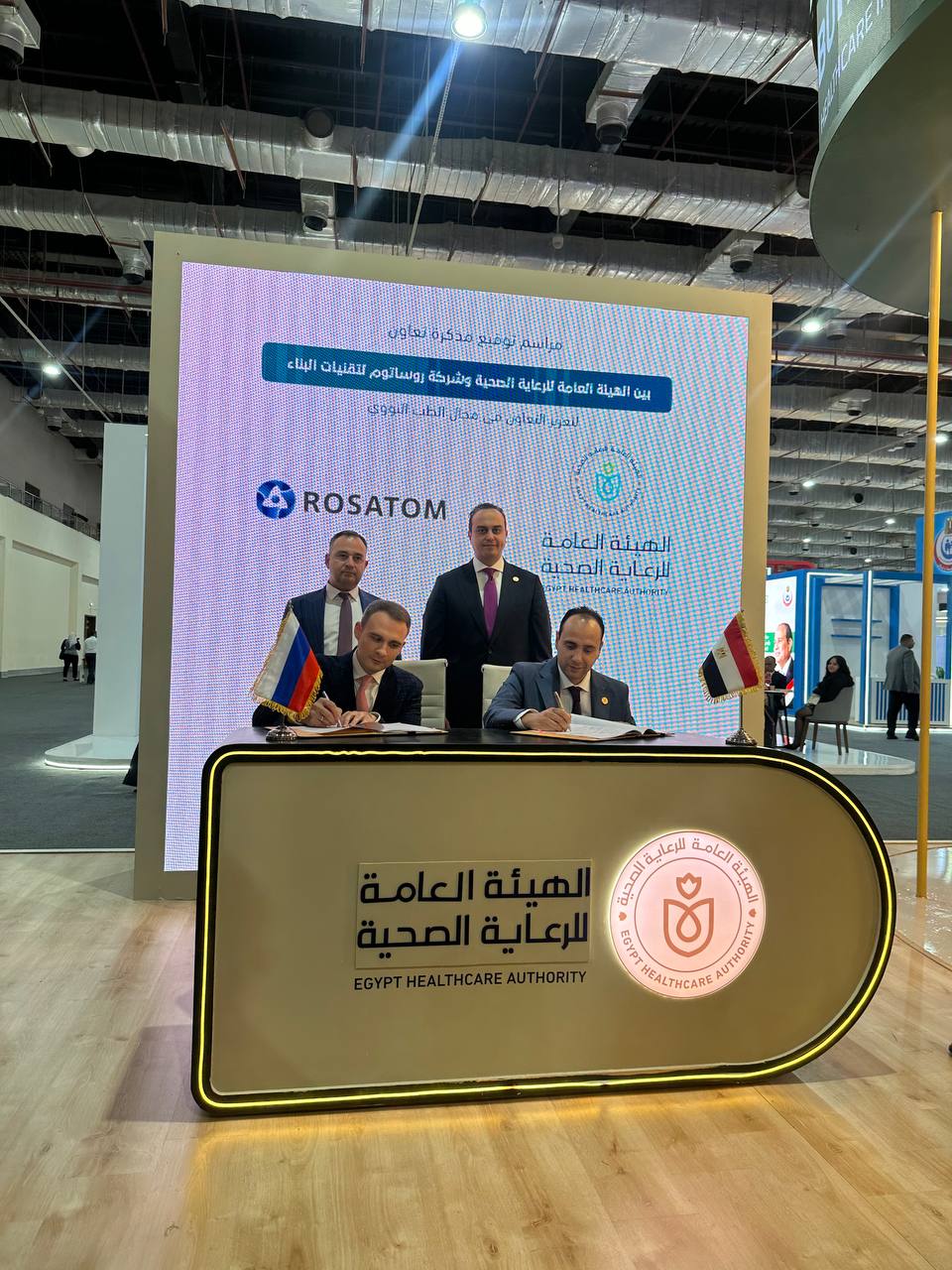
On June 17, LLC Rosatom Construction Technologies
(RTS LLC, an enterprise of Rosatom State Corporation) and the Egypt Healthcare
Authority entered into a cooperation agreement. The document was signed by
David Makharashvili, Deputy Director General for Economics, Finance, and
Investment at RTS LLC, and Dr. Amir El-Telwany, CEO of the Egypt Healthcare
Authority.
The agreement solidifies the mutual intent to collaborate on a project to construct a Nuclear Medicine Center in Egypt.
A key priority for Rosatom State Corporation is to expand the accessibility of life-saving medical technologies, equipment, and medicines for patients both within and outside Russia.
The baseline configuration of the modern Nuclear Medicine Center will feature a radiopharmaceutical production site equipped with its own cyclotron complex. It will also include a molecular imaging department with PET/CT and SPECT/CT scanners capable of performing up to 30,000 diagnostic scans per year, as well as a radionuclide therapy department designed to treat up to 400 patients annually. The construction of this medical infrastructure facility will improve access to high-tech healthcare in Egypt and position that country as an attractive hub for medical tourism.
The agreement was signed on the sidelines of the 5th Pan-African Medical and Pharmaceutical Conference in Cairo.
"The signing of this agreement with the Arab Republic of Egypt marks a vital milestone in expanding international healthcare cooperation," said Ilya Vergizaev, CEO of Rosatom Construction Technologies. "Establishing a modern medical facility will not only introduce cutting-edge nuclear medicine technologies but will also provide a powerful catalyst for the advancement of this field nationwide. We are confident that this project will make a meaningful contribution to improving the quality of healthcare services and strengthening public health. Rosatom Construction Technologies is fully committed to ensuring that the Nuclear Medicine Center in Egypt meets the highest international standards and serves as a primary engine of growth for the entire industry."
Rosatom State Corporation systematically drives the development of human
health technologies. Over eight decades, the company has accumulated
substantial expertise and practical experience, which today serve as the
foundation for modern nuclear medicine. One of Rosatom’s primary business
segments is the production of medical isotopes. The state corporation possesses
a robust scientific and technical framework alongside industrial-scale
manufacturing capacities to produce a diverse range of isotopes. These span
from traditional mainstays like Molybdenum-99, Technetium-99m, and Iodine-131,
to highly advanced, promising agents such as Radium-223, Actinium-225, and
Lutetium-177.
This extensive infrastructure enables Rosatom not only to fully meet the demands of the Russian healthcare sector but also to export its radionuclide products to more than 50 countries worldwide. In Russia, Rosatom supplies approximately 85% of the isotope market. Ranked among the top five global isotope producers, the state corporation boasts the widest portfolio of radionuclides in the industry. Demand for Rosatom's isotope products continues to grow steadily, with 2025 export volumes increasing by 5% compared to 2024. Globally, approximately 2.5 million diagnostic and therapeutic medical procedures are performed annually using radioisotopes supplied by Rosatom.
Today, the application of rare isotopes such as Lutetium-177 and
Actinium-225 is considered one of the most promising frontiers in nuclear
medicine.
In December 2024, JSC Isotope (Rosatom’s isotope business integrator, part of its scientific division) completed its first test delivery of the medical isotope Lutetium-177 trichloride to Egypt. Radiopharmaceuticals derived from Lutetium-177 are used in targeted radionuclide therapy for metastatic castration-resistant prostate cancer and neuroendocrine tumors. In January 2025, a contract was signed for the supply of Iodine-131. Medications utilizing Iodine-131 are widely employed to treat differentiated thyroid cancer and thyrotoxicosis, as well as for the management of neuroendocrine tumors.