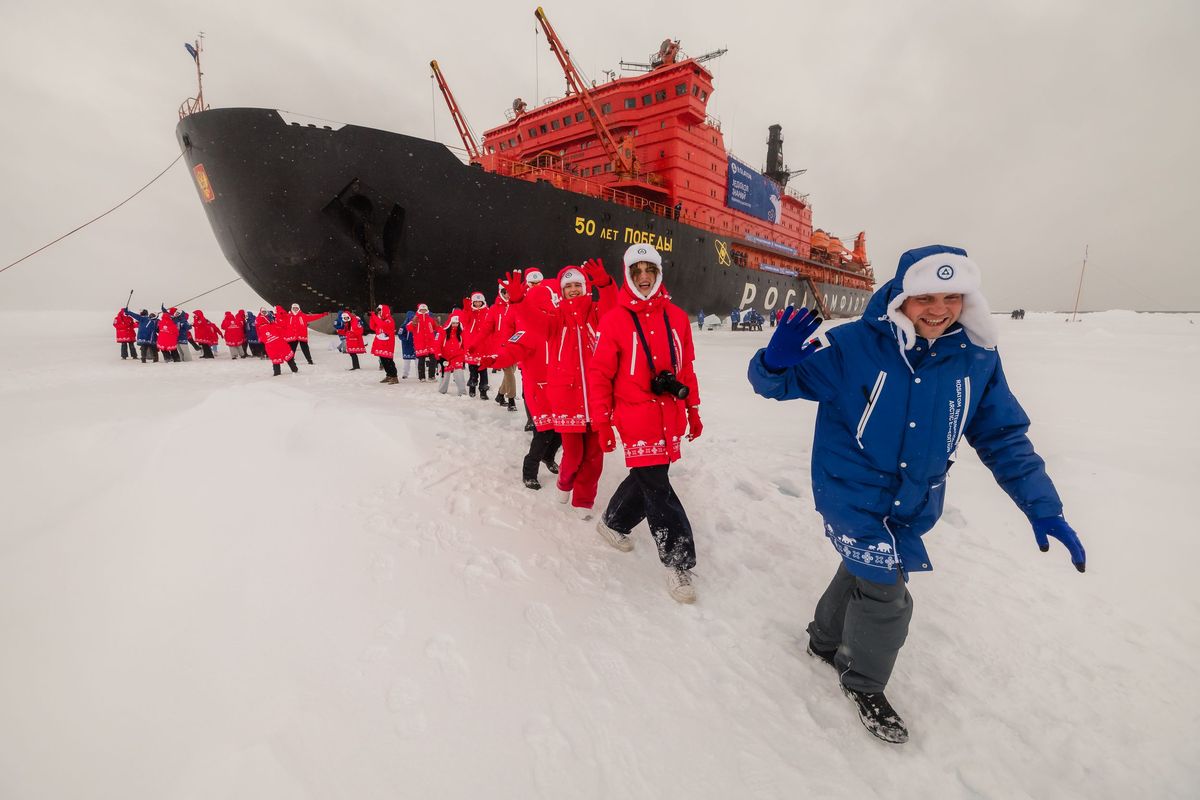
On August 13, the 7th international scientific
and educational expedition of Rosatom, Icebreaker of Knowledge, returned to
Murmansk. Over the course of ten days, 68 talented schoolchildren and college
students from all federal districts of Russia and 22 countries around the world
traveled aboard the nuclear icebreaker 50 Let Pobedy along the route Murmansk –
North Pole – Franz Josef Land – Murmansk. The voyage also made history as the
200th surface vessel expedition to the North Pole.
A rich scientific and educational program was organized on board for the participants of the Icebreaker of Knowledge expedition, including a real aerospace laboratory. As part of the expedition, participants, together with scientists, prepared and conducted two unique experiments: the launch of a radiosonde to support communications in remote Arctic areas and along Northern Sea Route shipping lanes, as well as a test of the world’s first returnable stratospheric platform for environmental monitoring. The platform was launched for the first time in the area of the Franz Josef Land archipelago, rose to an altitude of more than 15 km, traveled over 100 km, and successfully landed at a designated point on Hooker Island. After landing, the device was delivered back on board the nuclear icebreaker 50 Let Pobedy by the crew and inspectors of the Russian Arctic National Park.
“During Rosatom’s scientific and educational expedition Icebreaker of Knowledge, we managed to achieve the main goal — combining an educational program with a real scientific testing task. As a result of the experiment using the returnable stratospheric platform, meteorological data and video materials were obtained that will further help improve the efficiency of monitoring the Arctic and the Northern Sea Route. The uniqueness of the platform lies in the fact that it can be recovered, its flight path can be set, and it can be used repeatedly while preserving valuable payloads. Such experiments on a regular basis and with the necessary frequency are only possible with the participation of the Russian nuclear icebreaker fleet,” – said Anton Yurmanov, expert of the Icebreaker of Knowledge scientific and educational expedition, Vice-Rector for Research and Innovation at Murmansk Arctic University (MAU), and head of the high-latitude environmental monitoring system program using stratospheric platforms.
The expedition was dedicated to the Year of the Unity of the Peoples of Russia. To mark the occasion, a symbolic event took place at the North Pole — the northernmost and most international circle dance around the 90° point. It was held to a live performance by the music band AY YOLA from Bashkortostan.
“I became the first schoolgirl from Tanzania to reach the North Pole. It was simply an incredible feeling. I truly experienced the Arctic, saw endless ice and so much snow. Standing at the very top of the planet holding my country’s flag — that excitement is impossible to describe in words,” – said expedition participant from Tanzania Xylin Lerato Mapunda.
“At Rosatom, every day we work on things that only yesterday seemed like science fiction — from quantum technologies to biofabrication. That is why it is especially important for us to show these things to young people in person, and it is wonderful that this can be done right on board the nuclear icebreaker "50 Let Pobedy". During the expedition, the children saw that Russian science is about the future and about real technologies that change people’s lives for the better,” – noted Egor Plakhotnyuk, expert of the Icebreaker of Knowledge scientific and educational expedition, and project head at the Laboratory of Genomic Technologies and Tissue Engineering of the Research Institute of Technical Physics and Automation (NIITFA, part of Rosatom’s Science Division).
“We have successfully completed the seventh voyage of the Arctic expedition "Icebreaker of Knowledge". The crew always treats this project with special care: such voyages truly contribute to the development of the younger generation. The smartest and most talented young people take part in this expedition — and once again, we were convinced of that. Many of them dreamed of visiting the North Pole and seeing polar bears, and I am very glad that Rosatom and our crew helped make that dream come true,” — said Ruslan Sasov, Captain of the nuclear icebreaker 50 Let Pobedy.
The
Icebreaker of Knowledge scientific and educational project is organized with
the support of the Rosatom State Corporation. It aims to popularize natural
sciences and nuclear industry technologies, identify and support talented and
gifted children, develop their abilities, and provide career guidance. The
project involves schoolchildren and students in secondary vocational education
programs aged 14–16 from Russia, Europe, Asia, Latin America, and Africa. The
best of them will embark on a scientific and educational expedition to the
North Pole aboard the nuclear icebreaker 50 Let Pobedy.
Over
the seven seasons of the Icebreaker of Knowledge project, more than 470
talented schoolchildren from around the world have participated in Rosatom's
Arctic expeditions to the North Pole. The project provided them with a unique
opportunity to learn about an operating nuclear icebreaker and the cutting-edge
scientific and technological developments of the Russian nuclear industry.
The
world's first returnable stratospheric platform for Arctic monitoring was
developed by specialists from Murmansk Arctic University (MAU), the
Stratonavtika aerospace laboratory, RUVDS (communication systems), and the
Environmental Defenders Foundation, with the participation of Harbin Institute
of Technology (HIT) and the Rosatom State Corporation. The platform was first
launched near the Franz Josef Land archipelago during the Icebreaker of
Knowledge expedition.
The
nuclear icebreaker fleet is one of Russia's key competitive advantages: only
Russia has such vessels. Today, it consists of eight nuclear icebreakers: the
lead Project 22220 universal nuclear icebreaker Arktika; the serial universal
icebreakers of the same project, Sibir, Ural, and Yakutia; and the icebreakers
Yamal, 50 Let Pobedy, Taimyr, and Vaygach.
Major Russian companies continue to expand their range of solutions for unlocking the potential of schoolchildren and students. Rosatom and its enterprises are participating in the establishment of specialized departments at Russian universities, the implementation of scholarship support programs, and major educational projects.