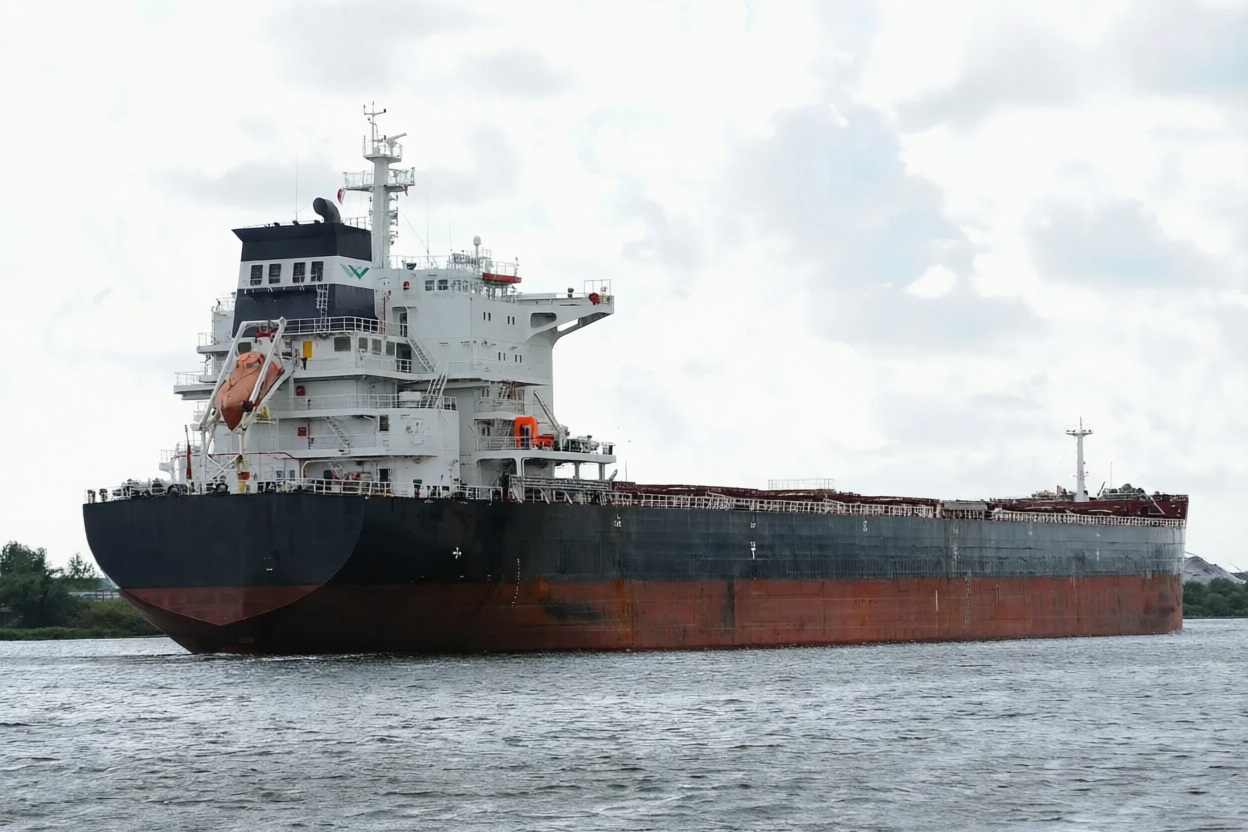
The first transit voyage carrying a shipment from Belarus to China is sailing from the Russian port of Ust‑Luga to Bayuquan Port in northeastern China. The vessel is slated to reach its final destination on October 13. It is transporting 77,000 tons of cargo.
According to Vladimir Arutyunyan, Head of Marine Operations, the vessel successfully completed the segment from the Boris Vilkitsky Strait to Cape Dezhnev and exited the boundaries of the Northern Sea Route (NSR), proceeding toward its destination port. The Arctic leg of the route was completed in nine days at an average speed of about 12 knots. “The bulk carrier has left the area managed by the vessel traffic control system, which is coordinated by the Federal State Budgetary Institution GlavSevmorput,” said Mr. Arutyunyan.
This first voyage carrying Belarusian cargo to China builds on a growing stream of international shipments that expand the use of the NSR for transit freight. In this case, a single logistics chain integrates a shipment from Belarus, Russian port infrastructure on the Baltic Sea, the Arctic maritime route, and the Chinese destination port.
The Northern Sea Route (NSR) is the shortest maritime corridor through the
Arctic Ocean, running along Russia’s northern coastline and connecting Europe
with the Asia‑Pacific region. It is one of Russia’s long‑established national
transport routes. The NSR extends for approximately 5,600 kilometers.
Currently, six major seaports in Russia’s Arctic zone lie along the NSR:
Sabetta, Dikson, Dudinka, Khatanga, Tiksi, and Pevek. Compared with traditional
southern routes, the Arctic cuts the distance from Asia to most European ports.
The Northern Sea Route offers significant potential for broad cooperation
across multiple areas—from expanding cargo flows and developing infrastructure
to scientific collaboration in environmental research and environmentally
sustainable Arctic shipping. Recent years have seen dynamic growth along the
route, with NSR cargo volumes exceeding 37 million tons for two consecutive
years. Interest in international transit along the NSR continues to grow:
during the 2025 summer–autumn navigation season, the route handled 400,000 tons
of containerized cargo, 2.3 times more than in 2024 (176,000 tons).
The 2025–2026 period has been marked by increased activity from foreign
shipping companies, with the number of container voyages along the NSR rising
from seven in 2022 to 23 in 2025. At
least 30 voyages are expected this year. For the first time, a regular service
with a pre‑announced schedule has been established along the route.
In 2018, the Government of the Russian
Federation granted Rosatom the authority of infrastructure operator of the
Northern Sea Route. The Corporation supervises the federal project
"Development of the Greater Northern Sea Route", and also participates
in implementing the plan for the development of the Northern Sea Route until
2035, approved by the Government of the Russian Federation.
The comprehensive development of Russia’s Arctic zone is one of the country’s strategic priorities. Increasing cargo volumes along the Northern Sea Route is essential for achieving national objectives in transport and freight delivery. This logistics corridor is being developed by establishing regular cargo services, building new nuclear‑powered icebreakers, and modernizing related infrastructure.