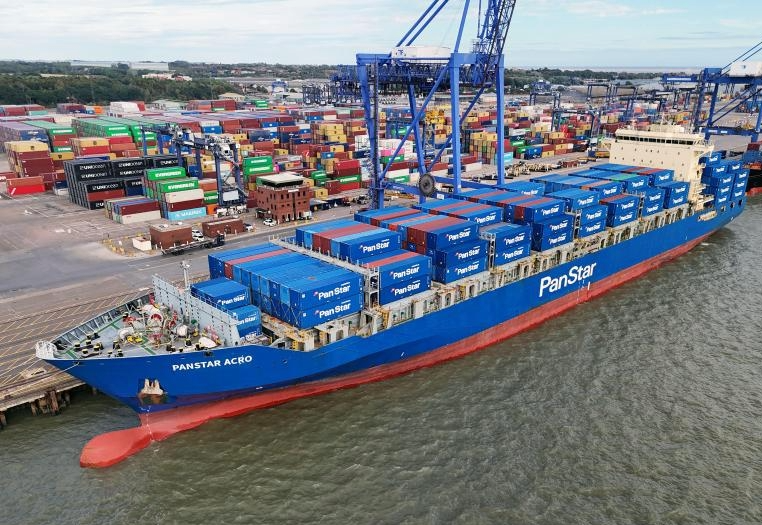
The South Korean container ship PanStar Acro has left the waters of the Northern Sea Route (NSR), which has been operated by the state corporation Rosatom since 2018, having completed the Arctic section as part of its return voyage from Europe to Busan. The vessel covered this section in 5.85 days. The return transit was faster than the westbound passage through the Arctic sector (6.4 days). Throughout the transit, specialists from GlavSevmorput (part of Rosatom) supported the voyage by providing navigational guidance, advice on hydrometeorological and ice conditions, and operational assistance to ensure safe passage. Timely information provided to the shipowner enabled route optimization and adherence to the planned schedule.
“PanStar Acro successfully completed the passage through the waters of the Northern Sea Route in a westerly direction in accordance with the calculated schedule. Entry into our area of responsibility was recorded on September 26, and less than 6 days later, on the evening of October 1, having demonstrated a good average speed of 17.1 knots, the container ship successfully passed Cape Dezhnev and headed towards its destination port,” noted Vladimir Arutyunyan, First Deputy General Director – Head of the Naval Operations Staff of the Federal State Budgetary Institution GlavSevmorput said.
The Northern Sea Route (NSR) is the shortest
maritime corridor through the Arctic Ocean, running along Russia’s northern
coastline and connecting Europe with the Asia‑Pacific region. It is one of Russia’s long‑established national transport routes. The NSR extends for approximately
5,600 kilometers. Currently, six major seaports in Russia’s Arctic zone lie along the NSR: Sabetta,
Dikson, Dudinka, Khatanga, Tiksi, and Pevek. Compared with traditional southern
routes, the Arctic cuts the distance from Asia to most European ports.
The Northern Sea Route offers significant potential for broad cooperation across multiple areas—from expanding cargo flows and developing infrastructure to scientific collaboration in environmental research and environmentally sustainable Arctic shipping. Recent years have seen dynamic growth along the route, with NSR cargo volumes exceeding 37 million tons for two consecutive years. Interest in international transit along the NSR continues to grow: during the 2025 summer–autumn navigation season, the route handled 400,000 tons of containerized cargo, 2.3 times more than in 2024 (176,000 tons).