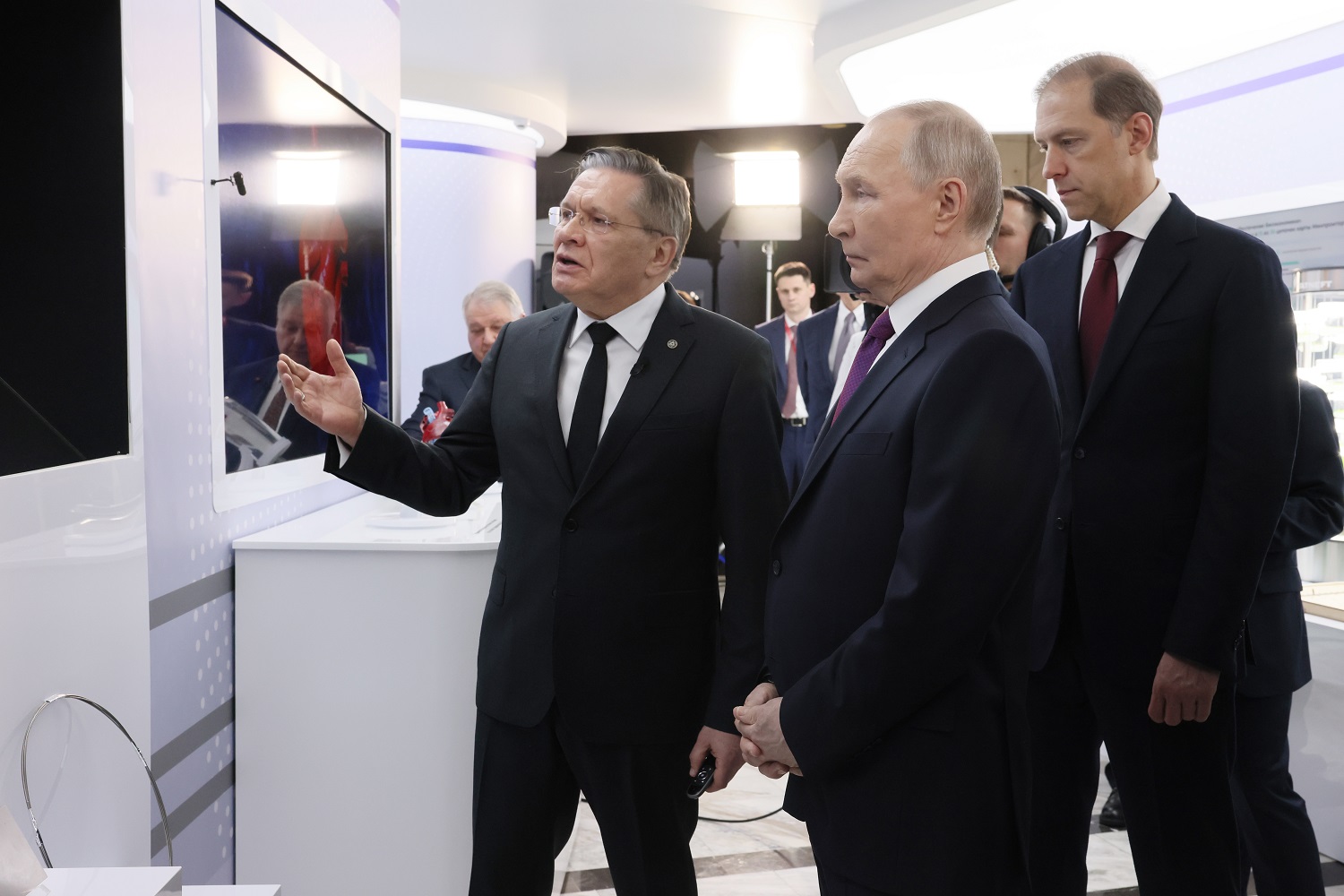
Alexey Likhachev, Rosatom Director General, showed the exhibits displayed at the booth of Rosatom to Russian President Vladimir Putin. In particular, the Russian leader was introduced to special genetic structures created in the laboratory. These structures make it possible to "reprogram" human stem cells into universal cells, which may be used for growing tissues suitable for any patient, as they do not cause immune rejection. This achievement opens up broad prospects in medicine and is considered one of the most advanced in the world. Other exhibits include a tissue-engineered heart valve (Rosatom’s specialists are developing a laboratory sample of the valve), and "nuclear batteries", miniature energy sources, which will bring the healthcare system to the next level.
“Today, Rosatom is conducting pioneering research and development for healthcare purposes, bringing the future closer with each step. Our scientists are truly remarkable as they are both visionaries and dreamers. Their ideas go beyond paper becoming groundbreaking technologies. Their work in additive biotechnology for medical purposes is an example of how scientific thought can become the foundation for technological advancement and benefit humanity,” said Alexey Likhachev.
"Genome editing technologies have already allowed us to 'program' cells, that is to impart necessary properties to them. The scale of this discovery is comparable to that of atomic developments by humanity. In the near future, we will create individual 'parts' for the human body, such as parts of hormone-producing glands or fragments of heart tissue. The technologies that improve quality of life form the basis of a new bioeconomy. We believe that through interdisciplinary synergy, we can establish a solid foundation for the future economy!" - said Vladislav Parfenov, Director of Scientific and Production Center for Medical Devices and Cellular Products (NIITFA JSC).
The tour of the exhibition included the presentation of a Molten Salt
Research Reactor (MSRR) mockup. The reactor is scheduled to be constructed at
the Mining and Chemical Combine (a company of the Environmental Solutions
division based in Zheleznogorsk, Krasnoyarsk Krai). The mockup demonstrates the
advantages of this technology, which allows for the near total
"burning" of minor actinides (the long-lived, most hazardous
radioactive waste that will also serve as reactor fuel) while at the same time
ensuring highly efficient electricity generation. Since the technological
challenge of the project is overcoming the extreme corrosiveness of molten
salt, Vladimir Putin was also shown the new materials planned to be included in
the design of the future reactor.
In addition, the president was introduced to
advanced technologies employed
by Rosatom to remediate accumulated
environmental harm at the Krasny Bor hazardous waste landfill in the Leningrad
Oblast. The interactive display demonstrated a high-tech
infrastructure designed specificallyfor the facility. This infrastructure
includes a 13-step liquid waste treatment system that allows for the return of purified water to
natural water bodies. The exposition
included two live silver carps, a species native
to the Tosna River where purified water is collected. The booth also
featured geopolymer reclamation materials produced
fr om recycled waste. These materials can be used to restore
natural landscapes.
Alexey Likhachev told Vladimir Putin about the development of the
"quantum project" (Rosatom has been tasked with overseeing it) and
presented the nuclear industry's practical experience in quantum computing. It
was noted that Russia has fundamentally strengthened its position in the global
quantum field compared to 2020, when systematic work in this area began under
the auspices of the Russian government. It was further said that Russia
possesses seven prototype quantum computers on four priority platforms, while
three of the processors have reached a capacity of 70 or more qubits.
The Forum will continue until 26 February.
According to medical studies,
cardiovascular disease is the most frequent
cause of death worldwide. A particular concern is associated with the frequency of heart valve problems, specifically
aortic valve disorders. This condition substantially
raises the risk of severe
complications and death. The tissue-engineered
heart valve is a biomedical cell product that consists of cells, biocompatible
materials, and auxiliary substances. This valve is expected to outperform existing mechanical and biological
analogues, which have a
number of limitations. It will also
pave the way for the development of fully functional biological
replacements and provide an effective solution for frequently occurring heart valve disorders.
Nuclear energy sources, also known as "nuclear batteries", are miniature radioisotope devices that generate an
electrical impulse triggering heart muscle contraction. The nuclear batteries
used in pacemakers ensure a virtually unlimited service life for these devices.
The solution will help eliminate the need for repeated replacement surgeries,
as these devices will be implanted for life.
Rosatom’s Scientific division is dedicated to innovative fundamental and applied research to develop
both nuclear and non-nuclear technologies including the closure of the nuclear
fuel cycle, thermonuclear fusion, and nuclear medicine. The division also works
on science-intensive technologies for both nuclear and other sectors. It
consists of 13 research institutes and commercial companies including LUCH
Research and Production Association (NII NPO LUCH JSC), State Scientific Research and
Design Institute of Rare Metals Industry (Giredmet JSC), V.G. Khlopin Radium
Institute, and others. They possess
a robust research infrastructure and in-house pilot production facilities, which allow them to implement a scientific idea from basic research to designs and prototypes. The majority of the division’s scientific
research and development efforts are
taken within the context of the general
industrial thematic plan. The scope of the division encompasses testing,
developing high-tech medical equipment and innovative construction materials. The division is also running projects aimed at
commercializing promising science-intensive technologies.
NIITFA JSC is a specialized
institute that conducts research in nuclear physics, nuclear medicine, and
other areas of Rosatom’s operations (a company of the Science and Innovations).
The Institute was founded in 1960 as the main developer and manufacturer of
radiation and medical X-ray equipment. The Institute's developments find their
way into the nuclear industry and nuclear power engineering, medicine, oil and
gas industry, geology and mining, agriculture, ecology, and other sectors.
The creation of a research
molten salt reactor is the next milestone
in the progress of technologies for closing the nuclear fuel cycle. Rosatom is running the project in partnership with the Kurchatov National
Research Center. The initial phase
including the design of the molten salt reactor was completed in 2025.
Molten salt reactors belong to the
fourth-generation nuclear energy technology. Their use may reduce the amount
and activity of nuclear waste as well as eliminate the need for expensive deep
burial sites. Molten salt reactor technology is considered a tool in solving
the minor actinides challenge in Russia. It is also part of services provided
to international partners interested in reprocessing spent nuclear fuel with
minimal release of highly radioactive waste.
Rosatom Ecology Unit plays a crucial role in ensuring the ecological safety in the nuclear industry, the ecological
wellbeing of people and sustainable
development of the country. Companies within the Unit are dedicated to managing
radioactive and hazardous waste (safe storage, reprocessing and disposal),
monitoring the environment,remediating
contaminated areas (including the removal of radioactive facilities) and
rehabilitating the ecosystem. In
addition, the Unit develops and implements the closed nuclear fuel cycle
technologies, which make it possible to turn nuclear fuel into a
renewable resource, as well as to minimize radioactive waste. As part of the "Environmental Wellbeing" national project the Unit is also creating a national system for managing industrial waste of classes I
and II. This includes the establishment
of processing facilities and the use of
digital tools for monitoring waste management.
The Russian "quantum project" involves active work on
the development of quantum software: 47 quantum algorithms have been created to
solve industrial problems. Rosatom has begun work on pilot applications of
quantum computing and launched a large-scale industry program (including over
30 pilot projects focused on optimizing a wide range of production processes,
as well as modeling chemical reactions). Among the tasks already solved, there
are optimization of production, processing, manufacturing, and supply chains;
production scheduling; optimization of NPP construction schedules; and others.
The Future Technologies Forum (FTF) is a platform for discussions about the
development of science-intensive technologies in Russia. The Forum was launched in 2023 and has since become a flagship event wh ere leading experts,
scientists, business representatives,
and government officials gather to discuss
the advanced scientific developments
and product solutions based on these developments. The Roscongress Foundation is the FTF
operator. Rosatom acts as a co-organizer.
This year's event has the
"Bioeconomics for Humanity" as its
main theme.
The field-specific agencies and major Russian companies have a strong focus on improving healthcare services and enhancing access to cutting-edge medicine. Major Russian companies support the comprehensive modernization of the healthcare system and the development of the related infrastructure. Rosatom and its subsidiaries are actively involved in these efforts.