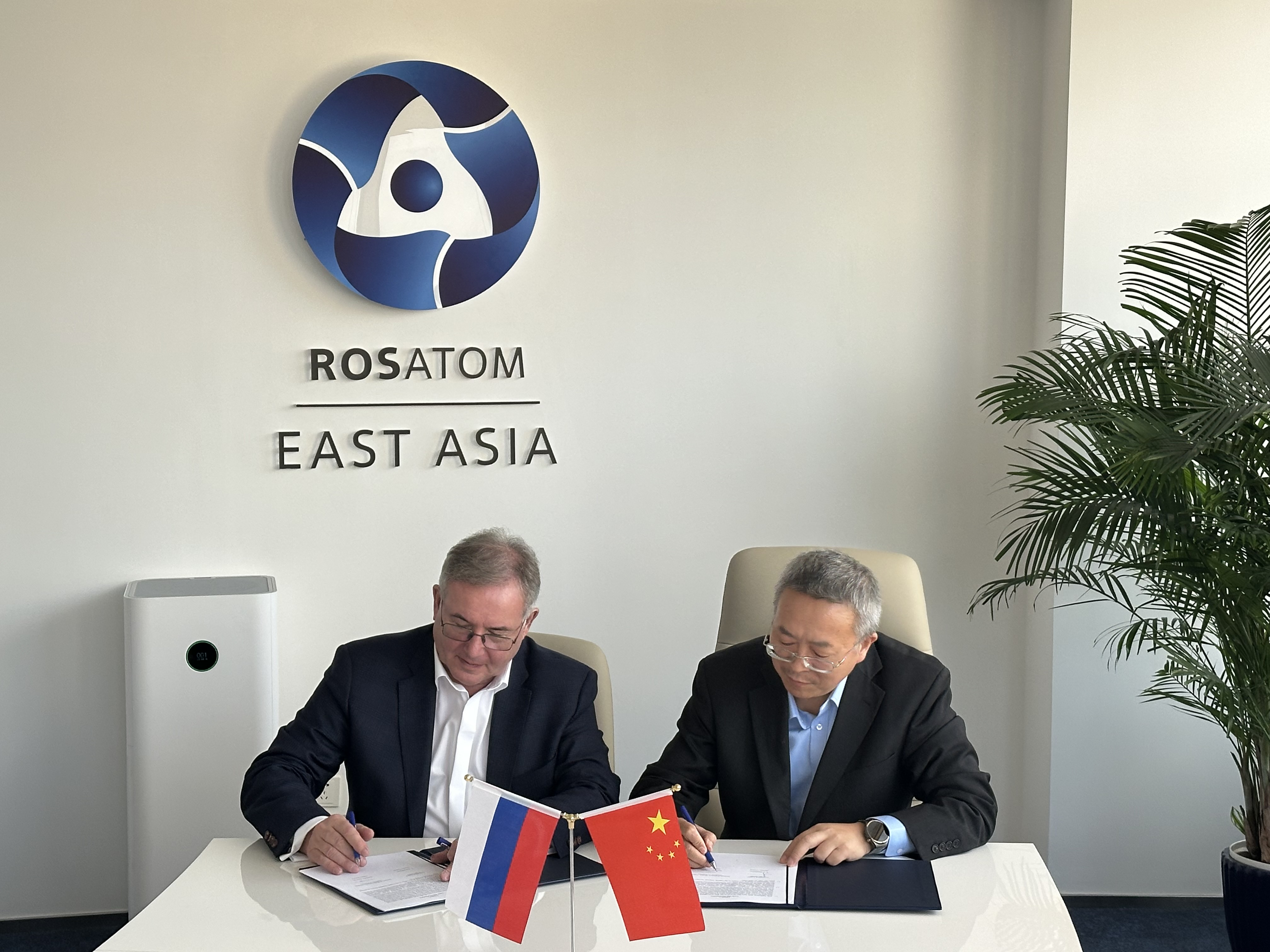
The Institute of Modern Physics of the Chinese Academy of Sciences (IMP
CAS) and Consortium Leader of MBIR Reactor International Research Centre, LLC
(Consortium Leader of IRC MBIR, LLC) have officially signed a cooperation
agreement, establishing a comprehensive framework for strategic collaboration.
The document establishes a framework for cooperation at the IRC MBIR platform and outlines the mutual intent of both parties to deliberate on the terms and conditions for the IMP participation in the Consortium.
The cooperation will cover several areas. Representatives from IMP CAS will participate in MBIR IRC scientific events, including meetings of the Advisory Board meetings and its dedicated committees. Within the framework of research projects, the parties will elaborate the terms and conditions for utilizing the capabilities of the MBIR reactor for ADS (Accelerator-Driven Systems) – this refers to research in materials science and neutron-based research. The agreement also provides for developing the terms for IMP CAS to join the IRC MBIR Consortium.
“The MBIR complements our accelerator facility infrastructure with neutron capabilities. The core areas outlined in the agreement – specifically ADS systems and neutron science – are highly dependent on exactly this type of experimentation,” emphasized Professor Yuan He, Deputy Director of the Institute of Modern Physics of the Chinese Academy of Sciences.
“I am confident that IMP’s expertise in heavy-ion physics research and accelerator technologies will significantly contribute to and enrich the formation of the MBIR Research Program,” noted Vasily Konstantinov, Director General of Consortium Leader of IRC MBIR, LCC.
The Institute of Modern
Physics of the Chinese Academy of Sciences (IMP CAS), is China's largest
scientific center in the field of heavy-ion physics and its applications.
Located in Lanzhou, it operates the Heavy Ion Research Facility in Lanzhou
(HIRFL) and participates in the construction of the future accelerator complex,
the High Intensity Heavy-ion Accelerator Facility (HIAF). The Institute is also
the lead organization for the China Initiative Accelerator Driven System
(CiADS) project—a demonstration accelerator-driven system (ADS) designed to
validate nuclear transmutation technologies. It conducts research in radiation
materials science, nuclear medicine, and related fields.
MBIR is a multipurpose
fast-neutron research reactor with sodium coolant and the thermal capacity of
approximately 150 MW. The reactor is under construction in Dimitrovgrad at the
site of the State Scientific Center - Research Institute for Atomic Reactors
(RIAR JSC, a part of the R&D division of Rosatom State Corporation) within
the framework of the national technological leadership project "New
Nuclear and Energy Technologies". Currently, work is underway on
installing the equipment of the reactor's primary circuit: in 2025, the cold
filter-traps of the emergency heat removal system loop were installed in their
design positions. As part of the primary circuit installation, adapters of hot
pipelines have been welded to the reactor vessel and the first pipeline blocks;
the installation of the main process equipment in the sodium storage building
has been completed; a fuel handling mechanism and steam-water washing sockets
for spent fuel assemblies (FA) have also been delivered. In 2026, two emergency
heat exchangers weighing 7.3 tons, 5 meters high, and 1.5 meters in diameter
have been installed in their design positions.
MBIR is intended for
performance of reactor tests, production of radioisotopes, production of
modified materials, as well as testing of new type equipment and systems. The
unique capabilities of the new reactor are expected to accelerate development
of solutions for the two-component nuclear power and the closed nuclear fuel
cycle, as well as design of safe Generation IV nuclear power systems.
The International Research Center (IRC) in the form of an international consortium is established on the basis of MBIR reactor. The Consortium participants gain ‘fast track’ access to carry out the experiments needed for national programs of nuclear energy peaceful applications. The Consortium format allows for flexible use of the reactor resource for the demands of the scientific community. IRC MBIR Consortium is open to new members. The Joint Institute for Nuclear Research, the Nuclear Physics Institute at the Academy of Science of the Republic of Uzbekistan and Shanghai ZDAN International, a Chinese company, have already joint the Consortium as the main participants.