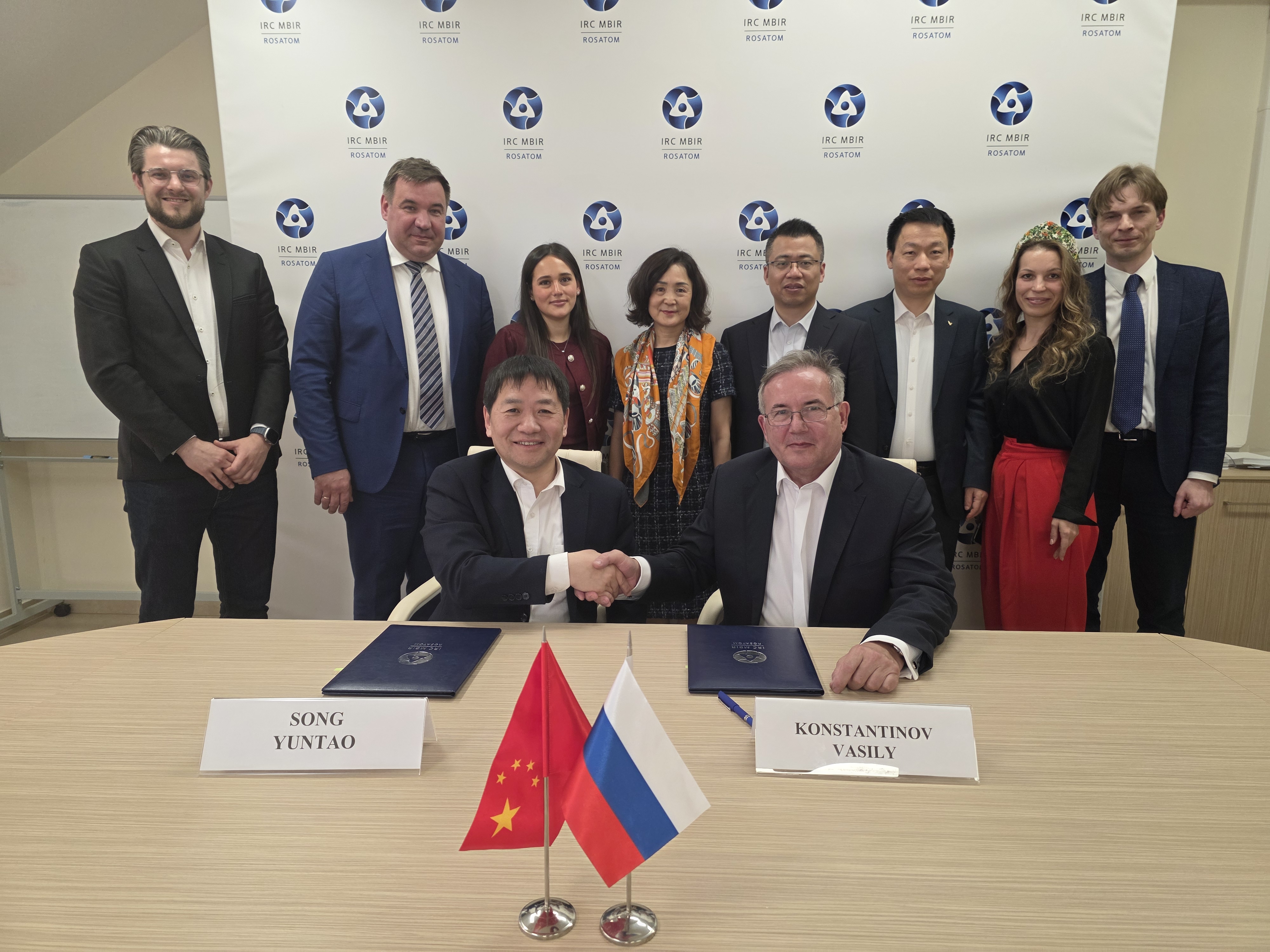
The agreement was signed under the Memorandum of
Understanding on scientific and technological cooperation between the Rosatom
State Corporation and the Chinese Academy of Sciences.
China's primary interest lies in materials science,
which is critical for building future fusion reactors. ASIPP is keen to test
materials capable of enduring the extreme thermal and neutron loads typical of
a burning plasma environment. The MBIR reactor's standout features—namely its
high fast-neutron flux density and a broad range of experimental
capabilities—allow scientists to rapidly simulate radiation damage equivalent
to years of operation inside fusion devices. This makes MBIR an indispensable tool
for testing engineering solutions for tomorrow's clean energy.
Song Yuntao, Director of the Institute of Plasma Physics of the Chinese Academy of Sciences, emphasized: "We are facing massive challenges in controlled thermonuclear fusion. Overcoming them directly depends on having access to an experimental base with the highest neutron-physical parameters. We see the MBIR mega-science facility as exactly that kind of resource. It can provide us with unique data to select and qualify reliable materials for future fusion reactors. We expect our cooperation within the International Research Center to expand, bringing significant results for both our bilateral relations and global progress in clean energy."
Vasily Konstantinov, CEO of IRC MBIR, LLC, noted: "This agreement marks a new milestone in our partnership with our Chinese colleagues. The MBIR reactor's capabilities make it highly sought-after for a wide range of tasks—from testing innovative materials to studies of closed nuclear fuel cycle technologies. The International Research Center built around MBIR is becoming a magnet for leading scientific organizations. We are thrilled that ASIPP views this as the right platform to realize its ambitious research plans."
About the Institute of Plasma Physics of the Chinese
Academy of Sciences (ASIPP)
Founded in 1978 and located
in Hefei, the Institute of Plasma Physics of the Chinese Academy of Sciences
(ASIPP) is China's leading research center for plasma physics and controlled
thermonuclear fusion. ASIPP operates EAST (Experimental Advanced Superconducting
Tokamak), the world’s first fully superconducting tokamak, which has achieved
record-breaking plasma confinement milestones. As a key contributor to the
global ITER project, ASIPP designs and supplies crucial components, including
power supply and diagnostic systems. The institute also drives an extensive
research program focused on materials science, neutronics, and future fusion
reactor technologies.
MBIR is a multipurpose fast-neutron research reactor
with sodium coolant and the thermal capacity of approximately 150 MW. The
reactor is under construction in Dimitrovgrad at the site of the State
Scientific Center - Research Institute for Atomic Reactors (RIAR JSC, a part of
the R&D division of Rosatom State Corporation) within the framework of the
national technological leadership project "New Nuclear and Energy
Technologies". MBIR is intended for performance of reactor tests,
production of radioisotopes, production of modified materials, as well as
testing of new type equipment and systems. The unique capabilities of the new
reactor are expected to accelerate development of solutions for the
two-component nuclear power and the closed nuclear fuel cycle, as well as
design of safe Generation IV nuclear power systems.
Currently, work is underway
on installing the equipment of the reactor's primary circuit: in 2025, the cold
filter-traps of the emergency heat removal system loop were installed in their
design positions. As part of the primary circuit installation, adapters of hot
pipelines have been welded to the reactor vessel and the first pipeline blocks;
the installation of the main process equipment in the sodium storage building
has been completed; a fuel handling mechanism and steam-water washing sockets
for spent fuel assemblies (FA) have also been delivered. In 2026, two emergency
heat exchangers weighing 7.3 tons, 5 meters high, and 1.5 meters in diameter
have been installed in their design positions.
The International Research Center (IRC) in the form of an
international consortium is established on the basis of MBIR reactor. The
Consortium participants gain ‘fast track’ access to carry out the experiments
needed for national programs of nuclear energy peaceful applications. The
Consortium format allows for flexible use of the reactor resource for the
demands of the scientific community. IRC MBIR Consortium is open to new
members. The Joint Institute for Nuclear Research, the Nuclear Physics
Institute at the Academy of Science of the Republic of Uzbekistan and Shanghai
ZDAN International, a Chinese company, have already joint the Consortium as the
main participants.