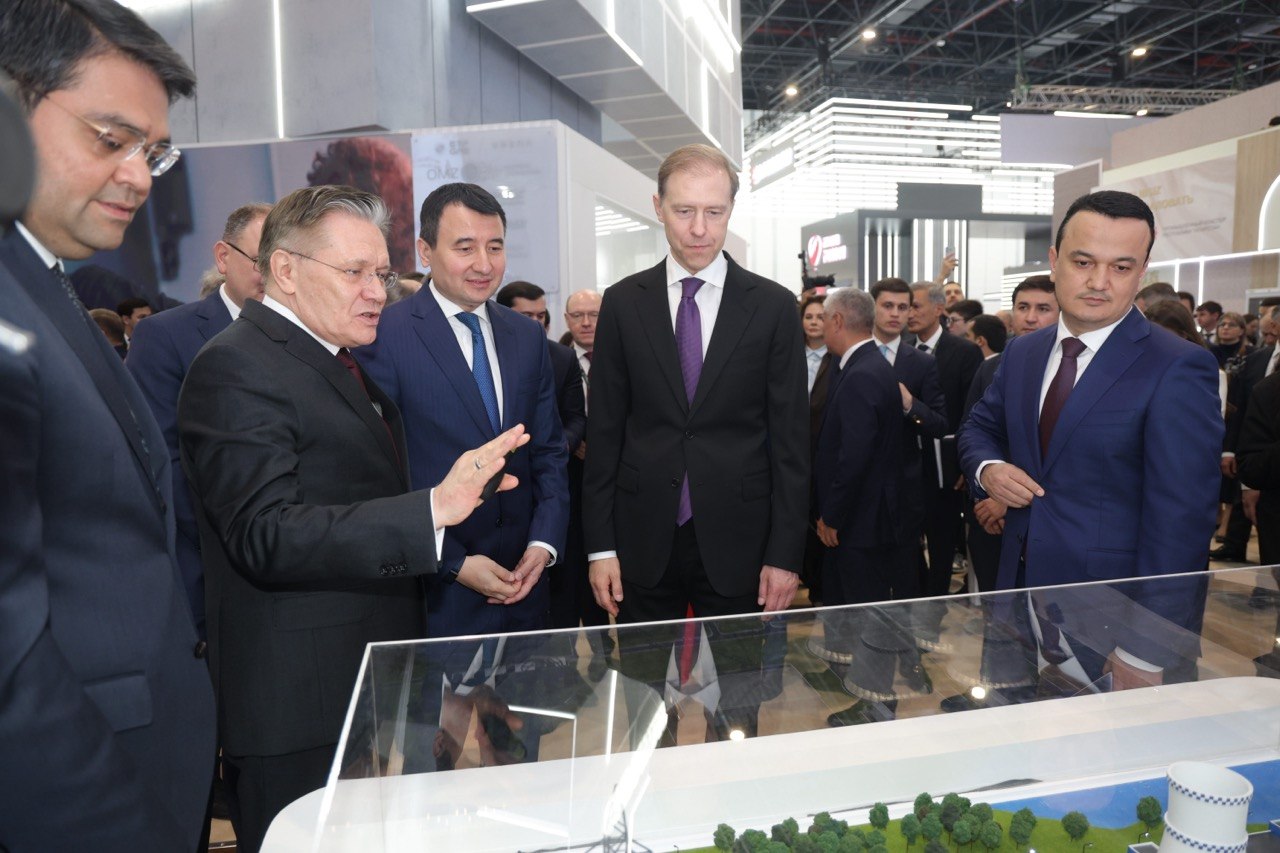
On 20 April 2026, Deputy Prime Minister of the
Republic of Uzbekistan Jamshid Khodjaev, Deputy Prime Minister of the Republic
of Belarus Viktor Karankevich and First Deputy Prime Minister of the Russian
Federation Denis Manturov visited the booth of
Rosatom at the 6th International Industrial Exhibition
"Innoprom. Central Asia" in Tashkent.
Aleksey Likhachev, Rosatom Director General, presented technological solutions
in the fields of nuclear energy and electromobility to the Uzbek leader. The exposition includes a mockup of
an integrated nuclear power plant based on RITM-200N and VVER-1000, as well as e-mobility solutions such as a lithium-ion cell, a lithium-ion battery module, and a universal battery.
The format of the integrated nuclear power plant was approved by an additional agreement signed between Uzatom Agency and Rosatom on March 24, 2026. The project includes the construction of both an SMR-based nuclear power plant and a large nuclear power planton the same site. Once completed, this NPP of a new configuration will meet approximately 14 % of Uzbekistan's energy needs. Approximately 13,000 people are expected to be employed during the construction stage of both small and large units, while the operation of the integrated NPP will require approximately 2,000 employees. The visitors paid a special attention to the concept of an integrated residential and research cluster in the NPP area – atomgrad.
"Nuclear energy in Uzbekistan is to become a major driver of economic development, impacting a wide range of sectors from industry and science to education and social infrastructure. The atomgrad, a purpose-built integrated residential and research cluster, will be a hub for not only nuclear energy development but also for other promising areas such as nuclear medicine, materials science, and sterilization of food, agricultural and medical products. In this city, a new community of scientists, technologists and researchers would emerge. They will acquire advanced knowledge while being able to significantly contribute to Uzbekistan's technological sovereignty and to create new development opportunities for decades to come," said Alexey Likhachev, Director General of Rosatom.
Rosatom State Atomic Energy Corporation is a diversified holding company with interests in energy, mechanical engineering,
construction, and other industries. Its
strategy focuses on the development of
low-carbon energy sources, including
wind power. The company is the national
leader in electricity generation, accounting
for about 20 % of the total
electricity generated in the country.
Rosatom is also the world leader in nuclear power plant construction
with 39 projects at various stages of
completion, including six small units in 10 countries. In addition to its nuclear business, the
company also has interests in
innovative non-nuclear industries,
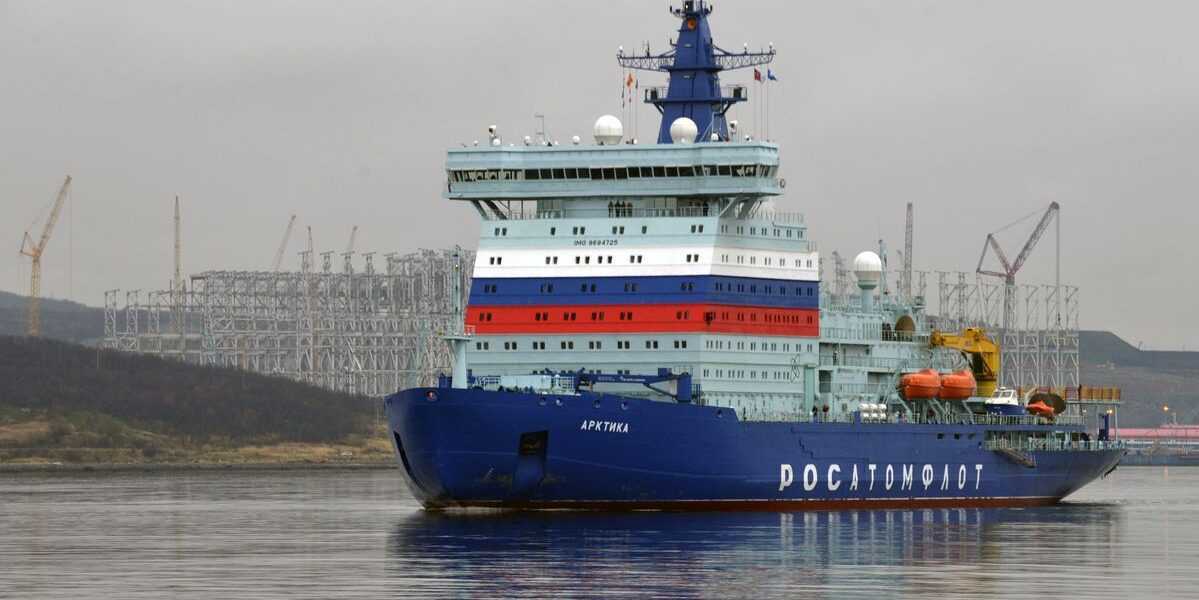
logistics and development of the Northern Sea Route, as well as environmental
projects. Rosatom comprises over 450 companies and organizations employing
approximately 420,000 employees.
On May 27, 2024, during the state visit of
Russian President Vladimir Putin to Uzbekistan, Uzbekistan and Russia signed a
protocol amending the intergovernmental agreement on cooperation on the
construction of a nuclear power plant in Uzbekistan. The protocol expands
cooperation for the construction of a Russian-design SMR-based nuclear power
plant (SNPP) in Uzbekistan. Following that, on the sidelines of the event,
Atomstroyexport Joint-Stock Company (the Engineering Division of Rosatom) and
the Directorate for Nuclear Power Plant Construction at the Atomic Energy
Agency under the Cabinet of Ministers of the Republic of Uzbekistan signed a
contract for the construction of an SMR-based nuclear power plant in
Uzbekistan. On March 24, 2026, Uzatom Agency and Rosatom signed an additional
agreement to the contract for the construction of an integrated NPP in
Uzbekistan. The project involves the construction of two high-capacity units
with Gen 3+ VVER-1000 reactors and two units with RITM-200N reactors, each with
a capacity of 55MW.
E-mobility is a
key of the new businesses of Rosatom.
This includes the entire range of
electric vehicle production, “from
mining lithium to recycling of traction
batteries”. Today, Rosatom offers its partners efficient energy storage solutions and modern charging infrastructure. The corporation is capable of producing
over 60% of all the components for e-vehicles, including batteries, motors,
rare-earth magnets, micro-components, and polymers and composites. Promising charging
solutions include booster EV charging stations with a storage system (ensuring
fast charging in the cae there is
insufficient power input), main line
stations (operating without electricity
supply provided that there is a possibility for gas supply), and mobile
charging stations (ensuring wide-area
charging in parking lots). The modular
architecture of the e-vehicle battery (its
internal design allows for the production of batteries with a
voltage ranging from 300 to 800 volts) and its versatile assembly make it possible to produce battery systems with capacities ranging from 37 kWh to 510 kWh (from 1 to 12 batteries (packs) are assembled in a system).
Rosatom's projects cover almost the entire technological cycle in the industry, ranging from the extraction of raw materials and the production of key components to the development of charging infrastructure and the recycling of used batteries. At the end of 2025, Rosatom began the pilot commercial operation of the Russia's first lithium-ion energy storage "gigafactory" in Kaliningrad Oblast. The company is currently preparing to put into operation the second gigafactory in Moscow.