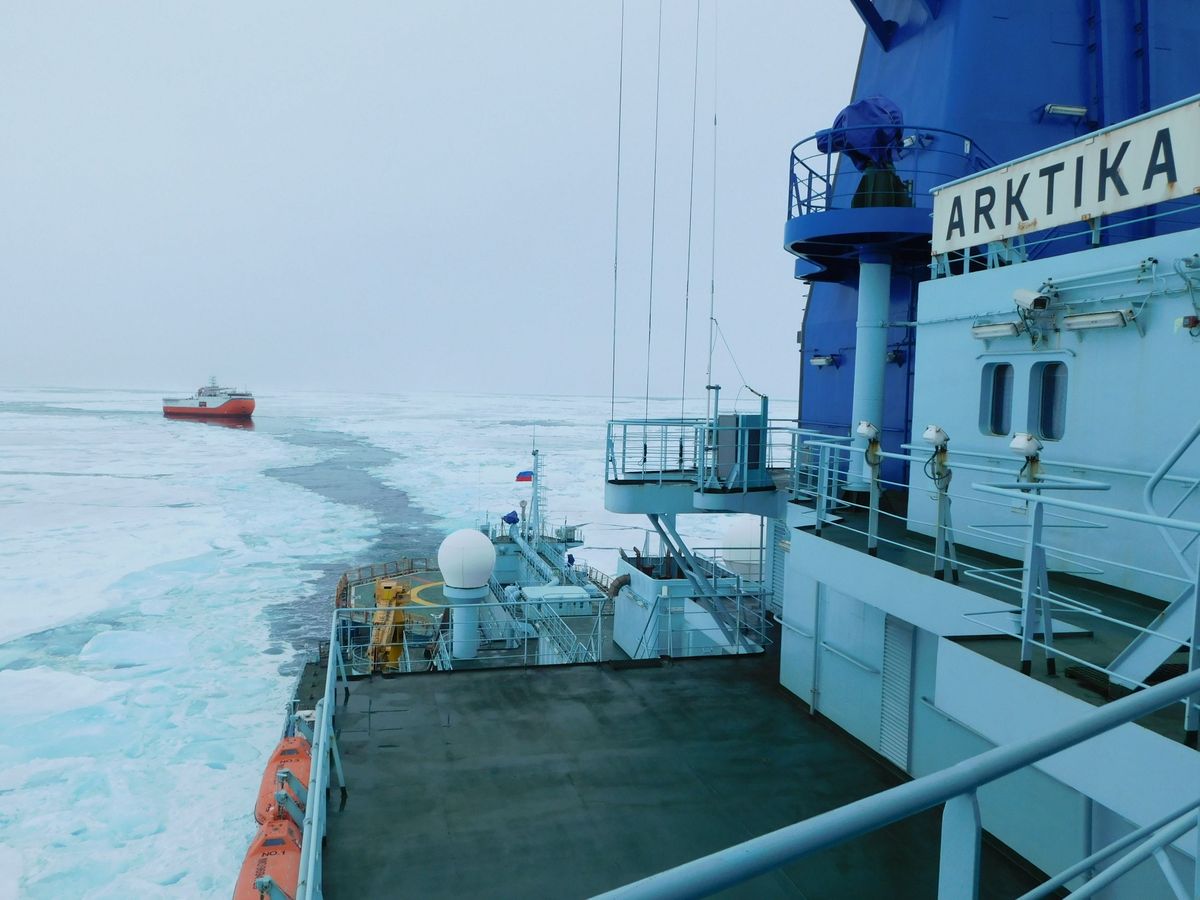
On July 12, the lead universal nuclear icebreaker Arktika of FSUE Atomflot, an enterprise of Rosatom, completed the icebreaker escort of the ice-resistant platform Severny Polyus out of the Greenland sector of the Arctic Ocean. The drifting research and expedition vessel required icebreaking escort to reach open water. On July 10, the nuclear icebreaker Arktika came to the scientists’ aid. The crew of the nuclear icebreaker escorted the platform through fields of multi-year and two-year consolidated ice three to five metres thick.
“The navigators of the lead universal nuclear icebreaker Arktika performed highly precise work,” said Yakov Antonov, Director General of FSUE Atomflot. Until now, nuclear icebreakers had not carried out icebreaker escorts in the Greenland sector of the Arctic. There is virtually no shipping in this area because of the severe ice conditions.”
In total, the convoy traveled 392.7 nautical miles. The escort operation concluded 50 miles west of Spitsbergen.
“The timing of the entire icebreaker operation and the icebreaker’s approach were chosen to be optimal given the weather conditions. By the time the escort began, the southerly storm winds had subsided,” said Alexander Skryabin, captain of the lead universal nuclear icebreaker Arktika. “This allowed the convoy to avoid ice compression. That is why, during the escort, the icebreaker had to break ice for the platform only once while passing through a difficult, heavily torus-covered section under conditions of local ice compression at the junction of ice fields. "I thank the crew for their coordinated work.”
The lead universal nuclear
icebreaker Arktika is a
Project 22220 nuclear vessel. The ship’s main specifications are as follows:
length– 173.3 meters (160 meters at waterline);
width – 34 meters (33 meters at waterline); side height – 15.2 meters; power –
60 MW (at the shafts); speed– 22 knots (in open water), draft– 10.5 meters/9.03 meters; maximum ice-breaking capability– up to 3 meters; displacement– 33,540 metric tons;
design service life– 40 years; crew– 54 people. The icebreaker was laid down on November 5, 2013, at the
Baltic Shipyard in St. Petersburg, and was launched on June 16, 2016. The
nuclear ship is named after the legendary icebreaker that became the first
vessel in history to reach the North Pole while afloat. On October 21, 2020, a
solemn ceremony was held in Murmansk to raise the Russian Federation’s national
flag on the icebreaker Arktika. Since entering service, the vessel has traveled
200,718 nautical miles and escorted 974 ships.
The nuclear icebreaker fleet currently consists of eight vessels: the lead universal nuclear icebreaker Arktika, the first production-series universal nuclear icebreaker Siberia, the second production-series universal nuclear icebreaker Ural, and the third production-series universal nuclear icebreaker Yakutia, each with a power output of 81,000 l.s., two nuclear icebreakers with a power output of 75,000 l. s. (Yamal and 50 Years of Victory), and two icebreakers with a power output of approximately 50,000 l. s. (Taimyr and Vaigach).
The North Pole-42 (NP-42) expedition was a continuation of the program of comprehensive drifting research in the high latitudes of the Arctic, established by Soviet scientists. The world’s first polar research drifting Arctic station, North Pole (North Pole-1), began operations on May 21, 1937. Since then, each subsequent expedition has been given the name North Pole followed by a sequential number. A total of 40 such expeditions were organized. Over the course of 75 years, the drifting stations conducted comprehensive research in the fields of oceanography, meteorology, and marine biology; they tracked changes in sea ice extent and conducted observations of the planet’s ionosphere and magnetic fields, which allowed scientists to draw conclusions about the propagation of radio waves. In 2013, the team of scientists from the drifting station NP-40 was evacuated, and the program was suspended for nearly 10 years: the critical condition of the ice–shifts, cracks, and breaks–made it impossible to maintain the ice camp’s operations. Since 2022, the drifting Arctic station program has been resumed at a new technological level–with the support of the unique research and expedition vessel North Pole.
The North Pole Research and Expedition Vessel – a unique scientific expedition vessel and ice-class platform that functions as a research center and is designed for year-round expeditions in the high latitudes of the Arctic Ocean. The vessel is designed to conduct geological, acoustic, geophysical, and oceanographic research; it is capable of navigating through ice without the assistance of an icebreaker, as well as carrying heavy helicopters such as the Mi-8 AMT (Mi-17) on board. The ice-resistant platform provides comfortable and safe working and living conditions for 14 crew members and 34 scientific personnel at temperatures down to minus 50°C and humidity of 85%. Main technical and operational characteristics of the vessel: length – 83.1 m; width – 22.5 m; displacement – approximately 10,390 metric tons; propulsion plant power– 4,200 kW; speed – at least 10 knots; hull ice class – Arc8; fuel endurance – approximately 2 years; service life – at least 25 years.