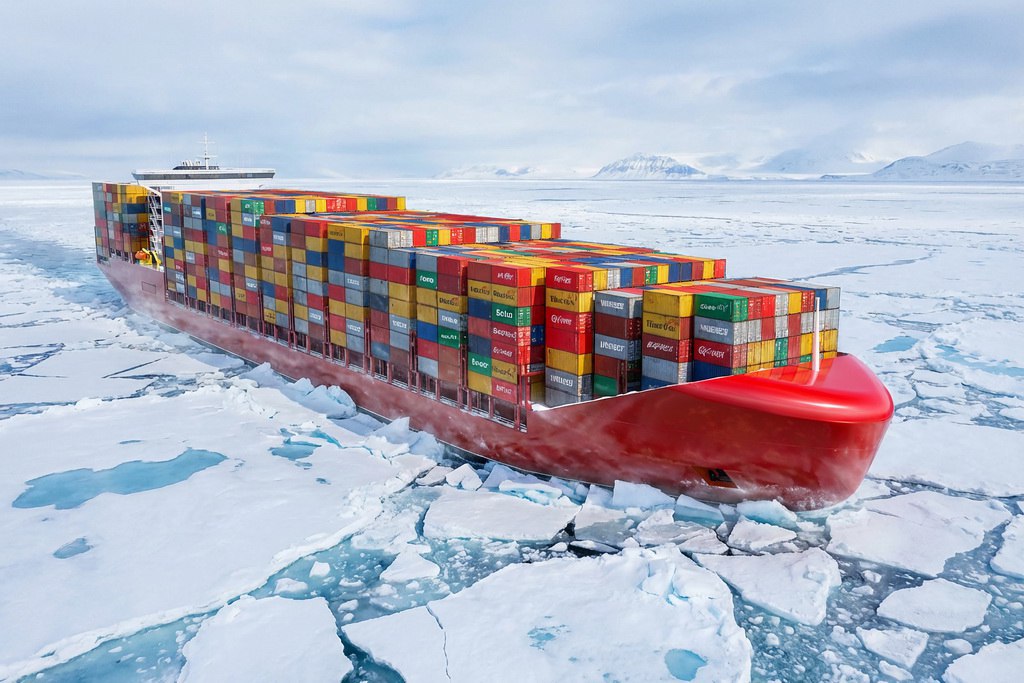
Rosatom has
approved the design for an Arctic-class container ship, which was developed by
the design team of the United Shipbuilding Corporation (USC).
The vessel
will have an Arc7 ice class, which guarantees its reliable and safe operation
in the Arctic. It will be able to navigate independently through first-year ice
up to 1.7 meters thick, which is essential for ensuring smooth year-round
navigation in certain sections of the Northern Sea Route.
The
container ship is designed in accordance with the existing icebreaking assistance system. Its width of 35 meters
matches the width of channels thatProject
22220 universal nuclear icebreakers make. This will minimize resistance and maximize the safety of assisting ships in heavy ice conditions.
Other
specifications include a hull length of 255 meters, a diesel-electric power
plant with a capacity of 46 MW, and a container capacity of more than 4,800 TEU
(a twenty-foot equivalent unit is a standard unit equivalent to the volume of a
20-foot container). Propulsion will be provided by two electric propulsion
motors with a power of 15 MW each, driving fixed-pitch propellers. This design
ensures high reliability and precise control in icy conditions.
The contract was implemented considering all of the customer's technical requirements with interim validation of the results based on the analysis of the vessel's specifications. The results were also verified and approved by Rosatom’s Chinese partner in the project.
In 2024, at
the St. Petersburg International Economic Forum (SPIEF), Rosatom and a Chinese
shipping company signed a memorandum of understanding to organize regular
container services along the Northern Sea Route (NSR). Following this, the parties established a joint venture named Northern Sea Route Shipping Line. Among its other objectives, the joint venture
will place orders for the design and
construction of high ice-class container ships.
The completion of the preliminary design has been aligned with Rosatom's plans to expand container shipping along the Northern
Sea Route. Incidentally, in late
September 2025, the container ship "Istanbul Bridge" completed the
first ever transit voyage along this route,
traveling from China to Europe (ports
in the United Kingdom, the Netherlands, and Germany). The voyage
took only 18 days (for comparison with a
usual voyage along the Suez Canal, which takes 30 days). A total of 24 container voyages were made in 2025 and the volume of
goods transported exceeded 410,000
tonnes, which represents a more than double increase compared to the previous
year.
The comprehensive development of the Russian Arctic is a national strategic priority. To increase the NSR traffic is crucial for the successful fulfilment of the tasks set in the field of transportation and cargo delivery. This logistics corridor is developing due to cargo shipping on a regular basis, construction of new nuclear icebreakers and modernization of the relevant infrastructure. Rosatom companies are actively involved in these efforts.