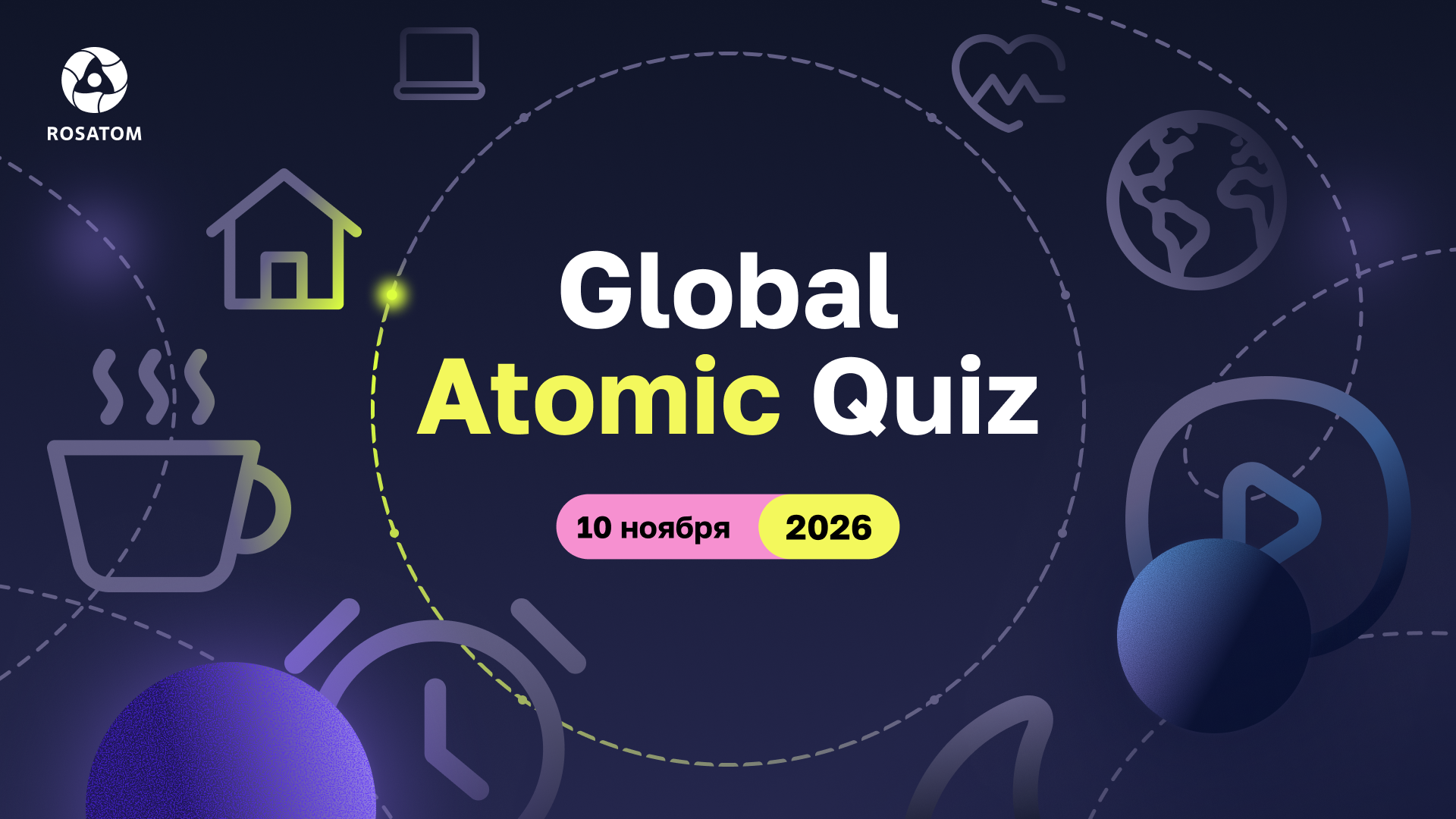
On November
10, Rosatom will hold the Global Atomic Quiz to mark World Science Day for
Peace and Development. This year's theme, One Atomic Day, is dedicated to
nuclear technologies that help make our lives more comfortable, safer and more
interesting. From the food on our tables and the electricity in our homes to
advanced nuclear medicine and the exploration of distant stars, nuclear
technologies are much closer to our everyday lives than we might think.
Global Atomic
Quiz invites participants to discover the role peaceful nuclear technologies
play throughout an ordinary day and explore the science behind familiar things.
The quiz will give participants an opportunity to test their knowledge, learn
surprising facts about the applications of nuclear technologies and take a
fresh look at the achievements of modern science.
Participants can take part in the quiz on November 10 via the project website. They will have a chance to compete for prizes, with the three top performers receiving the main prize – a trip to Russia, including a visit to the world's first nuclear power plant. All participants will receive an electronic certificate.
Global Atomic
Quiz is not just a popular science quiz but a truly global educational project
that explains the basics of nuclear physics, shows the importance of nuclear
technologies in everyday life and highlights the role that nuclear plays in
preserving our fragile planet. The project has been held since 2020 in 16
languages: Russian, English, Uzbek, Armenian, Arabic, Hungarian, Turkish,
Portuguese, Spanish, Burmese, Indonesian, Bengali, Kazakh, Mongolian,
Vietnamese, and Swahili. Since 2020, more than 111,000 school and university
students from over 100 countries have taken part in the quiz. In 2023, the quiz
became a prize winner of IX All-Russian award “For Fidelity to Science” in the
category “Science for the world”.
The
educational activities of Rosatom are aimed at a broad audience. The goals of
its scientific outreach projects, in addition to popularizing atomic
technologies, include increasing access to knowledge about science and
technology as a whole and enhancing the appeal of scientific and technical
education and engineering specialties.
The World Science Day for Peace and Development was established by UNESCO in 2001. Its purpose is to recognize the contribution of scientists to the progress of humankind.